"Full-stack AI app builder" is one of the most overloaded labels in software right now. Tools using it range from web prototypers to platforms that handle native mobile, backend, deployment, and App Store submission.
This guide covers 10 tools, each rated on mobile support, production readiness, code ownership, and deployment automation. One disclosure upfront: this article is published by the Bilt team, and Bilt is included in the list.
By the end, you'll know which type of builder fits your project and which specific tool to start with. The breakdown covers web-only builders, native mobile platforms, and hybrid tools that do both.
TL;DR: best AI full-stack app builder by use case
Quick reference: the best AI full-stack app builder depends on whether you need native mobile, web MVPs, budget builds, or validated ideas before writing code.
What 'full-stack' actually means for an AI builder
A full-stack AI builder generates all app layers from one prompt: frontend UI, backend logic, database schema, and deployment pipeline.
AI builders do generate all four layers: frontend, backend, database, and APIs. The problem is that working and scaling are different things.
A ShiftMag developer published a detailed case study on this. Their AI-generated backend passed every test with small datasets, then 25 real users hit the app.
The symptoms hit fast:
- Database CPU spiked within hours
- Requests timed out under normal load
- Each request fired 20+ queries due to N+1 patterns the AI never optimized
The fix required a full rewrite of the statistics pipeline.
Deployment automation determines who handles the release process after the app is built.
Code signing and provisioning profiles can block App Store submission for non-technical founders, especially when a builder leaves those steps manual.
Two gaps show up consistently across tools:
- Bolt.new uses Expo and EAS for native iOS and Android builds, but publishing moves outside Bolt into local CLI setup, developer accounts, App Store Connect, and Google Play Console
- Base44 and Softgen AI generate no native mobile layer. Bolt.new generates Expo apps and native store builds, but it does not publish them end-to-end inside Bolt
Understanding those gaps is exactly why tool type matters. Not all AI full-stack builders are solving the same problem.
The 4 types of AI full-stack app builder
Knowing which type you need narrows the list before you read a single review.
- Web-only AI builders — generate frontend and backend for browser-based apps with no native mobile output
- Native mobile AI builders — compile to real iOS and Android binaries with access to device APIs
- Full-stack web + mobile builders — cover both targets from a single codebase with shared backend logic
- Full-cycle platforms with market research — layer in audience validation, ASO data, and post-launch analytics on top of code generation
Each of the 10 tools below fits one of those four types. Here's how they stack up.
The reviews compare where each category tends to stop: web preview, native build, or store submission.
Best AI full-stack app builders, compared
The 10 tools below range from mobile-native generators that push directly to app stores, to web-only vibe coding platforms and browser IDEs with Firebase backends.
1. Bilt
Bilt is for builders who want a real mobile app without learning how to code.
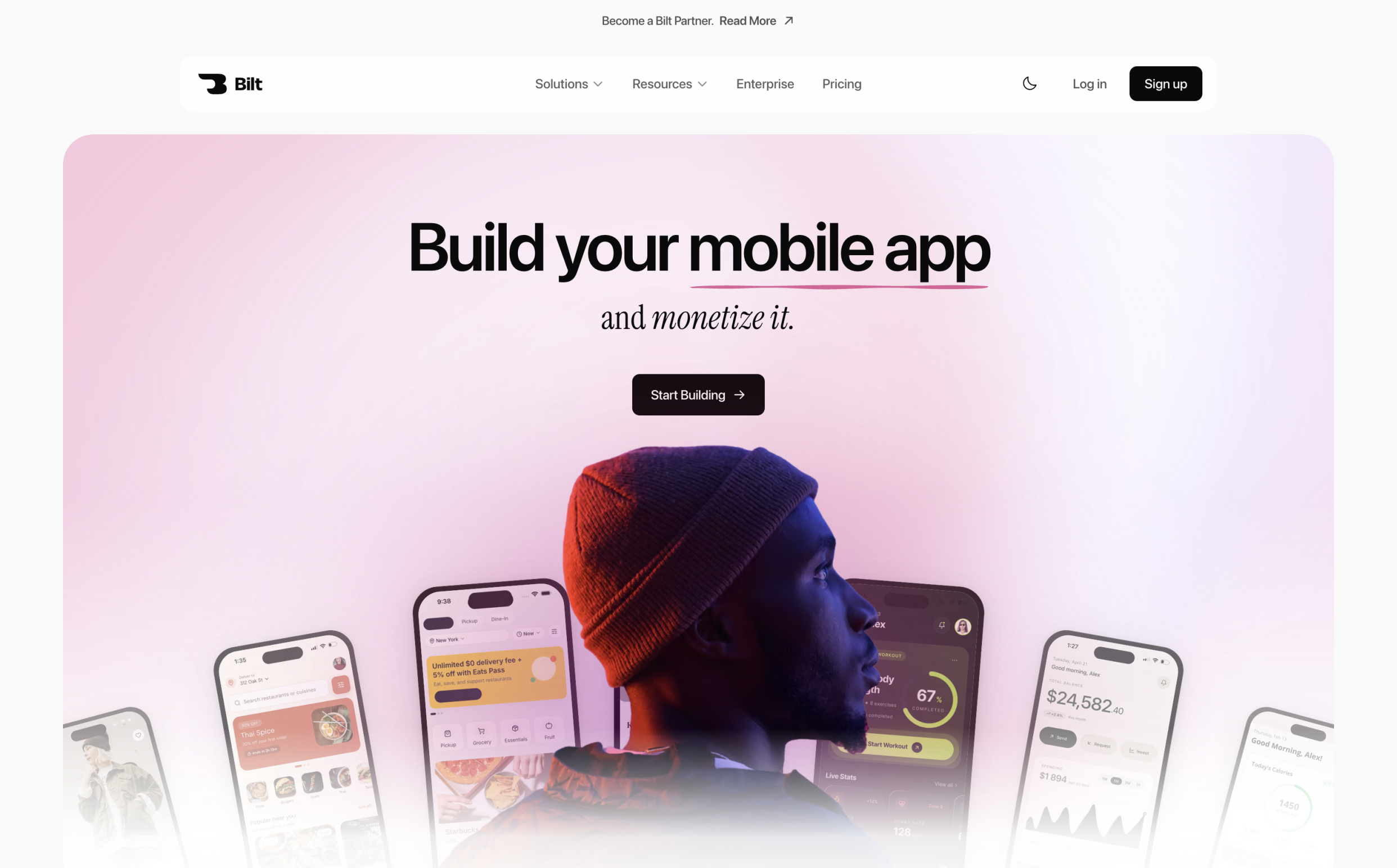
Describe your app idea in plain language. Bilt turns that idea into a native iOS and Android app, then helps you test it on your phone and submit it to both stores.
Describe an app and watch Bilt turn it into a native app in live preview.
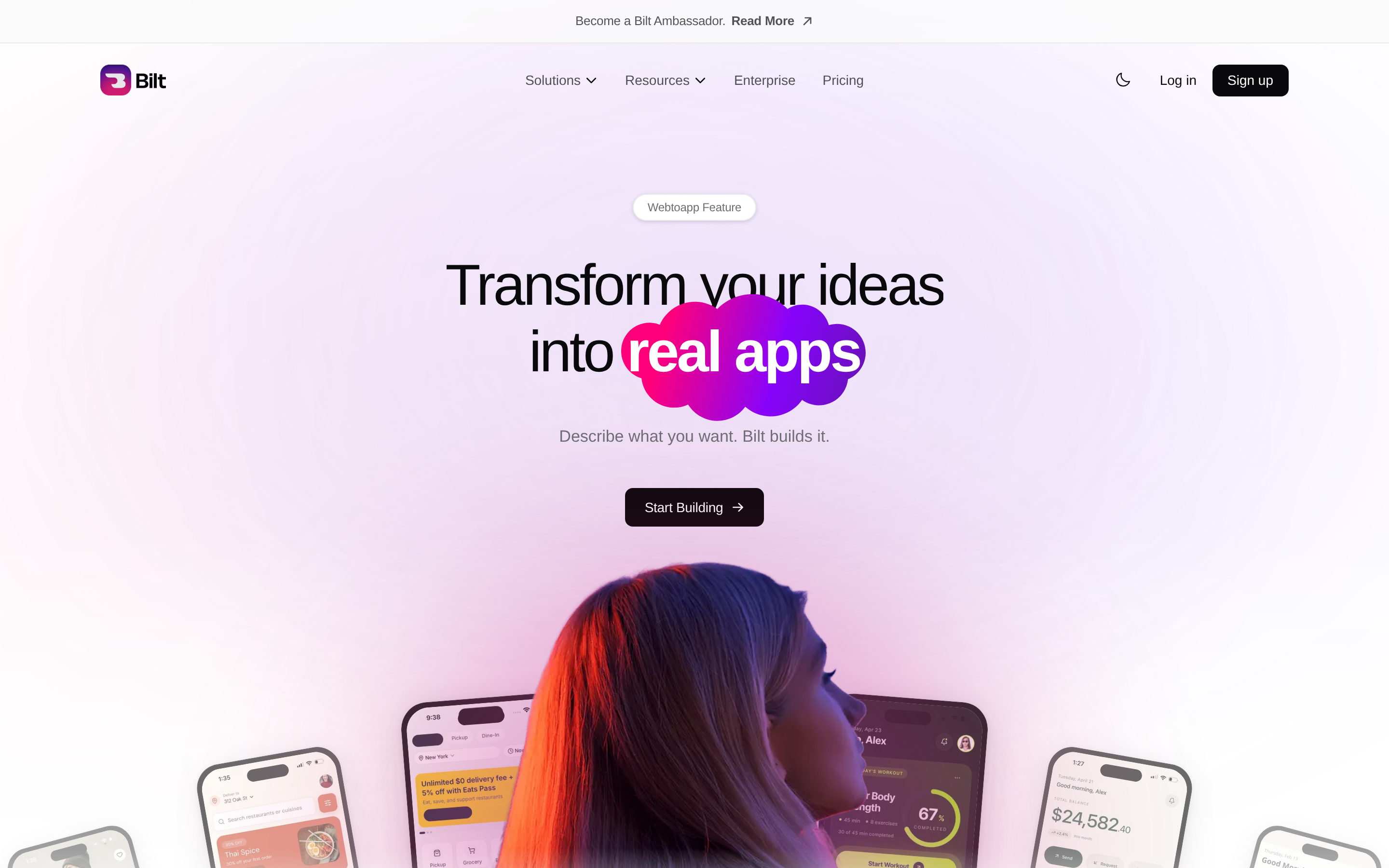
You do not need Swift, Kotlin, React Native, Xcode, Android Studio, or a developer account setup checklist just to get started.
With Bilt, the workflow is simple:
- Describe the app you want to build.
- Preview the app in your browser.
- Scan a QR code to test it on your phone.
- Use Bilt to build and sign the store packages; it uploads the iOS build and can send Android builds to internal testing, while you finish public submission in the store tools.
What you get:
- Native previews in minutes: See your working app in the browser or a streamed iOS simulator as you build.
- Mobile features and payments: Native modules support device features, while Bilt Payments handles purchase setup, transaction processing, and subscription state for iOS apps.
- Publish through App Store Connect: Bilt supports the App Store publishing workflow instead of leaving store delivery as a separate manual task.
- A real native app: Bilt generates React Native code for iOS and Android, not a web page wrapped to look like an app.
- No code needed: You tell Bilt what to build, then keep editing with plain-language prompts.
- Works on both major platforms: Build once and publish for iPhone and Android users.
- Start free: You can begin with Bilt's free plan and move to a paid plan when you're ready for more AI tokens and publishing support.
- Publish and earn: Launch your app in the stores, reach real users, and build around subscriptions, paid access, or whatever revenue model fits your idea.
Bilt is best for non-technical founders, entrepreneurs, and vibecoders who want to get an app into the stores without hiring a developer.
It also fits web app owners who already built with Lovable, Replit, V0, or Next.js and want a native mobile version without starting over.
Bilt is not the right tool for a web-only SaaS dashboard. It is built for mobile apps that need to feel native, run on real devices, and make it through the store process.
2. Lovable
Lovable is where most non-technical founders start, and for good reason. Its Supabase integration and collaborative workspace make web MVP builds feel approachable, even without a line of code.
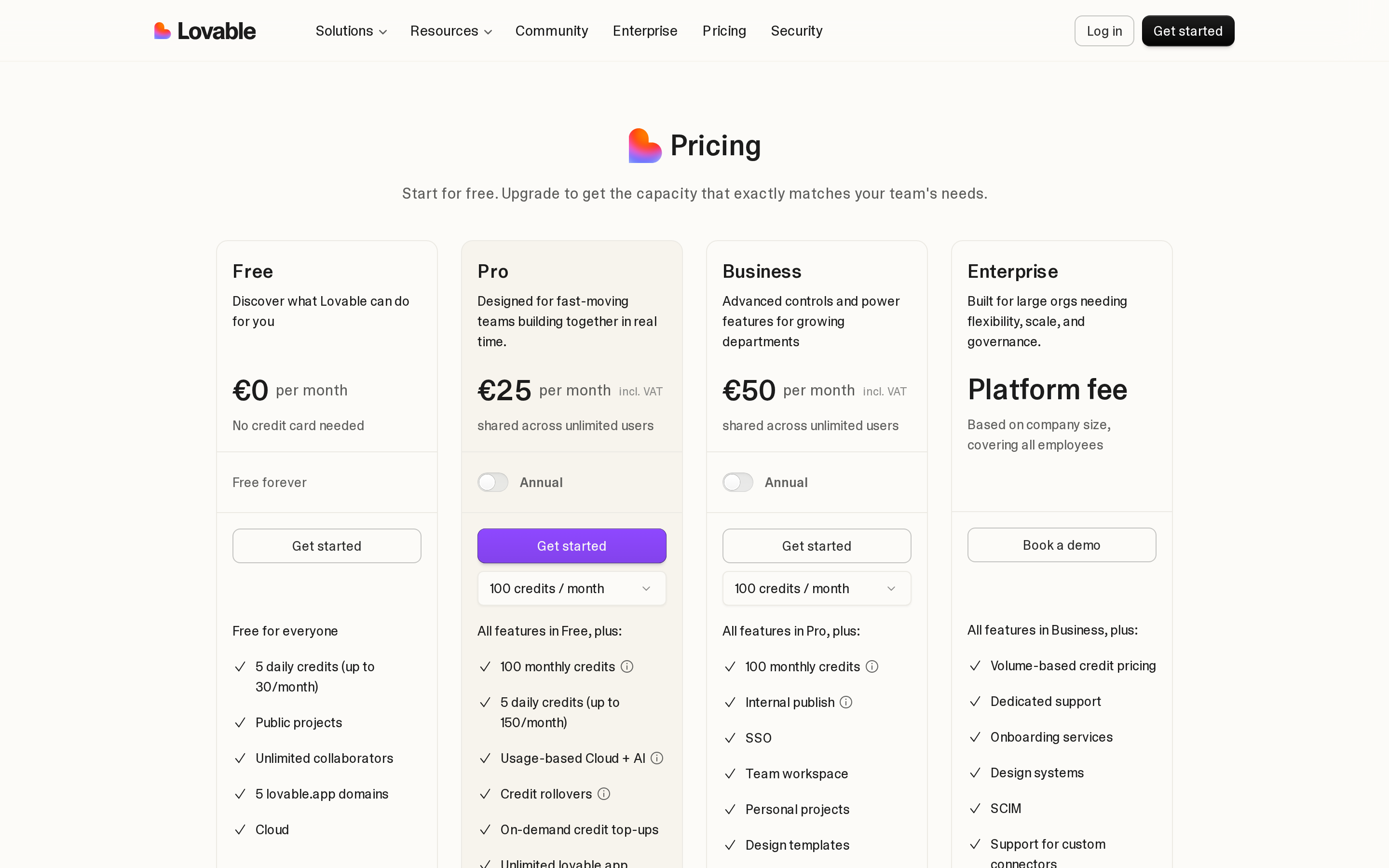
Lovable and Bolt.new are the closest rivals for web-only MVP generation. Both start at $25/month and use credit models, but Lovable edges ahead on integrations and collaborative workspaces.
Lovable has no native mobile output. For a real iOS or Android app, Bilt (React Native with App Store automation) or Vibecode (guided native publishing) are better fits.
- Integrations — Supabase, Stripe, Paddle, Slack, Twilio, Shopify, BigQuery, and HubSpot. The broadest connector set among web-focused builders in this list.
- Plan mode and Agent mode — map out the full app structure before Lovable starts building, reducing mid-build context drift common in prompt-only tools.
- Editable React code with GitHub sync — move work into Cursor or another IDE without starting from scratch.
- Reviewers on G2 (4.6/5) consistently praise the Supabase integration speed but flag credit burn on backend logic revisions as the main pain point. One recurring complaint: a single round of database schema fixes can consume 10–15 credits, eating through the Pro plan faster than expected.
- Web and PWA only. Lovable's April 2026 mobile app lets you build web apps from a phone. It does not generate native iOS/Android code or handle App Store submission.
- Credits burn 3-5 per fix, per G2 reviewers and Lovable's community forums. Code quality works for MVPs but needs manual tweaks before production hardening.
- Support responsiveness and credit depletion complaints on G2. Iteration cycles burn through credits faster than plan counts suggest.
Free plan includes 5 daily credits (up to 30/month). Pro starts at $25/month for 100 monthly credits, matching Bolt.new Pro on price at the base tier.
Both Pro and Business tiers offer 100 monthly credits. For web MVPs with real integrations, Lovable is the strongest choice in this list. The credit burn on complex backends is the tradeoff you accept.
That web-first focus is a useful lens for comparing AI builders for launchable MVPs.
3. Replit
Replit tries to be everything: browser IDE, mobile builder, deployment platform, and team collaboration layer. Whether that fits your workflow or gets in the way depends on how much environment you actually need.
Replit targets developers, indie hackers, and technical founders who want a real coding environment, not just a prompt-to-prototype tool.
Unlike Lovable and Base44 (both web-only), Replit added native mobile output via React Native and Expo in January 2026. It covers both web and mobile from a single browser-based IDE.
- React Native and Expo output — browser-based simulators and QR code previews via Expo Go for immediate device testing, no local setup needed.
The Replit mobile publish flow:
- Build your React Native app in Replit's browser IDE.
- Preview on device using Expo Go via QR code.
- Set up Apple Developer account ($99/year).
- Submit through TestFlight for internal testing.
- Submit for App Store review manually.
- iOS publishing is guided through TestFlight — requires an Apple Developer account ($99/year). Android Play Store submission is manual.
- Vibecode is the stronger choice for fully guided submission — automated code signing and store publishing are built in. Replit's path still requires manual developer account setup.
- 500+ programming languages including Python, React, Next.js, C++, and Java. Broader language range than any other AI app builder in this list.
- 300+ AI models, Postgres, built-in auth, database, and hosting — all accessible without leaving the browser.
- Live collaboration, Git integration, and real-time debugging — features absent from most pure prompt-to-app builders.
Replit's code generation is rated weak for production readiness. The Agent reportedly fakes functionality and falls apart on business logic, making complex tasks unreliable.
If you're a non-technical founder, Replit's breadth is appealing, but its production reliability is the reason to look at Lovable or Vibecode first.
Rocket.new is the strongest production-ready option in this list (SEO, WCAG, and GDPR optimized). Lovable produces cleaner, more editable MVP code with less iteration burn.
Replit's paid tier is Core at $20/month billed annually ($25 billed monthly). The Starter tier is free. Credits deplete quickly during iteration and bug-fixing cycles, so the Core plan's included credit allotment goes faster than the monthly price suggests.
4. Firebase Studio
Firebase Studio is scheduled to close in March 2027. Review Google's migration guidance before starting a new project there.
Before the shutdown: Export active projects and confirm the applicable deadlines in your Firebase account.
Firebase Studio is Google's browser-based IDE that pairs Gemini AI agents with automatic Firebase backend provisioning to generate full-stack web apps from natural language prompts.
| Pros | Cons |
|---|---|
| Auto-provisions Firebase Auth, Firestore, and Gemini via Genkit | March 2027 shutdown with data deletion risk |
| Multimodal prompts: text, images, and sketches | Weak production readiness — unreliable on complex business logic |
| Free IDE access with no per-message AI cost | Pay-as-you-go Firebase infra costs for production |
| Strong code export: GitHub, Git rollback, ZIP/CLI | No automated native iOS builds or App Store submission |
Developer reviews flag poor output quality and inconsistent error handling on complex builds.
Migration checklist:
- Push the project to GitHub.
- Inventory Firebase services and secrets.
- Test the replacement environment before the shutdown deadline.
Firebase infrastructure charges remain separate from IDE access and depend on the services your app uses.
Pricing:
- IDE access is free (3–30 workspaces depending on tier)
- Production usage runs on Firebase's pay-as-you-go Blaze plan, billed per Firestore read/write and Cloud Run compute
- Some integrations require Cloud Billing; Gemini API usage can incur additional costs depending on provider and features used
- No per-message AI cost unlike Lovable ($25+/month) or Vibecode ($20–$200/month) — you pay only for Firebase infrastructure your app consumes
Existing Firebase users building simple web MVPs who need Gemini or Firestore integration can extract real value before the deadline, provided they export their code well ahead of March 2027. If you're not already on this platform, don't start here.
5. Base44
Base44 is the only tool in this list built around autonomous Superagents for workflow automation rather than UI generation. That makes it the strongest tool here for workflow automation, and the weakest for anything requiring native mobile or production-grade reliability.
Base44 is web-only. Unlike Vibecode or Replit, it has no native mobile generation or App Store submission capability.
What Base44 does well:
- Superagents run autonomous multi-step workflows inside your app with no manual triggers required after setup
- 1-click integrations include Stripe, Slack, HubSpot, Zapier, Google Workspace, and Salesforce. Only Lovable comes close on enterprise connectors, but none are bundled as 1-click integrations
- Accepts both chat and voice prompts for app generation, which works well for non-technical PMs and marketers who don't write structured specs
Where it breaks down:
- Code export is weak. GitHub integration exists for code assistance, but there is no full code export from the hosted platform
- Production readiness is rated weak: suitable for prototypes but not production or critical apps. User reviews flag bugs and inconsistent output on production builds
- In practice, reviewers describe generated apps that break when data inputs fall outside the prompts used to create them. A form that works for 3 fields can fail silently at 6. Fine for internal tools with predictable inputs; risky for consumer-facing apps
- For code ownership and production-grade output, Lovable or Softgen AI are stronger fits. Both export editable code to GitHub with no vendor lock-in
Credit-based pricing: Free plan at 25 messages/month, paid plans from ~$16/month, Pro at ~$80/month, and Elite at ~$160/month. Credits burn fast on bug fixes, a pattern shared by Lovable, Replit, and Bolt.new.
| Good fit | Poor fit | |
|---|---|---|
| Workflow | Internal tools, CRMs, business automations | Consumer-facing or production apps |
| Team | Non-technical PMs, ops teams, marketers | Teams needing native mobile output |
| Goal | Web prototypes and dashboards | Anything requiring long-term code ownership |
6. Bolt.new
Bolt.new is the most widely adopted tool in this comparison. Millions of builders have shipped web apps with it, which signals how fast it moves for simple projects and how often it's the first stop before people outgrow it.
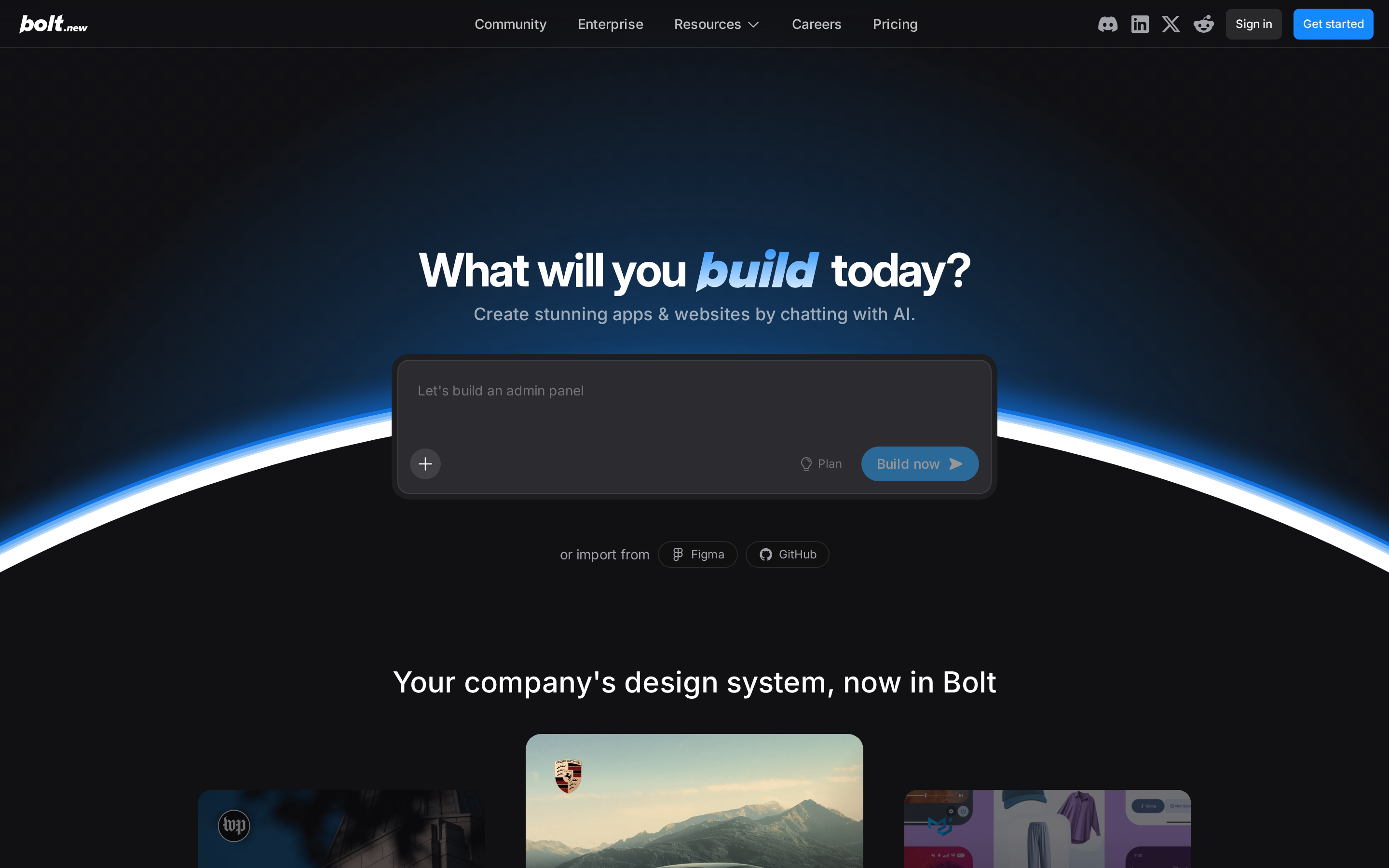
It runs on full-stack JavaScript and TypeScript inside a browser-contained environment. Unlike Replit's multi-language approach or Lovable's web/PWA focus, Bolt.new targets vibecoders and agencies building web MVPs fast.
- Three things Bolt.new does well:
- WebContainers speed — Runs a full Node.js environment in the browser with no local install or server dependency.
- Real code export — GitHub sync and version control built in, not locked no-code blocks.
- Expo mobile builds — Bolt's Expo workflow creates apps for iOS and Android. Publishing requires downloading the code, configuring EAS CLI locally, and using Apple or Google developer accounts.
Community builders have shipped functional SaaS apps with GPS tracking and Stripe billing in Bolt.new, demonstrating viable MVP-to-production paths.
Limitations:
- Complex prompts degrade code quality; manual fixes are typically needed before shipping
- Token burn runs high on large projects; 10M Pro tokens can deplete before month's end
- Store delivery remains outside Bolt: iOS public release finishes in App Store Connect, while Android requires downloading a build file and uploading it through Google Play Console
Plans run Free (1M tokens/month, 300K daily limit), Pro at $25/mo (10M tokens/month, unused tokens roll over), Teams at $30/user/mo, and Enterprise on custom pricing.
The 10M token Pro plan is generous for simple apps; just budget for 20-30% overhead on anything with real backend logic.
Bolt.new covers web MVPs and Expo-based mobile projects. You still handle EAS setup and store submission outside Bolt.
7. Vibecode
Vibecode is purpose-built for the one thing most tools treat as an afterthought: getting a native mobile app into the App Store without touching a Mac or opening Xcode.
Only Replit, Vibecode, and Rork earn a core strength rating for native mobile in this list. Lovable, Firebase Studio, Softgen AI, and Base44 have weak or absent native mobile support.
Bolt.new and Rocket.new offer adequate mobile via Expo and Flutter respectively, but neither automates store submission. Vibecode handles guided signing and submission for iOS; Play Store submission is guided but requires additional manual steps for Android.
- Generates React Native/Expo apps with native device APIs, home screen widgets, and push notifications. These are real native builds, not web-wrapped PWAs.
- Pinch to Build is an on-device gesture feature in Vibecode's mobile app, letting users prompt and iterate on their app directly from their phone.
Pinch to Build works like this: open your live app on your phone, pinch the screen to trigger the build interface, type a change request, and the update appears in your running app. No switching to a laptop, no browser tab, no context break.
- In testing, Vibecode reached a working React Native preview on a two-screen auth flow in under 20 minutes via QR code on an iPhone 14. Independent developer benchmarks have placed it among the fastest tools for reaching a working native MVP.
- Android maturity lags iOS: Play Store submission requires more manual steps than the App Store workflow.
- Backend changes can break existing app functionality; production code needs a tech debt audit before scaling.
- No meaningful free tier: Free includes only $2.50 in credits total, not a recurring monthly allowance. The Plus plan at $20/mo provides 20 credits, which burn quickly on iterative builds.
Plans are Plus at $20/mo (20 credits), Pro at $50/mo (55 credits), and Max at $200/mo (220 credits), with credits priced at roughly $1 each. Softgen AI at roughly $33/yr is the budget alternative for web-only work; Vibecode's pricing is justified only for mobile-native workflows.
- For a non-technical founder who wants to ship a consumer iOS app without touching a Mac, Vibecode is the most accessible path after Bilt.
- Best for solopreneurs and consumer app creators who want guided store submission for iOS from a phone-native workflow.
- Rork Max, the $200+/month SwiftUI plan, targets native Apple apps and offers two-click App Store publishing. Replit covers web, API, and mobile work in one IDE.
8. Softgen AI
At $33 a year, Softgen AI is the only tool in this list where the math is almost embarrassing. Full Next.js code ownership, Supabase integration, and Stripe built in for less than most tools charge per week.
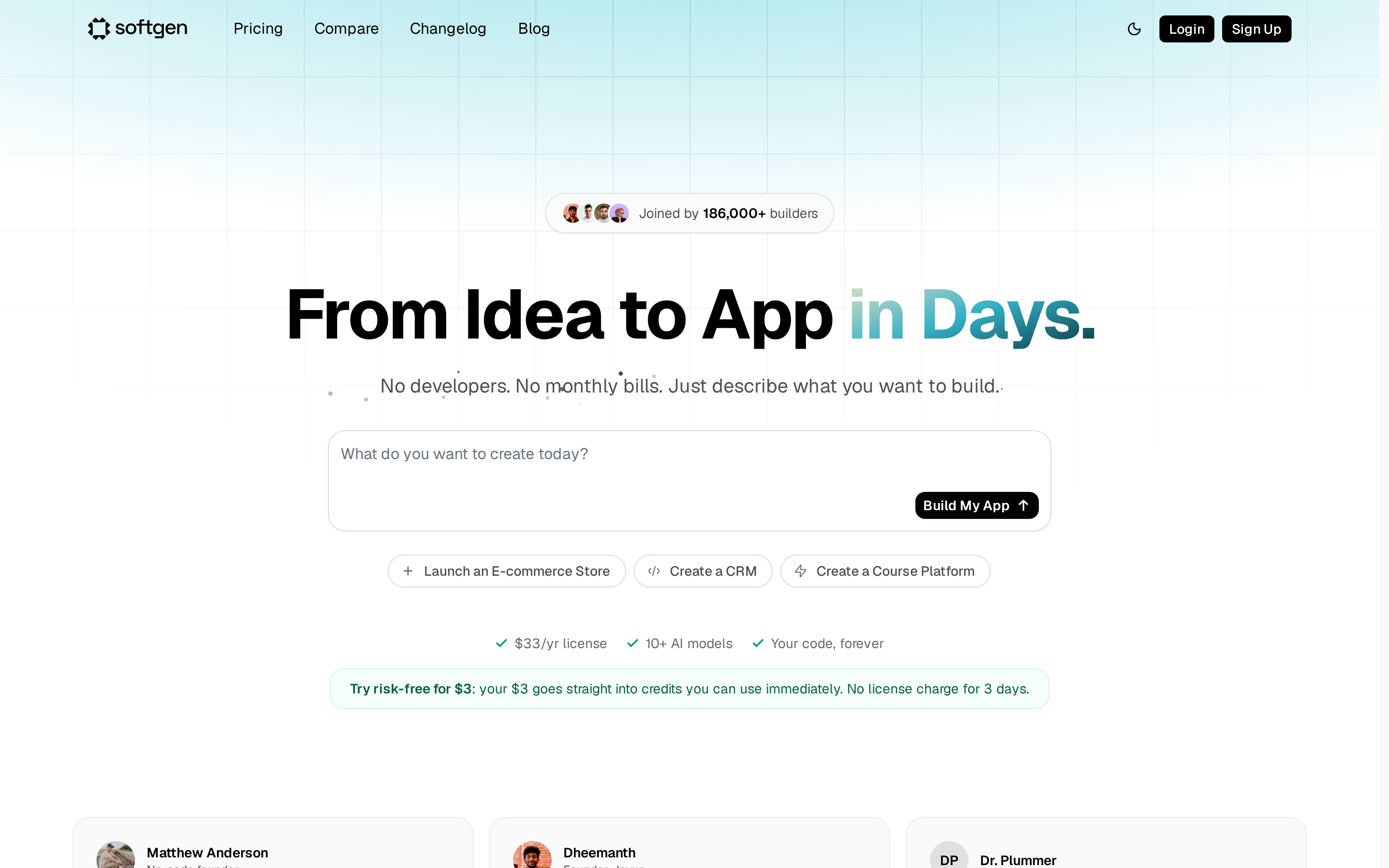
- $33/year (~$2.75/month) for 10 projects, plus a $5 starter credit and pay-as-you-go AI usage billed at wholesale rates
- 90%+ cheaper than alternatives at the entry tier: Lovable Pro runs $300/year, Vibecode Plus runs $240/year. Softgen AI costs $33/year.
- Generates production-ready Next.js apps with auth, Stripe, Supabase, SEO tooling, and Resend/PostHog/Intercom integrations built in from a plain-language prompt
- Apps export to your own GitHub and deploy to your own Vercel account. The app keeps running after you cancel the subscription — no lock-in, no revenue share
- Structured Cascade workflows guide the AI through defined logic steps, reducing the prompt-to-chaos drift common in less structured builders
Softgen AI generates web apps only (Next.js + Supabase/Vercel). There is no React Native output, no native iOS/Android generation, and no app store submission support.
For native mobile, Vibecode (React Native/Expo with guided App Store submission) or Rork (React Native Pro and SwiftUI Max with 2-click TestFlight) are the right alternatives.
- Handles simple SaaS and dashboard MVPs well. Complex business logic still needs manual fixes.
- For more robust production output, Rocket.new is a stronger fit.
- For a simple SaaS dashboard or internal tool, Softgen AI gets you to 80% without breaking the budget. Anything more complex and you'll want Rocket.new or Lovable.
- Softgen AI is the right call for budget-conscious founders who want a real Next.js codebase without a monthly subscription. It's not the most powerful tool in this list, but at this price it doesn't need to be. Over 186,000+ builders have already figured that out.
9. Rocket.new (by Dhiwise)
Most tools here start building the moment you describe your idea. Rocket.new asks a different question first: should you build this at all? Its Solve module runs market research and idea validation before writing a single line of code.
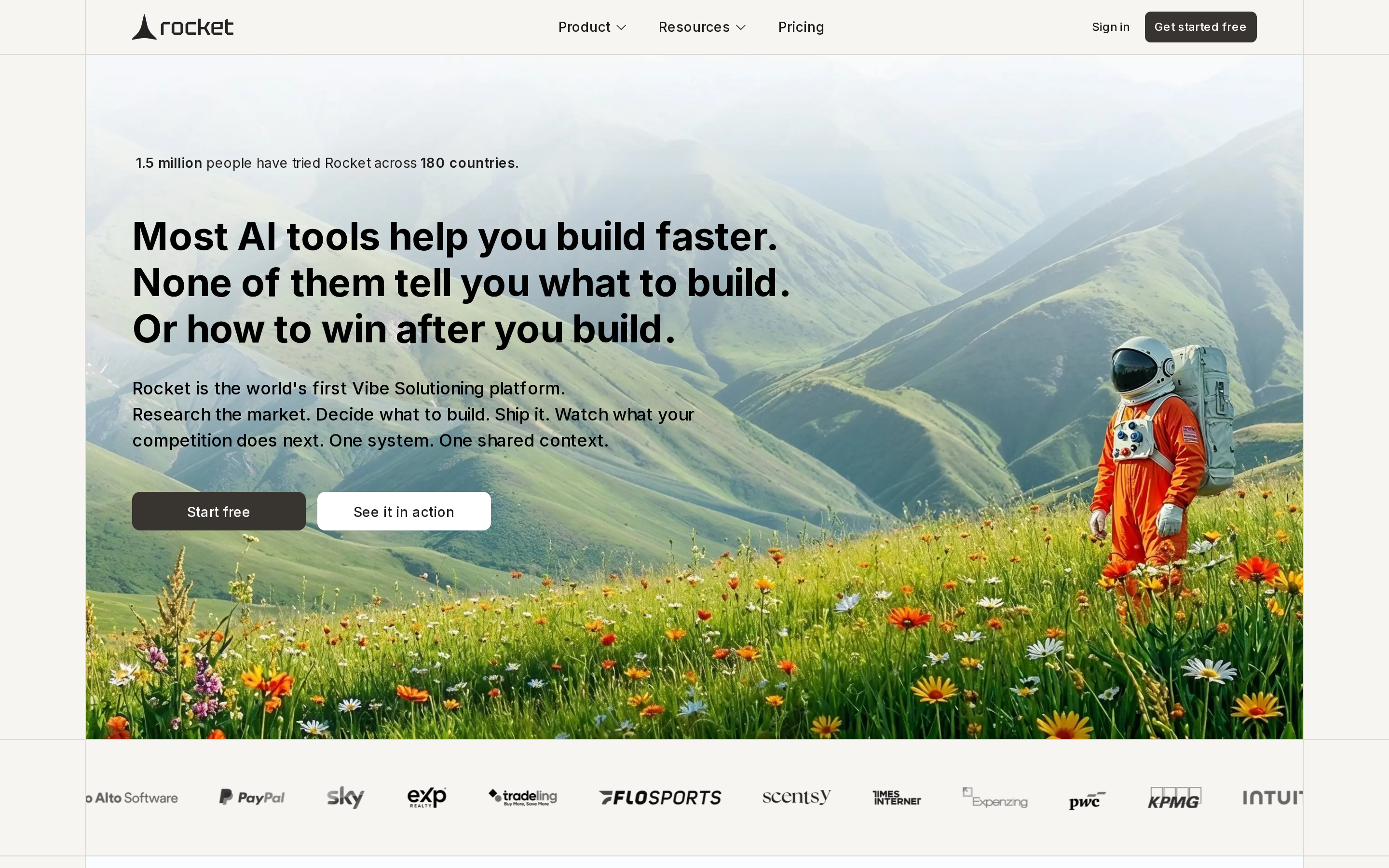
That pre-build validation step is the only one in this list. Every other tool assumes you already know what to build.
The company's own marketing materials claim 400k users, enterprise adopters including Meta and PayPal, and $4.5M ARR at 10k paid users. These figures have not been independently verified.
- Where it's genuinely strong
- Solve runs AI-assisted market research and idea validation before any code is written, helping founders confirm demand before committing to a build
- Intelligence is a post-launch competitor monitoring layer that tracks rival products — a capability absent from every other tool in this list, which all stop at deployment
- Generates native iOS/Android via Flutter, while most alternatives use React Native/Expo. A better fit for teams already in the Flutter ecosystem.
- The company reports generated code is optimized for SEO, WCAG accessibility, and GDPR compliance out of the box. No other tool in this list explicitly claims this standard.
- Integrations include Stripe, Supabase, Google Analytics, and Resend, comparable in depth to Bolt.new and Lovable
Where it breaks down
- App store submission is manual with no automated code signing or upload confirmed, putting it behind Vibecode and Rork Max for store publishing
Three paid tiers: Build at $25/month (100 credits), Solve + Build at $250/month (1,000 credits), and Solve + Build + Intelligence at $350/month (1,500 credits). A free tier is available with limited credits.
- Treat the company's production-readiness claims as a strong signal worth investigating, not a verified benchmark. The Solve and Intelligence modules are genuinely differentiated; the output quality is something you'll want to test yourself before committing.
- Best for: solo founders and product teams who want validated ideas, production apps, and ongoing market tracking in one platform
- For automated app store submission: Rork Max or Vibecode. For the widest integration library: Lovable (50+ connectors) or Base44 (1-click enterprise integrations)
10. Rork
Flowfy, built with Rork, generated $22k in revenue and reached #3 on the App Store. That's the most concrete real-revenue proof of concept in this entire list, and the clearest argument for what a native mobile AI builder can actually produce.
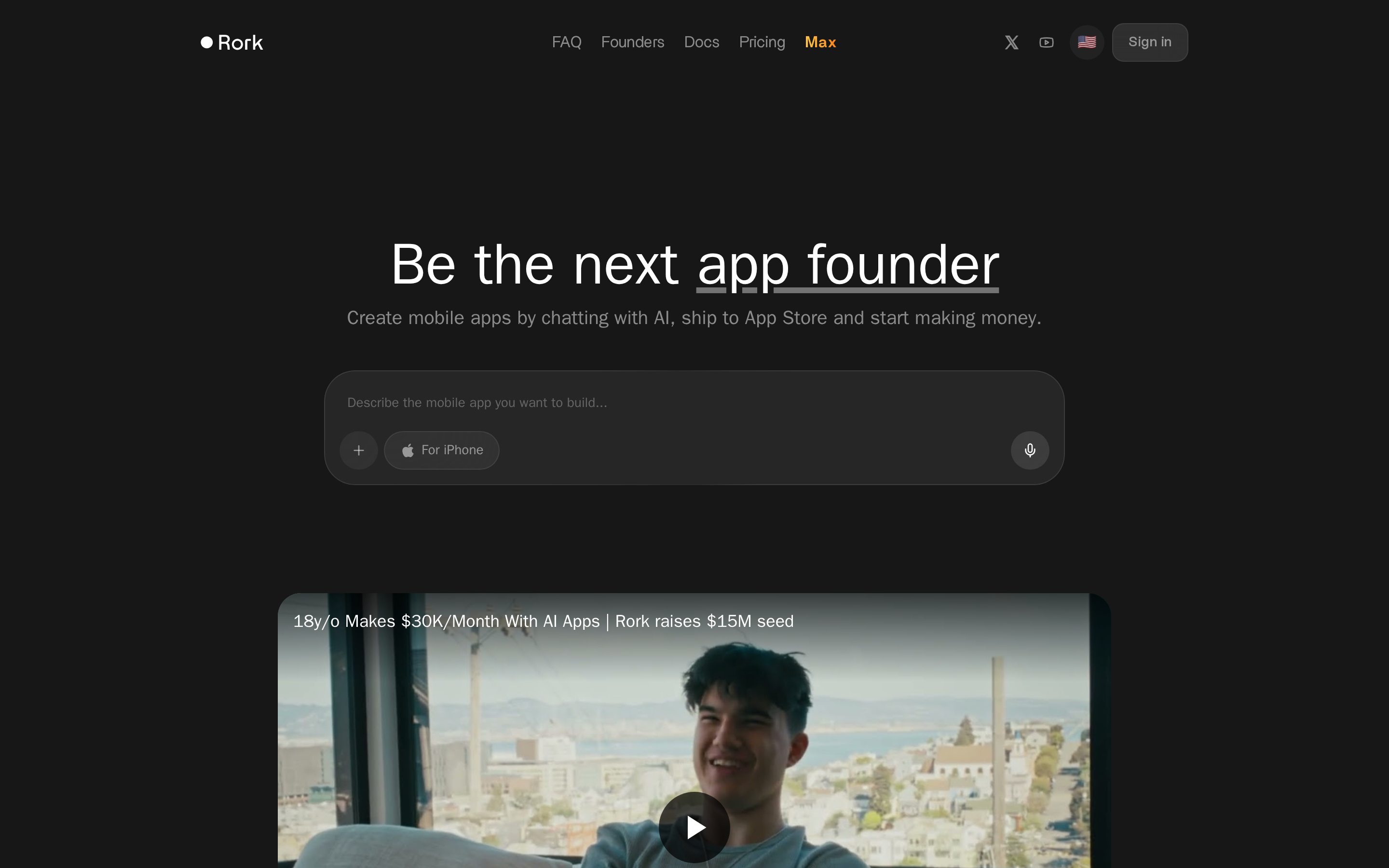
- Over 100,000 founders have built with Rork, making it one of the most-used native mobile AI builders in this list.
- Complex backends are Rork's main weakness. The platform enters error loops on deep backend logic, and results are heavily prompt-dependent — unclear instructions produce inconsistent outputs.
Watch out for: Rork's credit model means debugging an error loop costs real money. If a prompt produces broken output, the next 3-4 prompts fixing it burn credits at the same rate as new features. Budget for 20-30% credit overhead on any complex build.
- For projects needing complex server-side logic or intricate database architecture, Replit or Lovable handle that tier better than Rork.
| Feature | Rork | Vibecode |
|---|---|---|
| Output | Expo/React Native (Pro) + SwiftUI (Max) | React Native / Expo |
| iOS submission | Guided via Xcode (TestFlight + App Store) | Guided, near-automated |
| Android submission | Manual | Guided, more manual steps |
| Free tier | Available (no credit count confirmed) | $2.50 credits total |
| Lowest paid tier | $20/mo (Rork Pro, 100 credits) | $20/mo (Plus, 20 credits) |
| Best for | iOS-first, Apple ecosystem features | Symmetric iOS + Android |
Rork has three plan families: Free, Rork Pro, and Rork Max. Pro starts at $20/month with 100 credits; Max starts at $200/month with 1,000 credits and adds native SwiftUI.
For a consumer iOS app with in-app purchases, Rork Max is the most direct path in this list. The credit overhead is the price of admission — plan for it.
- Non-technical entrepreneurs building consumer iOS apps with subscriptions or in-app purchases
- Builders targeting native Apple features (Dynamic Island, ARKit, HealthKit, Siri) — no comparable option exists in this list through Rork Max
- Not designed for web-first products; Lovable, Base44, or Rocket.new fit better
Where AI full-stack builders genuinely help — and where they don't
Now that you've seen what each tool can do, here's the honest picture on where the whole category delivers — and where it quietly falls short.
AI full-stack builders excel at scaffolding, wiring UI, and launching MVPs fast. They skip performance optimization, miss scalability patterns, and require experienced review before production.
AI builders are genuinely fast at the repetitive setup work that slows every early-stage project:
For a clearer look at code signing and store uploads, Bilt's App Store submission walkthrough explains what automation removes for non-technical founders.
- Screen wiring and UI scaffolding — auth flows, navigation stacks, and component structure that normally eat the first week of a build
- Boilerplate backend routes — CRUD endpoints, session handling, and basic API wiring generated in minutes instead of days
- Speed to testable beta — one builder shipped a working, feature-complete app in 6 days that would have taken weeks from scratch
- Real production reach — Rork-built Flowfy reached $22k in revenue and ranked #3 on the App Store, showing AI builders can clear the prototype-only ceiling
- Deployment automation — The build, signing, and upload steps that tools like Fastlane were designed to automate for developers are handled end-to-end by Bilt, Rork Max, and Vibecode
| What AI builders do well | What they miss |
|---|---|
| Screen wiring and UI scaffolding | Performance optimization |
| Boilerplate backend routes | Query optimization (N+1 patterns) |
| Speed to testable beta | Scalability patterns |
| Fast prototype to App Store | Production hardening |
AI-generated backends produce structurally correct code that misses how databases actually perform under load.
- N+1 patterns — 20+ queries per request, queries running inside loops, no eager loading
- Full models loaded into memory just to calculate aggregates
- Missing indexes and zero caching stay invisible until real users arrive
- CPU spikes and request timeouts are the first sign something is wrong
- Code passes tests on small datasets. Problems surface under real load, making it easy to ship broken code without knowing it — the ShiftMag builder described hitting this wall after launch
- 45% of developers say debugging AI-generated code takes more time than writing it manually (Stack Overflow Developer Survey 2025)
- A randomized controlled trial of 16 experienced developers on complex codebases found a 19-20% net slowdown, with developers spending ~9% of task time reviewing and cleaning up AI suggestions
- Prototype to beta is where AI builders consistently deliver. Once real users arrive and traffic patterns emerge, a developer should audit performance-critical paths before scaling
- Code ownership matters at exit. Tools like Softgen AI, Lovable, and Bolt.new export full source to GitHub. If your plan involves scaling beyond the platform or handing off to a dev team, pick one that gives you the full codebase
- AI made things work. It didn't optimize them. That distinction holds across every tool in this list
AI full-stack builders vs no-code tools vs AI IDEs
AI full-stack builders generate real, exportable code; no-code tools use visual editors with limited customization; AI IDEs assist developers inside existing codebases.
- No-code platforms like Bubble and Wix AI lock apps inside the vendor's infrastructure. Migrating to a different stack means rebuilding from scratch, not exporting a codebase
- AI builders like Softgen AI and Bolt.new push full source code to GitHub. The app keeps running if you cancel your subscription
No-code scalability becomes a structural constraint as complexity grows. Visual logic layers can't match the performance of generated or hand-tuned code once traffic and data volume increase.
- AI IDEs like Cursor, GitHub Copilot, and Windsurf work inside an existing codebase. They don't generate a full app from a prompt or handle deployment
- Lovable and Vibecode both support exporting to Cursor or Xcode. The intended workflow is: generate with an AI builder, then hand off to an AI IDE for refinement
- Non-technical founder, need to ship fast, no existing codebase — AI full-stack builder is the right starting point
- Non-technical, internal tool or form-based app, zero tolerance for code — no-code tools (Bubble, Glide) are faster to start but carry platform lock-in risk
- Developer on the team, existing codebase, targeted feature additions — AI IDE (Cursor, Copilot) fits better than starting over with a full-stack builder
| Category | Output | Code Ownership | Customization Ceiling | Target User | Examples |
|---|---|---|---|---|---|
| AI Full-Stack Builders | Production-ready code (React, Next.js, React Native) | Full export, GitHub sync, no lock-in | High: edit code directly or hand off to IDE | Non-technical founders, solopreneurs, vibecoders | Bolt.new, Lovable, Softgen AI, Replit |
| No-Code Tools | Hosted app inside vendor platform | Low: platform-dependent, no raw code export | Low: limited to platform features and templates | Non-technical users prioritizing speed and simplicity | Bubble, Wix AI, Glide, Adalo |
| AI IDEs | Code additions, fixes, and suggestions within existing codebase | Full: developer already owns the codebase | Unlimited: full programming language access | Developers with existing projects and coding knowledge | Cursor, GitHub Copilot, Windsurf |
If you're in the AI builder category and ready to narrow down, four checks cut the list faster than a feature-by-feature comparison.
How to choose the right AI app builder for your project
Two filters cut the list faster than any other criteria: platform target (web vs. native mobile) and end goal (prototype vs. production-ready app). Every other consideration, including pricing, code ownership, and deployment automation, follows from those two decisions.
- Web only — Base44 and Softgen AI generate web apps. No native mobile support
- Partial mobile — Lovable and Firebase Studio focus on PWAs or web previews. Bolt.new generates Expo apps for iOS and Android, but publishing requires local EAS setup and manual store-console work
- Native mobile as core strength — Vibecode and Rork are the strongest options for native mobile store submission. Replit includes React Native support but rates weak on production readiness and business logic reliability
Quick filter:
- Need a native mobile AI builder? → Bilt, Rork, Vibecode
- Web only? → Lovable, Base44, Softgen AI
- Need market research before building? → Rocket.new
- Budget priority? → Softgen AI ($33/yr)
- Weak production readiness — Replit reviews describe it as faking functionality and breaking on business logic. Base44 is flagged in its own docs as unsuitable for production or critical apps
- Revenue apps ship from Rork, with Flowfy reaching $22k and #3 on the App Store, but Rork struggles with deep backend logic and error loops on complex builds
- Softgen AI, Lovable, Bolt.new, Vibecode, Replit, Firebase Studio, Rocket.new, and Rork all rate core strength on code ownership: GitHub sync, full export, no lock-in
- Base44 is the exception. Users own their content and apps, but there is no confirmed full code export. GitHub connects for code assistance only, not for owning the generated output
- For developer handoffs, tools with explicit IDE export paths reduce friction: Vibecode exports to Cursor, Xcode, and Android Studio; Rork exports to Xcode and React Native projects
- Lovable charges 3-5 credits per fix. Pro starts at $25/mo but scales to $1,688/mo at 7,500 credits. Heavy iterators exhaust plans quickly
- Softgen AI is the budget outlier: $33/year for 10 projects plus pay-as-you-go AI credits at wholesale rates, described as 30-50% cheaper than comparable tools
- Firebase Studio is free but shuts down in March 2027, with data deletion risk. New projects should not depend on it beyond short-term prototyping
- Bolt.new supports native iOS and Android builds through Expo and EAS. It does not automate the full publishing flow inside Bolt; you download the code and finish setup through the CLI and store consoles
- Vibecode and Rork offer guided or near-automated store submission. Vibecode handles code signing inside 20-minute builds; Rork Max offers guided App Store and TestFlight publishing with streamlined Xcode submission
- Non-technical builders should weight deployment automation heavily. Code signing, provisioning profiles, and App Store Connect submission are the specific steps that block most non-technical founders. Only Bilt, Vibecode, and Rork automate or guide these steps end-to-end.
If code signing and provisioning profiles are already making you nervous, that's exactly the problem Bilt is designed to remove.
For a broader tool comparison, see our iOS builders with publishing support.
Build and ship a real native app today, without the dev setup
Web-first AI builders can generate apps wrapped in a native shell. Web wrappers can fail App Store review and lack access to device APIs such as push notifications and camera.
Builders who need a real iOS or Android app need a platform designed for native from day one.
Bilt covers the full mobile workflow, from browser preview and QR-code testing to cloud builds, signing, and store uploads, without Xcode setup or provisioning profiles. You finish review submission in Apple's or Google's tools.
Choose the next step:
- Start building free and see a working native app preview in minutes.
- Book a free 15-minute call for help mapping your idea to the App Store.
Free to start. No credit card required.
FAQ
Do I need to know how to code?
No, you do not need to know how to code to build apps with Bilt.
Bilt turns natural language into production-ready React Native code. You describe what you want, the AI builds it, and you preview, test, and publish without writing a line of code.
The building and preview workflow runs inside Bilt; final store-review submission happens in Apple's or Google's tools.
Can I export the generated code?
Yes. Bilt provides exported React Native source code that you own.
You can hand the code to a developer and continue building outside Bilt. Owning the source code gives you a path forward without relying on the conversational builder.
Do these builders work for mobile apps?
Six of ten AI full-stack app builders generate native or cross-platform mobile apps for iOS and Android using React Native, Expo, or Flutter.
Bilt, Replit, Bolt.new, Vibecode, Rocket.new, and Rork generate native mobile apps for iOS and Android. Lovable, Firebase Studio, Base44, and Softgen AI focus on web apps or PWAs.
Are any of these tools free to use?
Yes. Free plans let you test an AI app builder before paying, but production hosting, API usage, and app-store accounts are separate costs.
- Bilt Free: 3M monthly AI tokens, authentication, database, storage, and live preview. Bilt pricing
- Bilt Professional: €25/month for 10M monthly AI tokens and priority access.
- Lovable Free: Free grants, private workspace projects, unlimited collaborators, and up to five lovable.app domains.
- Lovable Pro: $25/month with 100 monthly credits.
- Replit Starter: Daily Agent credits and a one-app publishing limit.