This guide covers Rork pricing for 2026: what the plans cost, how credits work, and how Rork compares to Bilt, Bolt, and Lovable.
Rork costs $0 to $1,800/month. AI interactions use monthly credits, while store fees and production work add to the final cost.
TL;DR
Rork pricing runs from $0 to $1,800/month, with paid Pro plans starting around $20/month.
Store fees are separate: Apple costs $99/year, and Google Play costs $25 one-time. Rork credits expire monthly, and Rork does not sell mid-cycle top-ups.
Bilt has a free tier for backend and native builds, plus signing and App Store Connect upload. You submit for review in Apple’s tools; paid self-service plans start at €25/month.
Quick answer: how much does Rork cost?
Rork costs $0 to $1,800/month. The Free plan is $0, Pro runs from $20 to $100/month, and Max ranges from $200 to $1,800/month.
The quick version:
- Credits are monthly AI messages. Each prompt, fix, and iteration uses credits, so complex builds drain the monthly allotment faster than simple app drafts.
- The paid range is $20-$200/month. Those plans mainly scale by how many credits you get each month.
- Max can go higher. Rork Max ranges from $200-$1,800/month, which matters for heavier builders and teams.
- Pro and Max differ by build targets. Pro already includes private projects, Dev mode, and GitHub integration. Max adds native SwiftUI generation for iOS, iPad, Apple Watch, Vision Pro, widgets, and games.
- Collaboration can affect the upgrade decision. Team features are tied to higher-tier plans, so the right plan is not always about credits alone.
Rork pricing plans at a glance
The credit allowance determines how far each Rork plan goes before the monthly reset.
At a glance:
- Free: limited testing with about 35 credits/month and a 5-credit daily cap
- Pro: paid monthly plans for builders who need more credits and production features
- Max: higher-volume plans that can reach $1,800/month for heavier app generation work
The main thing to check is whether your plan supports the next step you care about: testing, exporting code, keeping projects private, or preparing for store release.
Free ($0/month)
Rork's Free plan gives about 35 credits/month, with a 5-credit daily cap. That is enough to test prompts and simple public previews, not enough to build a serious app.
Use Free for:
- Checking whether Rork understands your app idea
- Testing the rough shape of a screen or flow
- Deciding whether Pro is worth the first paid month
Rork Pro ($20-$100/month)
Rork Pro is the paid tier for builders who want to move past the limited free plan without jumping to Max pricing.
The range runs from $20 to $100/month, with 100+ usage credits depending on plan level.
The question at Pro is how many build and repair cycles your app needs after the first working draft.
Where Pro starts to pay off:
| Feature | What it means for your build |
|---|---|
| 100+ monthly credits | Room for a first version and a small fix loop before credits become the constraint. |
| Private projects | Paid builds are not public like free projects. |
| Dev mode code editor | You can change code inside Rork instead of relying only on prompts. |
| GitHub integration | You can sync generated code to a repo for developer review or handoff. |
| More room to iterate | Early prototypes can go through more revisions than the Free plan allows. |
Credit consumption on a first build varies too much by app complexity to estimate reliably. Treat the first paid month as calibration data for your specific project.
Where Pro quietly gets expensive:
- Bug fixes use budget when generated screens need repair or behavior changes.
- Feature requests add up when each new flow or integration needs multiple passes.
- Production work is harder to estimate because the app may look close before the remaining fixes are clear.
Pro makes sense when you want a paid Rork workspace for one early app and you can tolerate credit math. The $100/month end gives more room, but it is still a usage-based plan.
Rork Max ($200-$1,800/month)
Rork Max is the high-usage tier for builders who need 1,000+ credits and native Apple ecosystem development.
The entry point is $200/month with 1,000 credits. Pro covers cross-platform React Native/Expo and native Android with Kotlin and Compose; Max adds SwiftUI generation for Apple platforms.
What actually justifies Max pricing:
- 1,000+ monthly credits. The main reason to upgrade is more room for larger build cycles and repeated refinements.
- SwiftUI generation for Apple platforms. Max supports native iOS, iPad, Apple Watch, Vision Pro, widgets, and games.
- Cloud Mac fleet for iOS builds. Native iOS compilation runs through Rork, so Expo EAS becomes less central to the budget.
- Direct chat support. Human help matters when a generation or build issue blocks release work.
- Pro workflow tools still apply. Private projects, Dev mode, and GitHub integration are already part of the paid workflow, so Max is not mainly an editor upgrade.
Max is mainly a volume and Apple-native build decision. Move beyond Pro when 100 credits is too tight or when SwiftUI targets such as iPad, Apple Watch, and widgets are part of the roadmap.
The $1,800/month upper range becomes a risk when failed previews, repair loops, or parallel team builds turn Max into a recurring software cost before release.
Why other sites show different prices (Junior, Middle, Senior, Scale)
Junior, Middle, Senior, and Scale are older Rork plan names. Rork now presents pricing as Free, Pro, and Max, so older reviews can look inconsistent even when some price points still line up.
| Old plan name | Closest current plan | Old reference point | What changed |
|---|---|---|---|
| Free / none | Free | $0/month | Current free access is limited by credits and daily actions. |
| Junior | Pro entry tier | $20-$25/month, about 100 credits | Junior is now closest to the lower Pro tier. |
| Middle / Senior | Pro higher tiers | Between Junior and Scale | These names appear to have been consolidated into Pro pricing. |
| Scale | Max entry tier | $200/month, about 1,000 credits | Max now starts near old Scale pricing and can run up to $1,800/month. |
Use the old names as a translation layer. Junior maps to lower Pro, Scale maps to entry Max, and today's Max range extends beyond the old four-tier structure.
How Rork credits work
Rork credits are monthly AI message allowances. Treat credits as the unit that pays for build prompts, refinements, and fixes when you estimate your monthly cost.
- One AI interaction uses credit. Initial build prompts, follow-up refinements, and debugging requests all draw from the monthly allowance.
- Bug fixes can still cost credits. Fix flows can deduct credits, including cases where the AI introduced the issue.
- A small tweak and a feature request can cost the same unit. A one-line copy change and a larger feature prompt each count as one AI interaction, so avoid guessing exact consumption by task.
- Unused credits expire monthly. Credits do not roll over, so a slow month can leave paid allowance unused when the billing period resets.
For planning, budget around the number of conversation turns you expect during the messy middle of the build. Refinement loops usually matter more than the first prompt.
What Rork really costs after store fees
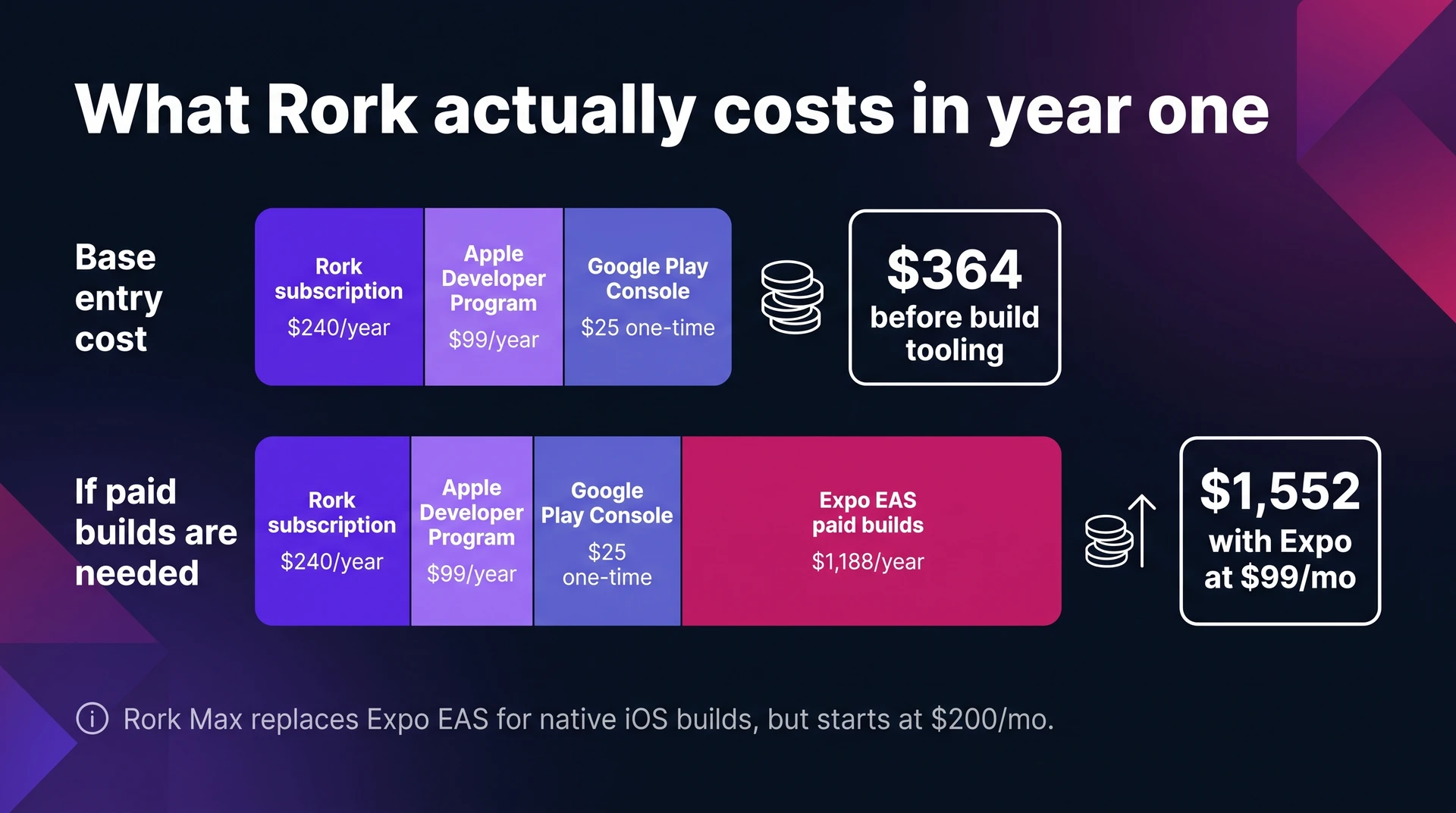
At the entry level, Rork's first-year cost is about $364 before optional build-service costs.
That assumes a $20/month paid plan for 12 months, plus the required Apple and Google developer account fees.
- Rork subscription: $240/year at $20/month
- Apple Developer Program: $99/year, paid to Apple
- Google Play Console: $25 one-time, paid to Google
- Year-one total: About $364 before optional build tooling or outside help
Store fees are separate from Rork. You pay Apple and Google directly if you want the app listed in their stores.
Build costs are the extra variable.
- Limited build volume: Expo EAS Build's free tier covers occasional builds.
- Priority or frequent builds: Paid Expo EAS plans start at $99/month.
- Rork Max: Uses Rork's own cloud Mac fleet for native iOS builds, which removes the Expo EAS Build variable from the budget.
Which plan should you choose?
Start with the cheapest plan that can prove the app idea, then upgrade when you hit a specific constraint.
For Rork, the plan decision comes down to the work left after the first version exists.
| Use case | Plan tier to consider | Why |
|---|---|---|
| Platform testing | Free | Use this to test prompt quality and UI direction before paying. The free tier is limited, so treat it as a test bench. |
| Simple 5-screen first version | Entry paid plan | A basic credit limit covers a first version, but not guaranteed polish, fixes, or store prep. |
| Active iteration | Higher Pro tier | More build attempts, bug fixes, and feature changes burn through credits faster than the first prompt. |
| Team or client work | Higher Pro or Max | Private projects, GitHub access, code editing, and direct support matter more when someone else depends on the app. |
| App Store-ready business | Max | This is the safer tier when native iOS builds, repeated submission work, and build infrastructure become part of the monthly workflow. |
Credits matter more during the fix loop than during the first generation.
Use these upgrade triggers instead of guessing:
- App complexity: More screens, user roles, payments, or backend logic usually means more generation and debugging.
- Iteration frequency: Weekly feature changes need a bigger credit cushion than a one-time prototype.
- Store readiness: Preparing for Apple and Google review adds extra build and bug-fix cycles.
- Private or team workflow: Client projects and internal business apps usually need privacy, GitHub access, and support.
A practical path is Free for evaluation, entry paid for a small first version, then a higher tier only when credits, build volume, or private-project needs become visible.
Rork vs Bolt and Lovable: is the price justified?
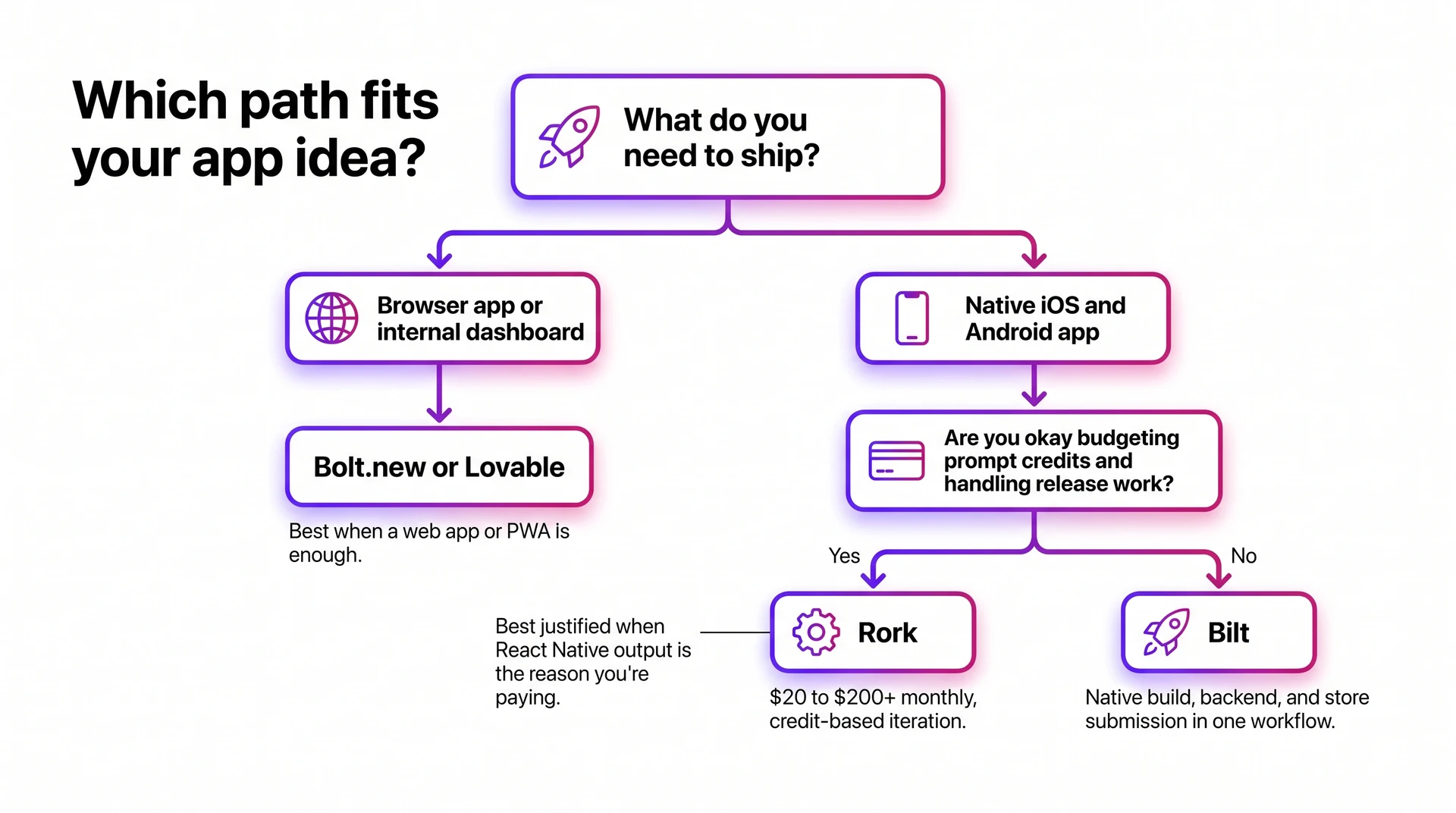
Rork's price is easier to understand when you need React Native output for iOS and Android, not a browser app.
Native architecture changes the work after generation because App Store review and Google Play release requirements still apply.
Bolt.new and Lovable answer a narrower question: can a web app or PWA get the job done?
For a dashboard or internal approval flow, a browser app can be enough.
Compare the tools in this order:
| Tool | Entry plan | Entry usage | Higher paid tier | Higher usage | Output type |
|---|---|---|---|---|---|
| Rork | $20/month | 100 credits | $200/month | 1,000 credits | Native iOS and Android apps |
| Lovable | $20/month | 50 messages | $200/month | 1,000 messages | Web apps and PWAs |
| Bolt.new | Free tier, then $20/month Starter | Limited free usage | $99/month Pro | Varies by token usage | Web apps |
For an initial build and revision cycle, Rork draws from monthly credits. Lovable's Plan Mode uses one credit per message, while Default Mode varies by task complexity.
Bolt.new draws from a monthly token pool. Run the same sample app in each tool before committing because each tool meters usage differently. Compare these four points:
- Output type
- Credit or token pool
- Export path
- Store submission work
Rork's fixed mobile bundle still starts at $200/month for 1,000 credits/month. Lovable's separate per-seat Teams plan is $30/user/month, while Bolt.new scales through larger token pools.
The architecture differences matter more than the unit labels. For push notifications, validate setup and behavior before choosing Rork Max's native Apple output.
- React Native output: Rork is relevant when the app needs native navigation and mobile API access before store review.
- Web-first builds: Bolt.new and Lovable are aimed at browser products such as dashboards or internal tools, where App Store review would add work without improving the product.
- Lovable rollover: Paid Lovable credits can roll over while the subscription stays active, so billing renewal is not an automatic reset.
- Lovable top-ups: Lovable sells extra credits in a 100-credit pack for $30, so the top-up rate is $0.30/credit.
When store handoff matters too, the native-workflow Bilt pricing breakdown covers Bilt’s self-service plans.
Bilt is the next comparison if you want native mobile with token-based plans and built-in build, signing, and store-upload workflows.
When Rork's pricing stops making sense
Rork can be worth it for a native mobile prototype at $20/month. It stops making sense when iteration cost or ownership risk becomes the main issue.
Slow down before upgrading in these cases:
- Heavy iteration: Redesigns and bug-fix prompts pull from the same credit pool, so experimentation can force the $200/month jump before the app is ready.
- Lock-in risk: Confirm how you will access or export the project before canceling, especially if you do not plan to maintain the code yourself.
- Team needs: Team features sit higher in the pricing structure, including GitHub integration and code editor access.
- Shared credit pool: Active collaboration can force a higher tier even when the app scope stays the same.
- Reliability concerns: Retries and broken generations hurt more when the same credits are needed for bug fixes and release polish.
Pay for Rork when the project needs native mobile early and you are comfortable owning the export path.
Stop at $20/month, or move to Bilt, when predictable publishing matters more than prompt-by-prompt iteration.
From idea to native build and store upload with Bilt
Rork's credit model helps you budget prompts. Bilt answers the launch question: can this idea become an app people install and use?
Describe an app and watch Bilt build it in a live native preview.
Describe your app idea, then build toward a true React Native app for iOS and Android. Bilt keeps the path connected from preview through backend setup to native builds and upload to App Store Connect or Google Play’s internal testing track.
Bilt prices its self-service plans by included AI token capacity:
| Plan | Monthly price | Annual price | Included AI tokens |
|---|---|---|---|
| Free | €0 | €0 | 3M |
| Professional | €25/month | €19/month | 10M |
| Professional Plus | €50/month | €39/month | 20M |
| Professional Max | €100/month | €79/month | 45M |
| Professional Ultra | €250/month | €195/month | 115M |
The table covers self-service budgets; Enterprise is custom-quoted by team size and usage. The bigger difference is what Bilt does after generation, when a prototype needs native code and a store-ready workflow.
- Start in plain English. Bilt turns the prompt into screens with navigation and working app logic you can test immediately.
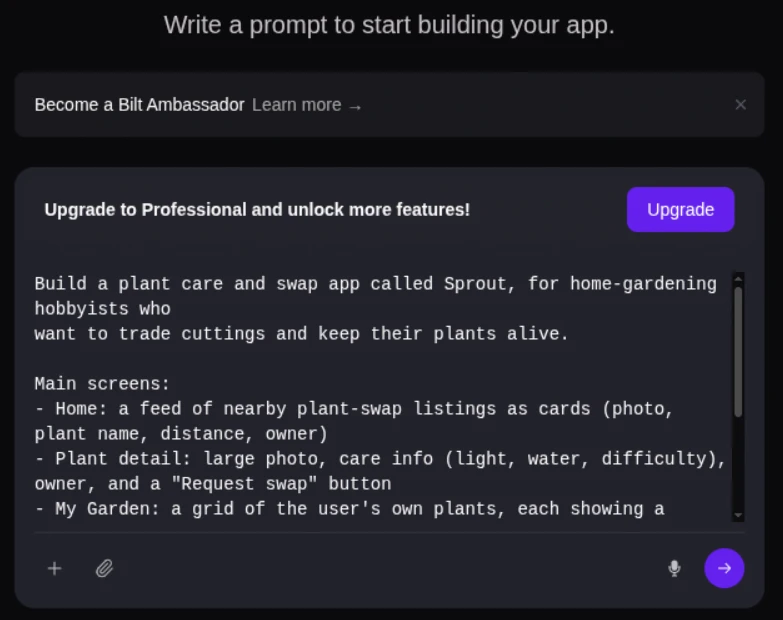
Bilt app-creation screen with a prompt field for describing an app idea - Build on true React Native code for iOS and Android, so the preview and submitted app share the same mobile foundation.
- Use Bilt's built-in product stack when the app needs real users:
- Authentication for sign-up and login
- Database and storage for user data
- iOS in-app payments and paywalls for monetization
- When the app is ready, Bilt handles the store handoff:
- Build generation
- Code signing, certificates, and provisioning profiles
- iOS builds are uploaded to App Store Connect; you submit them for App Review in Apple’s tools
- Bilt sends Android
.aabbuilds to Google Play’s internal testing track, though the first release may need a manual Play Console upload
- Code ownership stays with you.
Export the React Native project when you need the source. Keep iterating in Bilt when speed matters.
| Milestone | Bilt path |
|---|---|
| First working app | In minutes, with a live browser preview |
| Store workflow | Bilt builds, signs, and uploads the app; you complete the listing and review submission in store tools |
Bring the app idea and the blockers if Rork's credit math made you pause. We'll help you map a practical path to a native build and App Store submission.
Book mobile advice in a free 15-min call.
Common questions about Rork pricing
These quick answers cover the pricing edge cases that matter before you subscribe: credits, trials, cancellation, and team access.
What happens when you run out of credits?
When Rork credits run out, you either wait for the next monthly reset or upgrade to a higher plan. Rork does not offer one-time credit top-ups.
- No mid-cycle top-ups: You cannot buy a small extra credit pack to finish a project without changing plans.
- No rollover: Unused credits expire at the end of each billing cycle, so saved credits do not carry into next month.
Does Rork offer a free trial for paid plans?
No, Rork does not offer a free trial for paid plans. You can use the free tier, but it is limited and should be treated as a basic test, not a full paid-plan preview.
The lowest paid entry point on current pricing is around $20/month at the entry Pro tier, with 100 credits, though you may see older reviews reference this plan as Junior.
Can you cancel anytime?
Yes, you can cancel Rork anytime. The catch is that unused credits are deleted immediately when you cancel.
- No grace period: You do not keep the remaining credits after cancellation.
- Monthly expiry still applies: Credits also expire at the end of each billing cycle, even if you stay subscribed.
Can multiple team members share one subscription?
Yes. Multiple team members can share one Rork subscription.
- Shared allowance: Prompts and revisions from every collaborator draw from one monthly credit pool.
- Higher-tier features: Collaboration features require higher plans, and Rork does not use per-seat pricing.