I reviewed Lovable pricing the way a founder would: start with the visible plan price, then follow the credits, top-ups, and backend usage.
My verdict: Lovable is easiest to justify for web prototypes, where a few rebuilds and prompt retries are expected. The bill gets harder to read when credits, top-ups, and Lovable Cloud usage stack together.
This guide breaks down each plan, what credits buy, and where Lovable stops matching a native app workflow.
Lovable pricing at a glance
The plan structure is simple. Extra credits and Lovable Cloud usage are what change the working budget.
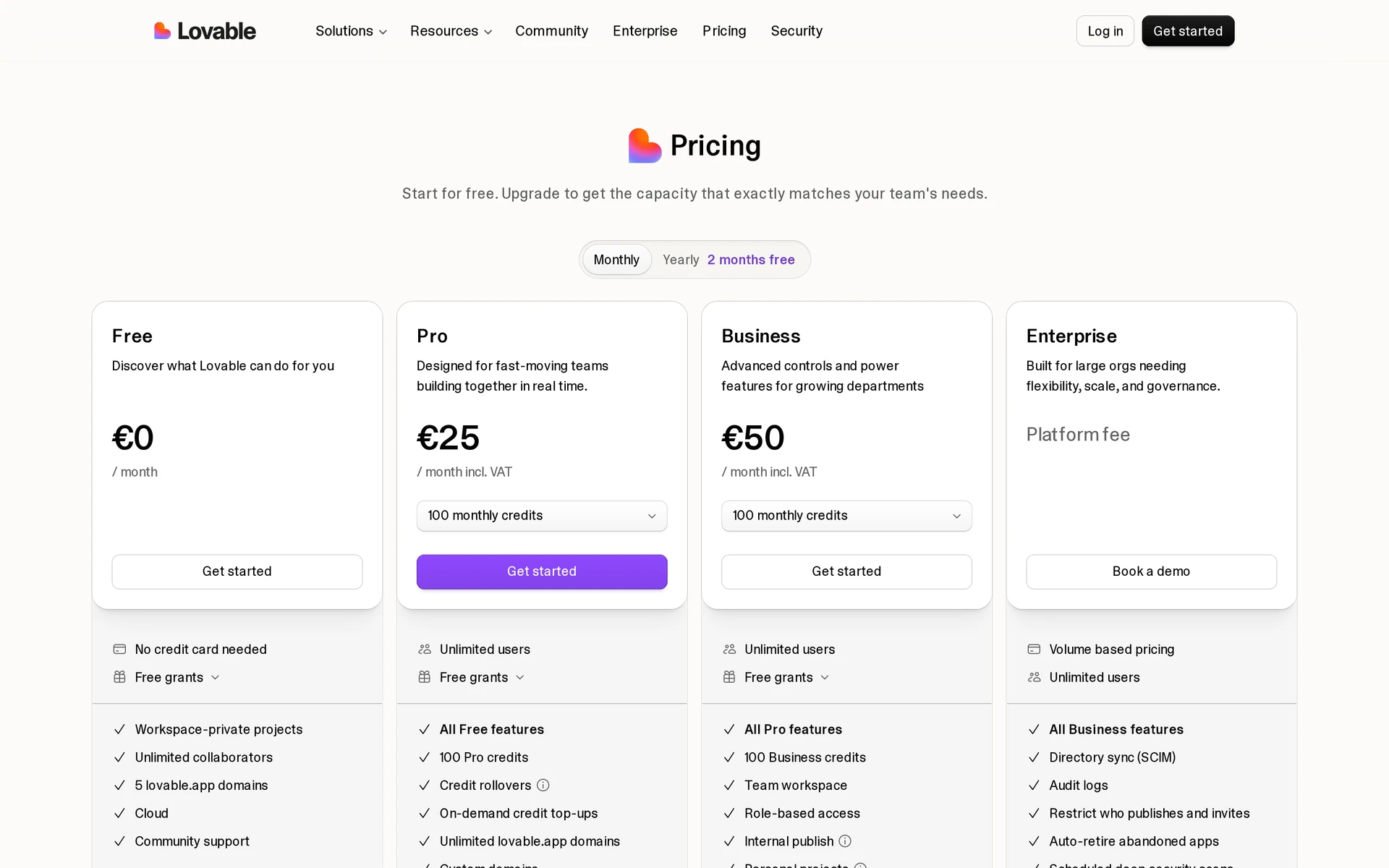
| Plan | Price | Credits | Best fit |
|---|---|---|---|
| Free | $0 | 5 daily, capped at 30/month | Trying Lovable |
| Pro | $25/month | 100 monthly + 5 daily | Private web prototypes |
| Business | $50/month | 100 monthly + 5 daily | Teams needing controls |
| Enterprise | Custom | Custom | Larger organizations |
The subscription is only one layer of cost:
- Monthly credits reset: Free daily credits reset each day, and paid monthly credits expire at the end of the billing cycle.
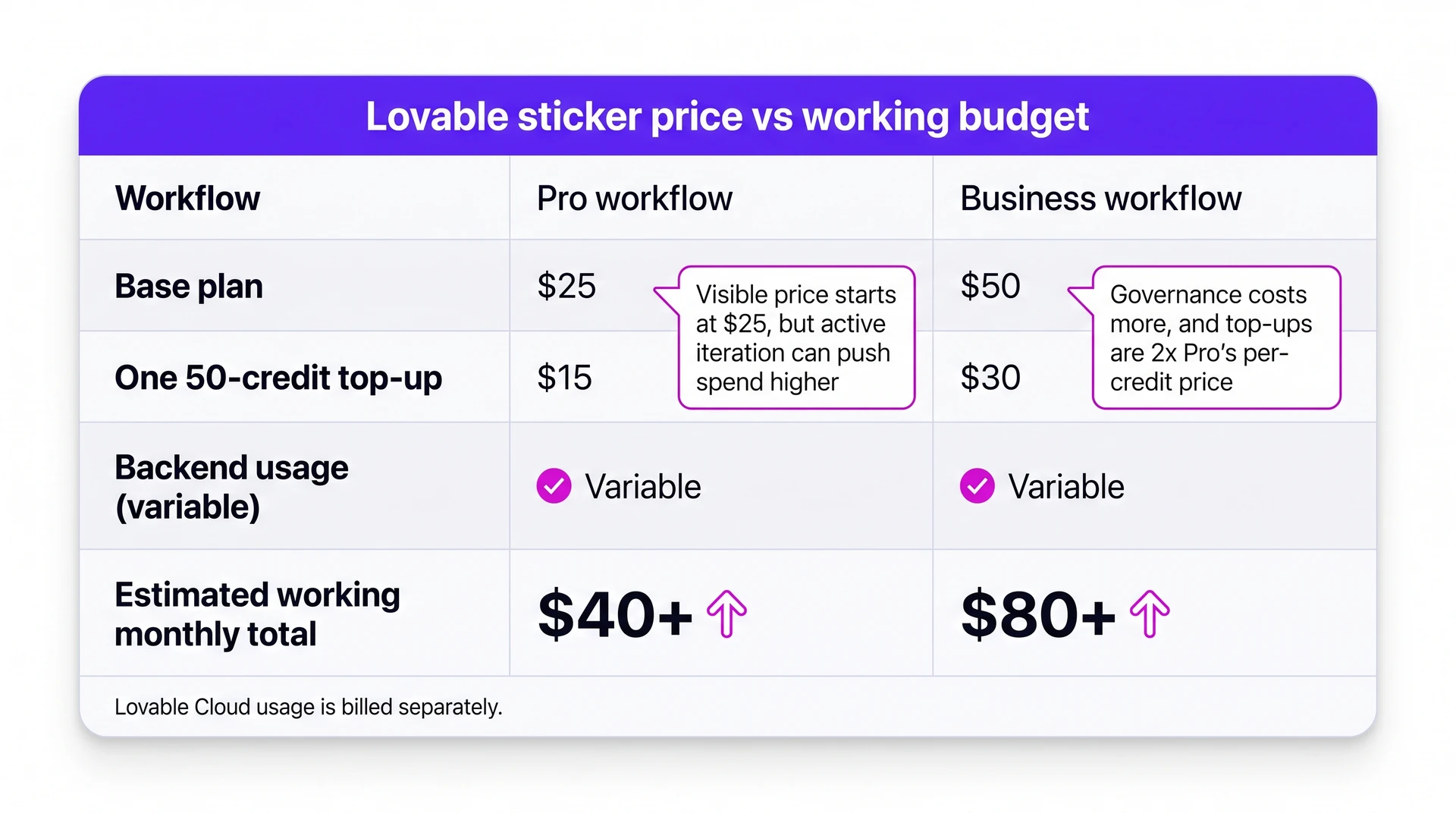
- Top-ups cost extra: Pro top-ups are $15 for 50 credits; Business top-ups are $30 for 50 credits.
- Backend usage is separate: Lovable Cloud can add usage-based costs beyond the plan price.
The sticker price can understate the working budget once a Lovable project needs shared controls or backend-heavy features.
TL;DR: quick comparison
Short version: Lovable pricing fits browser-based web-app work. Credits and backend billing matter once the project needs repeated prompt cycles.
| Plan | Price | Best for | Watch out |
|---|---|---|---|
| Free | $0 | Testing the platform | 30-credit monthly cap |
| Pro | $25/month | Solo web prototypes | $0.30/credit top-ups |
| Business | $50/month | Teams needing controls | $0.60/credit top-ups |
| Enterprise | Custom | Larger organizations | Custom terms |
Builder type changes the pricing math
Builder type changes the budget because Lovable's plans and credits are designed for browser-based prototypes and web apps.
| Web project | Lovable fit |
|---|---|
| Browser-based demo | Built for quick prompt-led iteration |
| Landing page or internal web app | Works when the output stays in the browser |
| Prototype you plan to rebuild later | Useful for validating the web flow first |
Lovable makes the most sense as a web-only AI builder when the output stays a web app.
The generated stack is web-centric:
- React and Vite
- Tailwind styling
- Supabase-style backend pieces
Lovable plans, broken down
With that builder-choice lens in mind, Lovable’s plans are easier to read. Each tier mainly changes how many credits you get, whether your projects can stay private, and how much team infrastructure you need.
Free plan ($0)
Lovable’s Free plan is best for testing the builder, not running a full build cycle. You can experiment, but the credit ceiling arrives fast.
Key limits to know:
- Credits: 5 daily credits, capped at 30 credits per month.
- No rollover: Unused daily credits do not carry into the next day or month.
- Example usage: A landing page with images and themes can cost 2 credits.
- Small edits: A simple style change, like changing button colors, can cost 0.5 credits.
- Bug fixes: The “Try to fix” button does not use credits on any plan.
- Projects: Free projects are public, so private work requires a paid plan.
- Domains: The plan includes 5 Lovable-branded domains on the lovable.app subdomain.
If you use all 5 daily credits, you can hit the 30-credit monthly cap in six active days. That makes the free tier useful for a quick sanity check, not sustained iteration.
To put 30 credits in context, that is roughly 15 landing-page generations at 2 credits each.
It can also cover a few multi-screen experiments if each flow only needs light polish.
For a single-page idea check, Free is enough. For a real product build, the cap can arrive before the second feature is finished.
Pro plan ($25/month)
Lovable Pro costs $25/month.
- Credits: $25/month includes 100 monthly credits, enough for roughly 50 page-level generations if each page costs 2 credits.
- Project privacy: Pro unlocks private projects, so your code and builds are not publicly visible.
- Publishing: Custom domains remove the lovable.app subdomain restriction for web apps.
- Code handoff: Standard GitHub.com sync is available on all Lovable plans, including Free. Direct ZIP code download from the editor is limited to paid plans.
- Limits: Unused monthly credits expire at the end of the billing cycle, and Pro does not include SSO or advanced team controls.
- Mobile note: Lovable is web-app focused; it does not generate native iOS or Android apps on this plan.
In practice, 100 credits gives a solo builder room for one focused build sprint with light polish rounds included.
It gets tight if you are exploring multiple app directions in the same month. One Pro top-up adds 50 credits for $15, bringing that cycle to 150 credits.
Business plan ($50/month)
Business is where Lovable gets expensive to test: $50/month makes sense when SSO and data training opt-out are required, but overage credits cost twice as much as Pro top-ups.
- Price: $50/month for the Business tier.
- Security: SSO is included here; it is not part of Free or Pro.
- Privacy: Business adds data training opt-out, which matters when teams are building with proprietary product logic or customer workflows.
- Team workflow: Team workspaces, reusable design templates, RBAC, and internal publishing are included where supported.
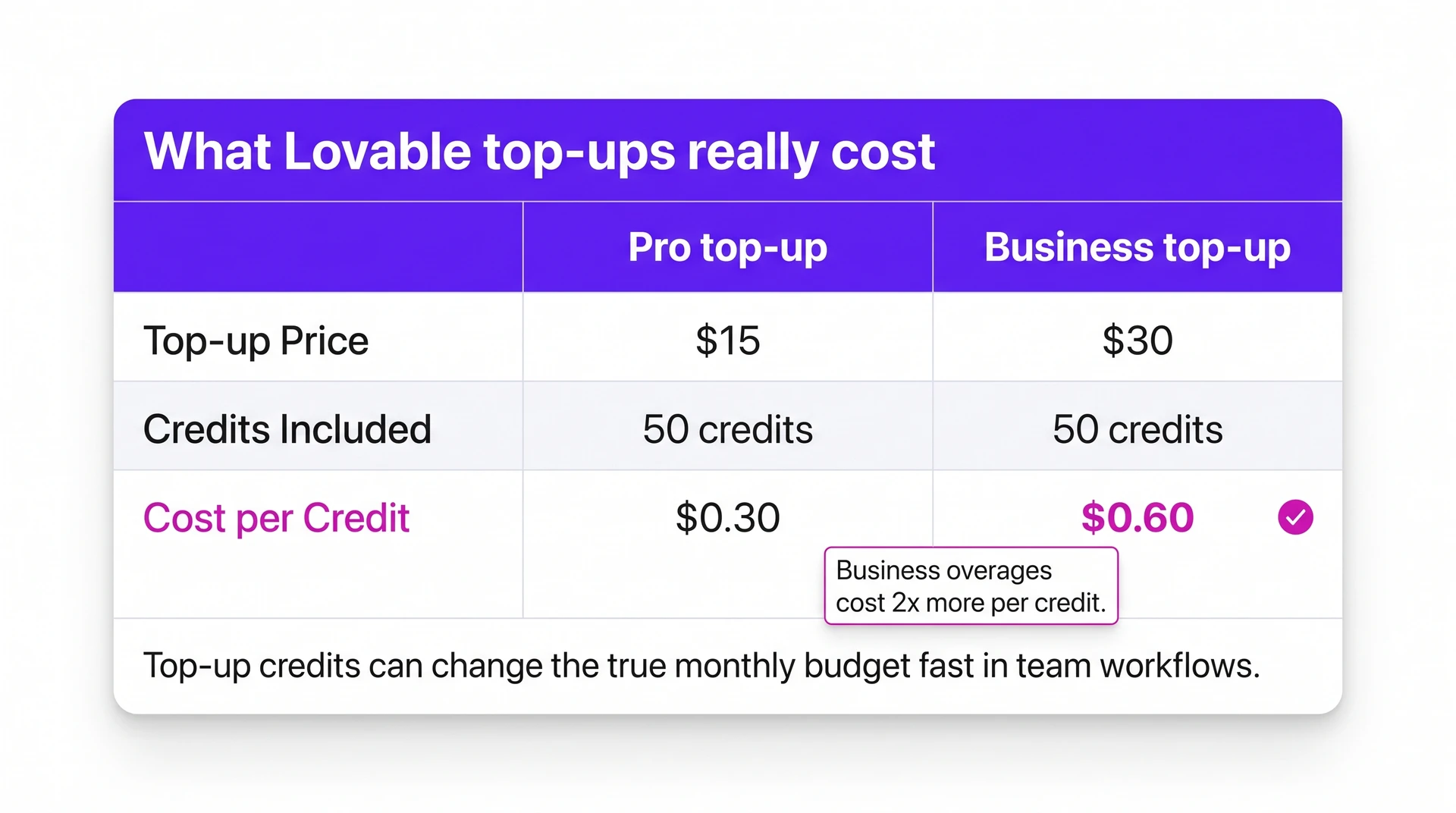
- Credit top-ups: If the included credits run out, Business top-ups cost $30 for 50 credits, or $0.60 per credit.
- Top-up expiry: Business top-up credits are valid for 12 months, unlike monthly plan credits that reset with the billing cycle.
- Tradeoff: Business is the better governance tier, but its top-up credits cost more per credit than Pro top-ups.
Enterprise (custom pricing)
Enterprise is a procurement tier, so evaluate the contract before comparing it with Business.
- Pricing: Negotiate a custom credit contract. The standard Business allocation is not the starting point for large teams.
- Onboarding: Dedicated onboarding and personalized project templates help teams standardize how builds are created, reviewed, and handed off.
- Access controls: Advanced RBAC and team segmentation are available. Confirm whether automated user provisioning is included before signing.
- Support: Dedicated support is included. Clarify response SLAs and whether support covers deployment issues or only account questions.
- Best fit: Enterprise fits organizations using Lovable across departments, not one product team or solo builder.
What to ask during procurement: Confirm the minimum credit commitment, overage rate, support scope, and whether deployment help is included.
Lovable does not publish an exact Enterprise floor, so compare the contract against your expected credit usage before signing.
How Lovable credits actually work
Lovable credits are units used for building, Cloud hosting, and AI gateway usage. Usage-specific grants are used first, then general credits; Default Mode starts at 0.5 credits, while Plan Mode costs one credit per message.
Monthly credits vs daily credits
The easiest way to understand Lovable pricing is to separate free daily credits from paid monthly pools. The free plan is for light testing; paid plans are for sustained building.
| Plan | Credit structure | What it means in practice |
|---|---|---|
| Free | 5 credits per day, 30 credits per month hard cap | Unused daily credits do not roll over, so you cannot bank credits for a bigger build later. |
| Pro | 100 credits per month at $25/month | Better for one active builder who expects to revise pages, flows, and copy across the month. |
| Business | 100 credits per month at $50/month | Better for teams or heavier builds where multiple people share one pool. |
Check the non-credit limits before upgrading:
- Free: No custom domains or per-member limits.
- Pro: No SSO.
- Business: Top-up credits cost twice as much per credit as Pro top-ups.
Lovable also charges different amounts for different actions:
- Simple styling edit: 0.5 credits, such as changing a button color.
- Landing page generation: 2 credits when images and themes are included.
- Try to fix button: 0 credits, so the automated bug-fix attempt does not drain your balance.
The important detail is that paid usage depends on what you ask Lovable to do, not only how often you prompt it. Five polishing rounds on one page can turn a 2-credit generation into a 6 to 10 credit workflow.
How teams burn through credits faster
Teams use credits faster because one shared pool has to absorb everyone's experiments, revisions, and follow-up prompts. The subscription may look predictable, but collaboration makes usage spike quickly.
Common credit drains:
- Parallel builders: Three people each creating a 2-credit landing page can use 6 credits before anyone starts polishing.
- Repeated iteration: If each page takes five rounds to refine, that same work can reach 18 to 30 credits across the team.
- Manual debugging: The Try to fix button is free, but follow-up prompts after a failed fix still consume credits.
- Broad prompts: Larger requests usually cost more than narrow styling edits because Lovable has more to generate, connect, or rewrite.
This is where top-ups matter. Pro users can buy 50 extra credits for $15, while Business users can buy 50 for $30.
Top-up credits are useful during a launch push, but they change the real monthly cost. A team that repeatedly needs top-ups is not just paying for Lovable, it is paying for its iteration pattern.
The costs beyond your subscription
Lovable's sticker price is only the starting point. Your real monthly cost depends on how many credits you use, whether you buy top-ups, and how your backend grows after launch.
The main extra costs to watch:
- Credit top-ups: Business users pay $30 for 50 credits, or $0.60 per credit. Top-up credits stay valid for 12 months, while monthly plan credits expire at the end of the billing cycle.
- Lovable Cloud: Backend services such as storage, authentication, and serverless functions are billed separately. Costs are hard to predict until real users, uploads, and API calls start showing up.
- External services: Custom domains, third-party APIs, databases, and payment tools add their own costs depending on how you build.
If your project is still a prototype, backend unpredictability matters less.
If customers depend on the app, budget for more than the subscription. Backend spend is hard to forecast before Lovable has real users, uploads, and API calls to meter.
Which Lovable plan should you choose?
Start with privacy, then work through the team requirements.
- Does the project need to stay private? If yes, skip Free and start with Pro.
- Does your team need security controls? If yes, Business is the practical floor for SSO and data training opt-out.
- Will multiple people share credits? If yes, estimate usage as a team pool, not as one person's monthly allowance.
1. Is your project public or private?
Free is for public projects only. If the work should not be visible, Pro at $25/month is the functional minimum.
Public means the project does not have private access controls. That is fine for experiments, learning, and throwaway prototypes, but it is a poor fit for client work or an app idea you are not ready to expose.
Use this rule of thumb:
- Choose Free for public experiments, demos, and learning Lovable's workflow.
- Choose Pro when the project needs private visibility and a larger monthly credit allowance.
- Choose Business when privacy is not enough and your team also needs SSO or data training opt-out.
This distinction matters most when the project contains customer data, proprietary workflows, or a serious product concept. Privacy is not a cosmetic feature here; it changes which plans are safe to use.
A private project that is really a mobile app may need a mobile-first builder instead. Bilt lets you describe the app in plain English, then build for iOS and Android and handle the App Store and Google Play steps.
If store release is the next filter, the store-ready iOS software guide compares tools by output and submission support.
2. Do you need SSO, RBAC, or compliance controls?
Check the plan against your company’s identity and data policies before assigning customer or proprietary work.
- Free: No SSO or data-training opt-out.
- Pro: Private projects, but no SSO.
- Business: SSO and a data-training opt-out.
- Enterprise: Group-based RBAC, audit logs, and compliance support.
Free and Pro are best for low-risk prototypes because they do not include SSO or the data training opt-out.
Business is the first tier to consider when company access policies or privacy requirements enter the picture.
Enterprise is the safer path when you need advanced controls such as group-based RBAC, audit logs, and compliance support. If automated user provisioning is non-negotiable, verify it during procurement rather than assuming it is included.
If your organization needs centralized identity for native mobile app work, Bilt Enterprise supports SAML SSO and automated provisioning.
3. How many people will share the credit pool?
Use 100 Pro credits per month as the safer planning baseline. The important question is not how many people can join, but how quickly active builders split the same pool.
Simple math:
- 1 active builder: about 100 credits/month.
- 2 active builders: about 50 credits each.
- 4 active builders: about 25 credits each.
That can disappear quickly. A landing page generation costs about 2 credits, a small styling edit can cost 0.5 credits, and five meaningful iterations can burn roughly 6-10 credits.
A 2-4 person team can drain Pro faster than expected when everyone is generating screens, testing flows, and refining copy.
Monthly credits also do not roll over, so the pool rewards consistent usage more than sporadic bursts.
If you run out mid-cycle, Pro top-ups are commonly sold in 50-credit blocks. Treat those as overflow, not the operating model for a team that builds every day.
A quick practical map
Here is the fast version if you are trying to choose without overthinking it:
- Testing an idea or learning the credit model? Start with Free.
- Building a private web prototype on your own? Pro adds private projects and more monthly credits.
- Need SSO, a data-training opt-out, or stronger privacy controls? Move to Business.
- Buying for a larger organization with RBAC, audit logs, compliance, or procurement needs? Look at Enterprise.
- Planning a native iOS or Android app? Use Bilt instead of a browser-based web app builder.
Lovable fits fast web app iteration. Bilt fits teams that need to publish native mobile apps.
How to pay less for Lovable
There are 5 practical ways to lower your Lovable cost before you upgrade or add more credits:
- Switch to annual billing: Annual pricing saves about 16% compared with paying month to month.
- Run the Pro math: Pro is about $25/month monthly or about $21/month annually, saving roughly $48/year.
- Run the Business math: Business is about $50/month monthly or about $42/month annually, saving roughly $96/year.
- Use the student discount: Eligible students can get 50% off with a university email.
- Share Pro carefully: Pro supports unlimited users, but everyone draws from the same 100 monthly credits. Even 2-4 active builders can drain that pool quickly.
Pro tip: Switch to annual billing only when the project has a 3-6 month build runway. The 16% saving is real, but a 12-month commitment costs more if the project stalls after one sprint.
Validate the idea on Free first. Once you know the app structure, the main screens, and the credit burn, upgrading becomes a planning decision instead of a guess.
Upgrade only when your measured build pace exceeds the current plan. Monthly credits expire, so unused capacity is still wasted spend.
Common Lovable pricing mistakes
The biggest pricing mistake is treating the $25 Pro plan like a fixed monthly build budget. Lovable's subscription buys access, but credits decide how much work actually gets done.
- Prompt vaguely, then regenerate whole pages. A landing page costs 2 credits; a style edit costs 0.5. Five full-page polish rounds can burn 6-10 credits.
- Treat unlimited Pro users like unlimited work. Pro supports unlimited users, but the 100 monthly credits are shared. Five polish rounds can leave under 25 meaningful tasks for the month.
| Mistake | What happens | Better move |
|---|---|---|
| Upgrade before measuring usage | Unused credits still expire at the higher tier | Track one month of usage, then decide |
| Pay credits for fixable bugs | A new prompt costs credits; the free Try to fix button does not | Always try the free fix first, then prompt only if it fails |
- Ignore cloud costs after launch. Credits cover development actions, while live apps can still create hosting or backend charges between prompt sessions.
How Lovable pricing compares to alternatives
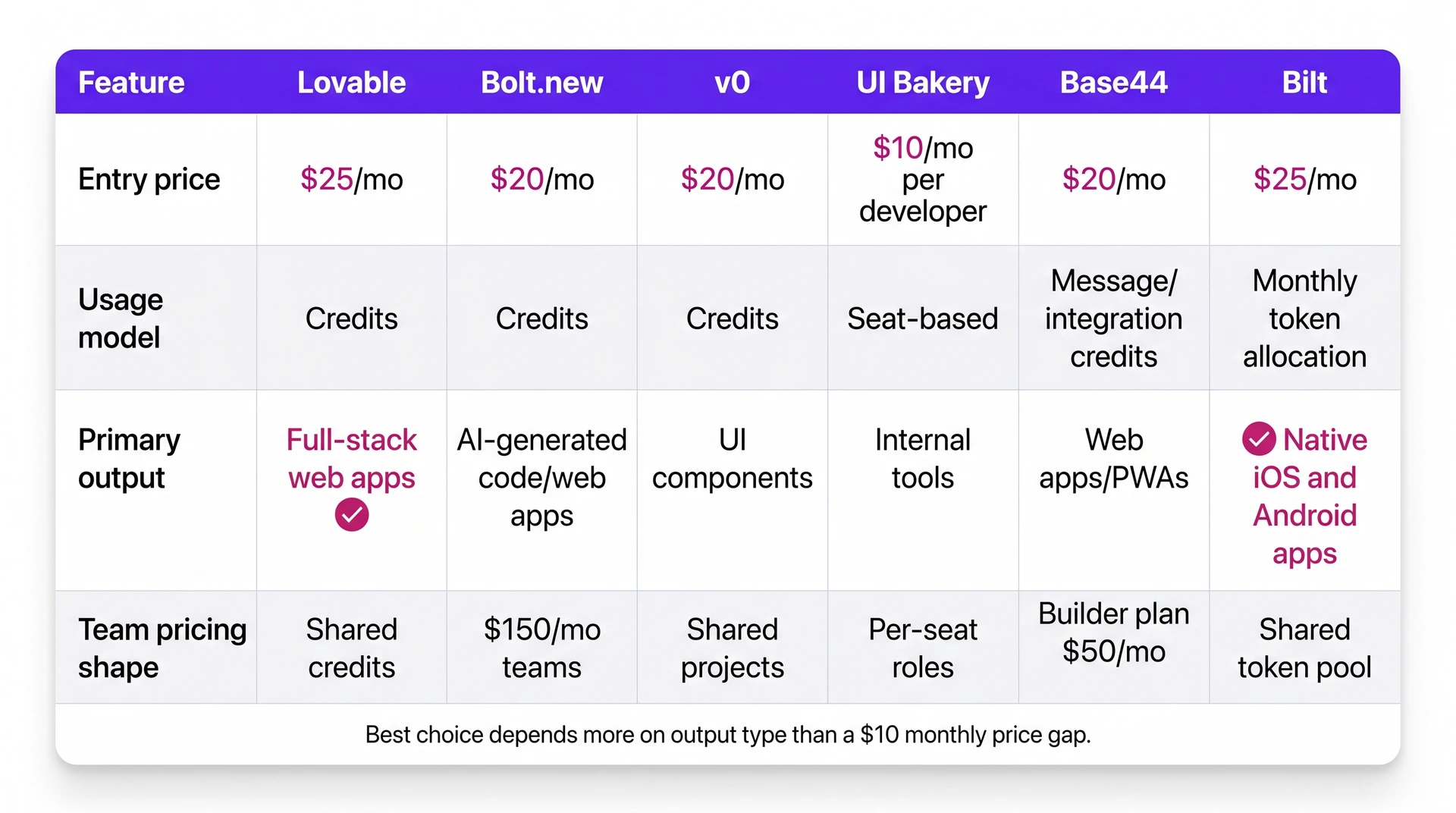
Across Bolt, v0, UI Bakery, Base44, and Bilt, the cheapest plan matters less than the output type.
The practical differences are simple:
- Lovable: Fits fast web-app prototypes where revision credits are acceptable.
- Bolt.new: Fits workflows where code inspection matters more than built-in product hosting.
- v0: Fits UI component work better than full app delivery.
- UI Bakery: Fits internal tools with structured teams and permissions.
- Base44: Fits quick PWA-style web apps, with Base44 credit costs to watch.
- Bilt: Fits native iOS and Android builds; Professional Plus adds a €50/month tier above Professional.
| Tool | Entry Price | Usage Model | Primary Output | Team Pricing |
|---|---|---|---|---|
| Lovable | $25/month (Pro) | Credits (variable cost per action) | Full-stack web apps | $25/month for up to 5 users (shared credits) |
| Bolt.new | $20/month | Credits | AI-generated code, web apps | $150/month for teams |
| v0 (Vercel) | $20/month | Credits | UI components | Team plans with shared projects |
| UI Bakery | $10/month per developer | Seat-based | Internal tools (low-code) | Role-based access, per-seat cost |
| Base44 | $20/month (Starter) | Message/integration credits | Web apps / PWAs | Builder plan at $50/month |
| Bilt | €25/month (Professional) | Monthly token allocation (10M tokens) | Native iOS and Android apps (React Native) | Token pool shared across team |
Lovable's cost feels predictable only after you stop regenerating whole screens. Bolt has the same revision risk; UI Bakery is steadier because pricing is seat-based.
Use a hard rule: pick the tool by output, then price the plan. A $10 monthly difference is irrelevant when the platform generates the wrong kind of app.
For native output, the native-output iOS vibe-coding roundup tests how far seven builders get toward App Store submission.
Where Lovable's pricing leaves gaps
Lovable's pricing gaps show up when a prototype becomes a live product. Four pressure points matter:
- Live-app costs can be hard to forecast. A page generation costs 2 credits; a style edit costs 0.5. Broad prompts can make the same feature cost more than targeted edits.
- Credits punish uneven build cycles. Monthly credits expire. I would budget stop-start projects around the next active sprint, then compare top-ups with the $50 Business tier.
- Backend lock-in grows with the project. Lovable's Supabase-style backend ties database rules, auth, and generated app logic together as real users arrive.
- Native mobile sits outside Lovable's pricing model. A team planning App Store or Google Play release should price a native builder separately before spending credits on a web-first prototype.
Build a native app Lovable's credits can't limit with Bilt
Treat the Lovable-to-Bilt handoff as a platform decision. Lovable helps you prove a web MVP; Bilt builds the installable mobile app.
Describe an app, then watch Bilt build a native mobile app in live preview.
We built Bilt for founders who need iOS and Android users to install the product. You describe the app in plain English, and Bilt generates React Native screens, navigation, and source code.
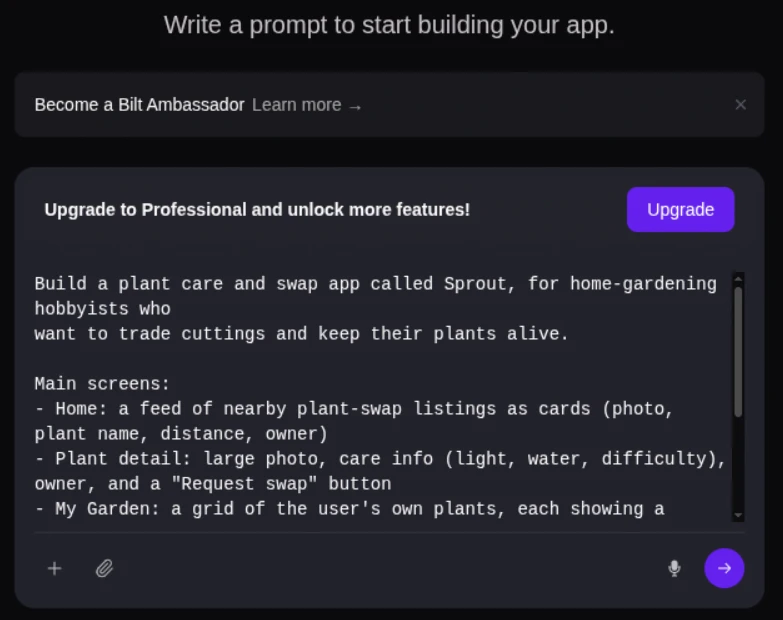
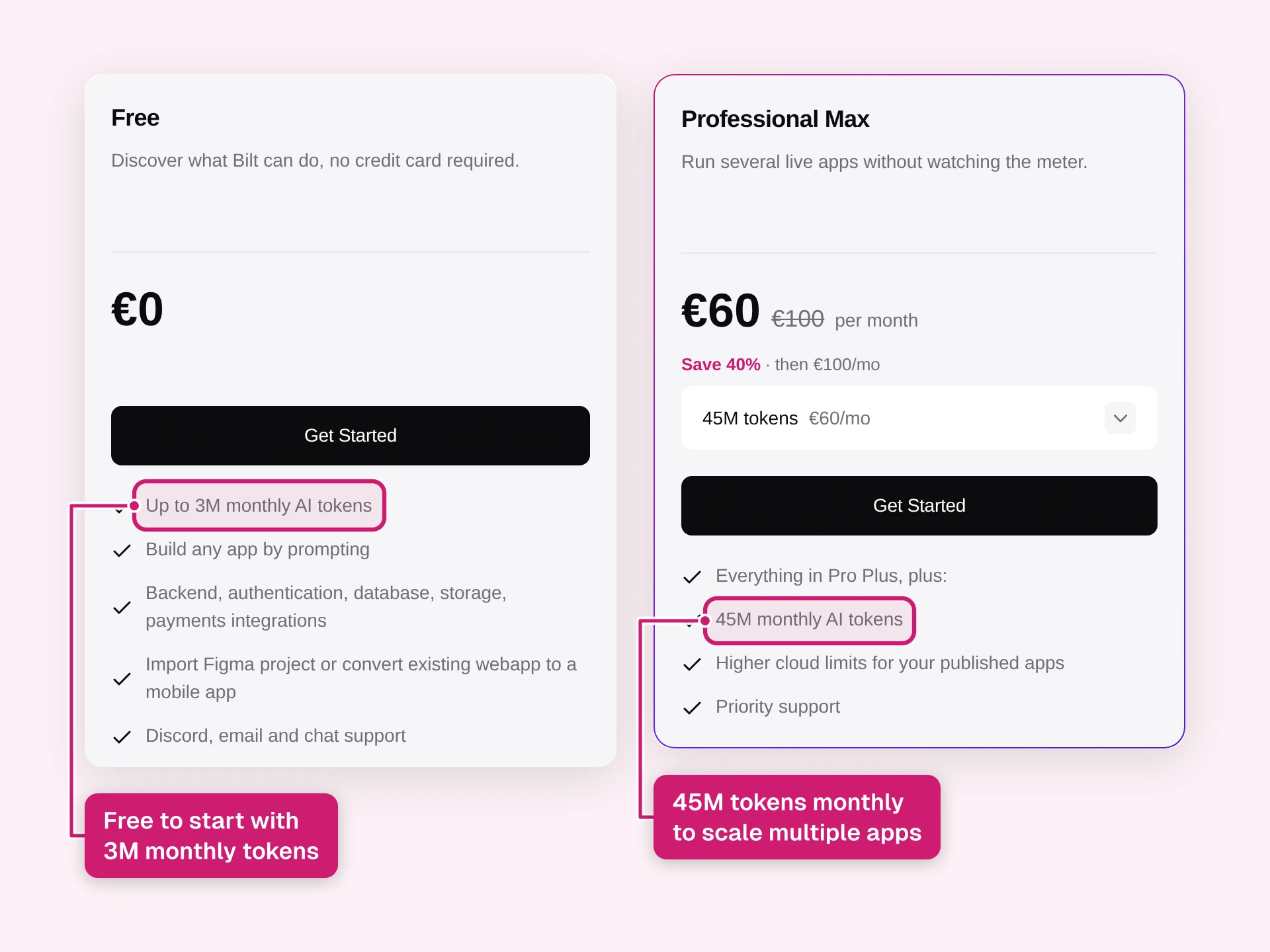
The pricing model is easier to plan because Bilt uses stated monthly token pools instead of per-action credits:
- Bilt Free: Up to 3M tokens per month, granted daily, before paying.
- Bilt Professional: €25/month with 10M tokens per month.
- Bilt Professional Plus: €50/month with 20M tokens per month.
- Top-ups: Need more before the next reset? Add 5M extra tokens for €15 on any paid plan, valid for 30 days.
- Lovable Free: 30 monthly credits, plus daily credits that expire instead of rolling over.
Bilt and Lovable use different units, so do not compare tokens to credits directly. The practical difference is that Bilt's free tier is built around native mobile iteration, while Lovable's free tier caps browser-app testing at 30 credits per month.
Bilt also handles the mobile work that decides whether an app ships:
- React Native output: Bilt generates real screens with configured navigation and editable source code for iOS and Android.
- Native builds: Bilt produces iOS and Android binaries, then handles code signing and asset generation for store submission.
- Store submission: Bilt guides App Store and Google Play submission, including Apple and Google developer account fee planning.
- Device testing: Bilt supports QR code testing on real devices plus browser-based native simulators.
The result is a mobile workflow that stays in one place: describe the idea, preview the native app, revise by chatting, and move toward store submission without hiring a developer for every change.
Turn your Lovable prototype into a real native app for iOS and Android with Bilt. Start building free when you are ready to build, preview, and publish.
Comparing token allowances first? See all plans.
Common questions about Lovable pricing
Use these answers for the short version before you choose a Lovable plan.
Is a Lovable subscription worth it?
Yes, for a fast web MVP or shared React prototype.
For native mobile apps or long production cycles, I would budget for another workflow before committing credits.
Lovable earns its subscription when:
- Your prompts are structured: Clear inputs reduce wasted generations.
- Your team shares one pool: Paid team plans can be efficient when multiple people build from one subscription.
- You need paid features: Code editor access and custom domains require a paid tier.
- You use Try to fix: Lovable's repair flow can stretch paid credits during debugging.
The tradeoff: Monthly plan credits expire, while top-ups last longer. The same feature can cost different amounts depending on how you prompt, so monthly usage is hard to forecast when a messy build drains the credit pool quickly.
For a native mobile app, use a mobile-first builder instead. Bilt starts free with up to 3M tokens per month, granted daily; Professional is €25/month with 10M tokens.
Which is cheaper: Bolt or Lovable?
Lovable is cheaper in the team example below. Solo pricing is close based on the plans compared here: Lovable Pro is $25/month, while Bolt is around $20-$25/month.
Compare the billing model before comparing features: Lovable uses shared credits, while Bolt Teams charges per user.
The simple math:
- Lovable: $25/month for the comparable Pro plan.
- Bolt Teams: $30 per user per month.
- Five-person team: $150/month on Bolt versus $25/month on Lovable Pro, if Lovable's shared-user terms fit the team.
For a solo builder doing a 3-month web MVP, Lovable Pro at $25/month comes to $75 before top-ups.
Add one $15 top-up in each active month and the 3-month build-cycle cost lands around $120. Bolt at $20/month lands at $60 for the same period, but team pricing jumps when a second collaborator joins.
Native-app budgeting gets clearer on the deployment-aware Bilt pricing page, where tiers map to mobile-building workflows.
Does Lovable offer a student discount?
Yes. Verified students can receive up to 50% off Lovable Pro.
Check the Lovable student page for the current verification process and eligibility terms.
Is the free plan free forever?
Yes. Lovable offers a permanent Free plan with 5 daily build credits, capped at 30 credits per month. Unused daily credits expire at the end of each day.
The Free plan includes:
- public projects
- unlimited collaborators
- 5 lovable.app domains
- included Cloud grants
Four limits matter:
- Daily credits reset: Free-plan credits refresh each day and unused daily credits disappear; paid monthly credits reset each billing cycle.
- Small changes still cost credits: A landing page with images can use 2 credits, while a button color change can use 0.5 credits.
- Extra credits stay locked: Free users wait for the next daily reset after hitting the cap.
- Key features stay locked: SSO and RBAC require Business at $50/month; free projects are public by default.
Use the free plan to test Lovable's workflow. Upgrade for team controls or enough credits to polish a real project.