Base44 and Lovable answer the same broad question: how fast can a prompt become a working web app? Both offer free tiers. Base44’s paid plans start at $20/month, while Lovable’s start at $25/month.
The better choice depends on what happens after the first build. Base44 is usually faster inside its managed environment, while Lovable becomes stronger when code export and developer handoff matter.
Lovable can take longer to set up because Supabase adds more moving parts. In return, it produces a more portable React and TypeScript project that can sync to GitHub.
Building for iOS or Android?
Base44 and Lovable are web-first builders. Neither produces a native app you can publish directly to the App Store or Google Play.
What kind of builder do you actually need?
Start with the shape of the project, not the feature list.
- Web app or native app: Base44 and Lovable are web-first builders. Native iOS or Android publishing needs a different path or extra packaging work.
- Fast MVP or portable codebase: Choose Base44 for speed inside one managed system. Choose Lovable when GitHub export and developer handoff matter.
- Simple build or serious growth: Pressure-test the choice against the first real scaling event, such as users, auth, payments, or a developer taking over.
How we evaluated both platforms
This comparison uses research-backed criteria rather than a first-person build diary. The goal is to show where each platform fits before the deeper feature sections.
The strongest split came from the CRM-style build path. Base44 felt faster and more enclosed, while Lovable took longer because of Supabase but produced more structured, readable code.
- Build approach: How quickly a usable first version appears.
- Backend and auth: How much setup is required for accounts and data.
- Code ownership: Whether the project can leave the platform.
- UI editing: How easy visual changes are after generation.
- Pricing structure: How credits affect iteration after Base44’s $20/month and Lovable’s $25/month entry points.
Base44 vs Lovable at a glance
Base44 fits a fast managed web MVP. Lovable fits projects that need portable React and TypeScript code for developer handoff.
Base44’s paid plans start at $20/month, while Lovable’s start at $25/month. Their credit models differ too.
- Base44: Paid plans increase available credits and capacity as the subscription tier rises.
- Lovable: Paid plans use monthly message credits, with different actions consuming different amounts.
- Base44: No full code export, so moving outside the platform can require rebuilding or heavy rework.
- Lovable: More setup because of Supabase, and exported apps still need separate work for native app stores.
- Both: These are web-first builders, not direct native iOS or Android app builders.
Here is the short version before the deeper head-to-head.
| Dimension | Base44 | Lovable |
|---|---|---|
| Primary output | Managed web app | React + TypeScript app |
| Backend | Managed Base44 backend | Supabase setup |
| Code ownership | No full export | GitHub export |
| Target user | Non-technical MVP builders | Portable-code builders |
| Free tier | Yes | Yes |
| Paid plans start at | $20/month | $25/month |
| Mobile output | Needs outside packaging | Needs outside packaging |
| Main strength | Faster managed setup | Better portability |
| Main limitation | Higher lock-in risk | More setup work |
The core difference: managed speed vs portable ownership
Base44 and Lovable both turn prompts into web apps, but the architectural split is simple: Base44 keeps the app inside its hosted system, while Lovable makes code ownership part of the workflow.
That difference affects what happens after the demo. Base44 favors managed speed; Lovable favors a codebase a developer can inspect, export, and keep moving outside the original builder.
Base44: managed environment
- What it means: Base44 handles the app workspace, hosting, database layer, and backend wiring inside one managed platform.
- Portability tradeoff: You can export schema or debugging information, but not the full application code, backend logic, or data layer.
- Long-term effect: If the project outgrows the platform, migration usually means rebuilding the app elsewhere rather than moving the same codebase.
Lovable: portable source code
- What it means: Lovable generates a conventional web app codebase, commonly using React, Vite, Tailwind CSS, and Supabase.
- Ownership tradeoff: Export and GitHub workflows let the project move into developer tools, self-hosting, or a handoff to an engineering team.
- Long-term effect: Portability reduces platform dependency, but the exported app still needs normal engineering review before serious production use.
Shared limitation: web-first output
Neither platform natively produces compiled iOS or Android apps. Base44 projects are web-based by default, and Lovable generates web application code.
App store distribution usually means adding a separate mobile wrapper or building a native pipeline after the fact. That extra step matters if the goal is a real app store app, not just a web app that runs on phones.
What each platform actually is
Base44 and Lovable both turn prompts into web apps, but they fail in different places. Base44 removes setup decisions; Lovable exposes more of the stack you eventually have to own.
Base44
Base44 is a managed AI web app builder. You describe the app, and Base44 creates the interface, logic, database, and hosted environment inside its workspace.
The useful part is fewer setup decisions before the first working web app. The tradeoff appears later, when export, mobile shipping, and custom backend changes matter.
- Primary user: Non-technical builders, solopreneurs, hobbyists, and small teams making web MVPs or internal tools.
- Project fit: CRM-style tools, dashboards, small business workflows, personal projects, and client prototypes.
- Backend judgment: Base44 manages the backend day to day inside its environment, while export gives you a handoff copy of the codebase and backend functions.
- Export reality: Base44 offers complete codebase and backend function export. That makes the old "no export" critique too broad, but exported functions still need review.
- Mobile risk: iOS or Android store deployment still needs a wrapper or native build path, so a web MVP can outgrow the default workflow.
Lovable
Lovable is an AI web app builder that generates source code from prompts. In plain English, the output looks like a web project a developer can inspect.
Key terms in Lovable projects:
- React builds the app screens.
- Vite packages the web app for development and release.
- Tailwind CSS controls styling.
- TypeScript is JavaScript with extra checks.
- Supabase provides the database.
- Supabase Auth handles login, and Supabase Storage handles files.
- Primary user: Founders, individual developers, designers, and small startup teams building web MVPs before deeper engineering work.
- Project fit: SaaS prototypes, landing pages, dashboards, job application tools, and simple business web apps.
- Backend judgment: Supabase gives Lovable a recognizable backend, but account setup and permission rules become part of the build earlier.
- Ownership check: Code export and GitHub workflows improve handoff, but generated code still needs security and maintainability review.
- Mobile risk: Lovable does not produce native app store binaries by default; mobile deployment needs extra engineering after export.
That is the platform-level tradeoff. The sharper comparison is where each workflow breaks during setup, backend work, export, UI editing, and integrations.
Head-to-head: five criteria that actually matter
Fast demos are easy to overrate. The useful question is where the build slows down after the first screen works.
Ease of use and setup
Day one favors Base44. Lovable asks you to think about Supabase earlier, which helps handoff but makes the first session rougher for a true beginner.
A CRM-style Base44 test can begin with separate prompts:
- Create contacts and companies.
- Add a deal pipeline.
- Add a form for new leads.
Those prompts can produce a functional prototype before backend terms enter the conversation.
Lovable uses the same product brief and adds Supabase setup for:
- Database storage
- Authentication
- Access rules
Supabase lets technical users inspect the database and access rules directly.
Where Base44 feels easier
- The first build stays inside a guided prompt workflow, so there is no local environment to configure.
- A CRM-style prompt can create the first app structure before the user learns backend terms.
- Failure mode: prompt-only fixes can turn one layout problem into a second regression elsewhere.
Where Lovable slows down early
- Supabase appears early because user accounts and saved records live there.
- GitHub and backend concepts make more sense to users who have seen web development before.
- Full-stack changes can need extra chat iterations because the app, database, and permissions have to line up.
- The payoff is visibility: after setup, a developer can see how the app is wired. That visibility matters more when database and auth rules enter the build.
Backend, database, and auth
Backend choices decide what happens when real users create accounts, save records, or upload files. Base44 hides more of that work; Lovable makes Supabase part of the project.
| Backend area | Base44 | Lovable |
|---|---|---|
| Database | Managed during prompt builds | Supabase PostgreSQL |
| Auth | Managed backend behavior | Supabase Auth |
| Storage | Managed platform services | Supabase Storage |
| Permission model | Less visible to inspect | Supabase policies to review |
- Base44 manages backend behavior during the prompt-driven build, which is why beginners can move quickly.
- Outside services still need user-provided API keys, and those accounts remain the user's responsibility.
- Failure mode: hidden backend rules are harder to inspect when saved records, permissions, or webhook behavior look wrong.
- Supabase is the backend layer for generated apps, so database and login work happen in a recognizable tool.
- Projects can use PostgreSQL, Supabase Auth, and Supabase Storage without setting up a separate server.
- Failure mode: a broken permission rule can look like an AI bug until someone checks Supabase policies.
- Technical users get a clearer inspection point before trusting the backend with customer data.
For production use, inspect the generated backend before real customers touch the app. Pay special attention to auth rules and API-key handling.
Code ownership and export
Export is where the comparison changed. Base44 does offer complete codebase and backend function export, while Lovable's GitHub path still feels closer to normal developer handoff.
Base44 export is more serious than the old critique suggests
- Base44 offers complete codebase and backend function export, including backend functions.
- That is a meaningful ownership improvement for teams that outgrow the hosted workspace.
- The gotcha is round-trip editing: verify whether local changes can return cleanly to Base44 before treating export as a live development workflow.
Lovable is built around the handoff path
- GitHub sync supports full-stack code export and version control.
- The exported app uses React for screens and Supabase for backend services.
- In the CRM-style test, Lovable's code was structured enough to read and review.
- Failure mode: generated code can pass a demo while still needing cleanup around permissions and error states.
UI quality and visual editing
UI editing is where the tools feel less equal. Base44 can produce usable screens, but Lovable gives more direct control over layout and component details.
Base44 depends on prompt repair
- Base44 produces functional generated interfaces for simple flows.
- Layout and styling changes go back through the AI chat layer.
- Failure mode: precise spacing and placement can take multiple prompts and still miss the intended detail.
Lovable gives more direct surface control
- The visual editor controls layout and component styling.
- Non-code users can adjust the interface without sending every change back through chat.
- In the CRM-style test, Lovable handled UI editing better than Base44's prompt-only workflow.
- The cost is complexity: visual editing sits beside Supabase and code concepts. That complexity matters when the app starts using payments or AI APIs.
Integrations and scalability ceiling
Integrations matter when the prototype starts charging customers or sending email. AI APIs add another failure point.
Base44 keeps integration setup contained
- Base44 uses user-provided API keys for outside services.
- Stripe and OpenAI credentials still need proper accounts and billing controls.
- Failure mode: a non-technical user may think the integration is handled because the prompt worked once.
- Scaling choices remain tied to Base44's platform controls and published limits.
Lovable exposes the ecosystem earlier
- Supabase covers database and login for generated projects.
- Stripe payments and Clerk auth are normal services to plan around when the app moves beyond a demo.
- Lovable documents workspace-level 429 rate limiting for AI integrations, so OpenAI or Anthropic features need quota checks before launch.
- Resend-style email flows need deliverability and error handling review after export.
That is why pricing needs to include ownership work alongside the monthly plan.
Pricing: what you actually pay
Base44’s first paid plan starts at $20/month. Lovable’s first paid plan starts at $25/month, and the two bills behave differently once prompting becomes daily.
Base44 pushes heavier usage toward higher plans. Lovable’s paid monthly credits roll over, which is better than a hard reset, but full regenerations can still burn the balance quickly.
Base44 pricing
Base44’s public tiers are simple: free, then $20-$200/month on monthly billing. Builder is the price jump to watch because export starts there.
| Plan | Monthly | Annual | Main pricing note |
|---|---|---|---|
| Free | $0 | $0 | 5 daily, up to 25 monthly |
| Starter | $20/mo | $16/mo | Entry paid tier |
| Builder | $50/mo | $40/mo | Code export starts |
| Pro | $100/mo | $80/mo | Higher usage volume |
| Elite | $200/mo | $160/mo | Highest listed tier |
What changes as you move up Base44 tiers:
- Usage volume: Higher tiers mainly increase message credits and integration credits.
- Code export: Complete codebase export and backend function export start on Builder at $50/month, or $40/month annually.
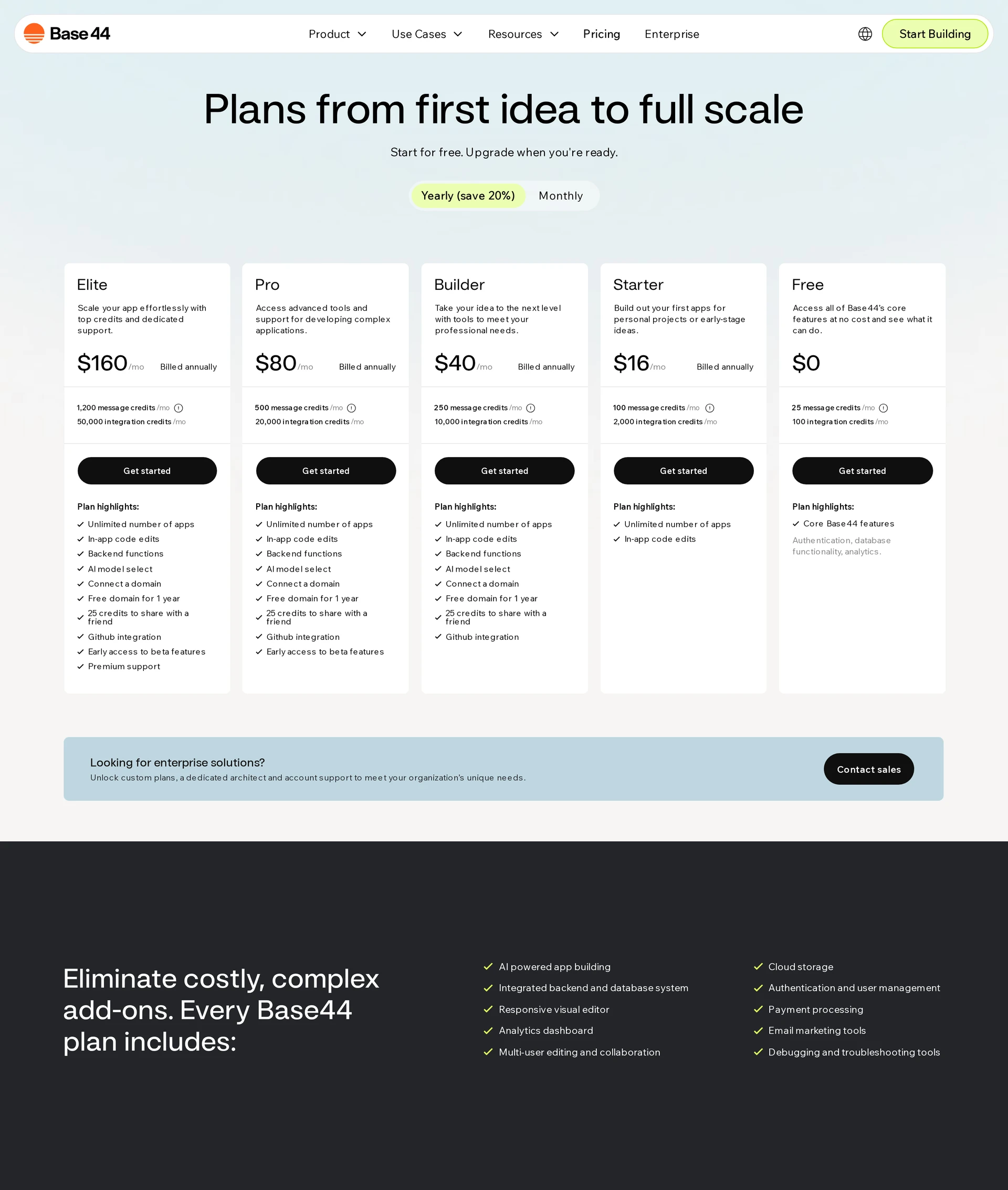
- Annual discount: Paid annual plans are roughly 20% lower than monthly billing.
- Extra credits: Budget for a plan upgrade before counting on modular credit packs.
Base44 rollover is the billing detail I would verify before assuming unused credits carry forward.
Lovable pricing
Lovable’s Pro plan starts at $25/month with 100 monthly credits. Paid monthly credits can roll over, but they expire two months after issuance.
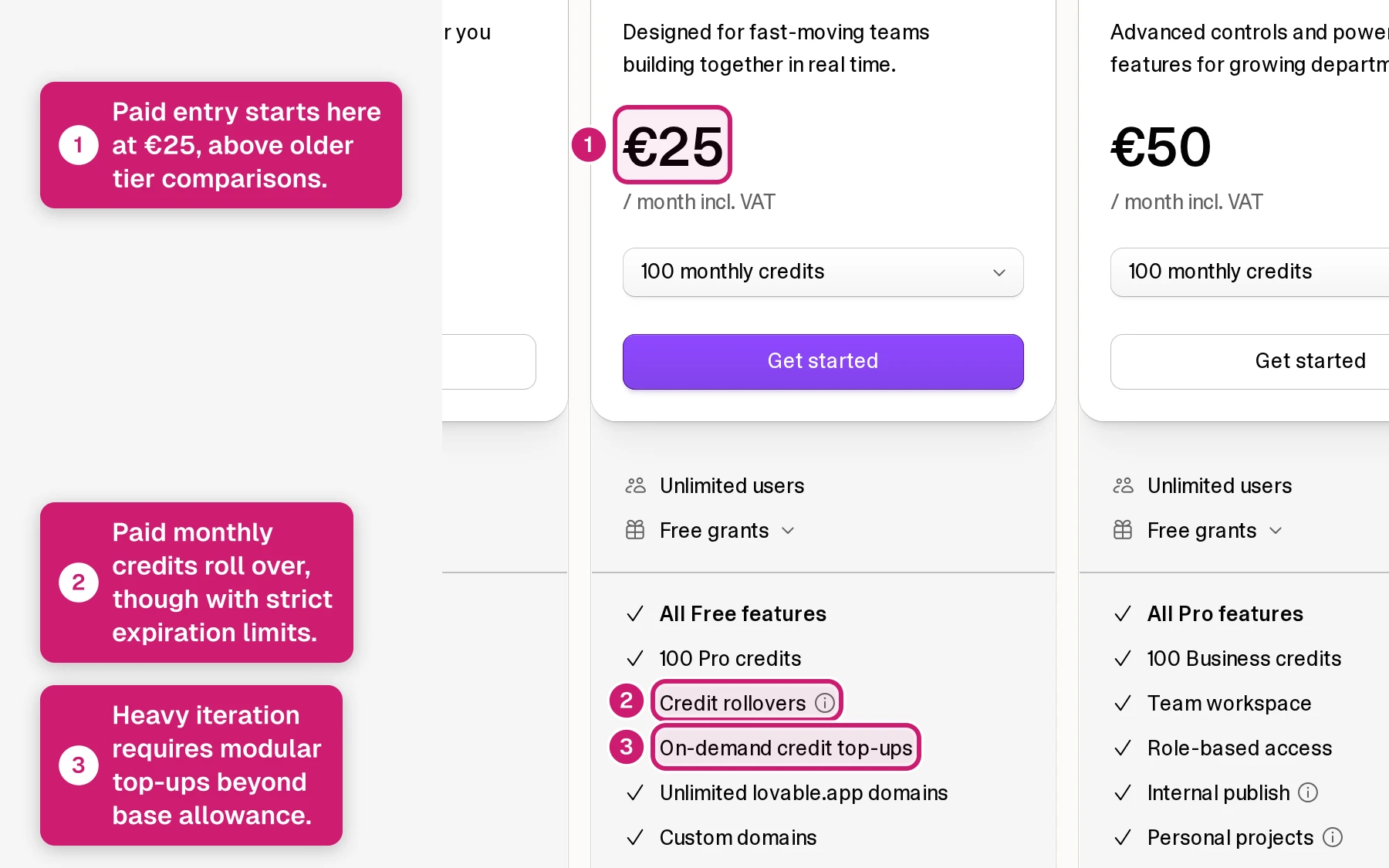
| Plan | Monthly | Included credits | Pricing note |
|---|---|---|---|
| Free | $0 | 5 daily, up to 30 monthly | Free grants |
| Pro | $25/mo | 100 monthly | Rollover and top-ups |
| Business | $50/mo | 100 monthly | Advanced team controls |
| Enterprise | Custom | Volume based | Custom controls |
What matters in Lovable's pricing:
- Paid credits roll over: Unused monthly credits on paid Lovable plans carry forward, which makes uneven build schedules less punishing.
- Starting price: Lovable’s first paid plan starts at $25/month, so older $20/month comparisons should be ignored.
- Top-ups: Treat credit bundles as a checkout detail, because outdated bundle prices can make a build look cheaper than it is.
- Top-up planning: Confirm the expiration window before buying extra credits, especially if your build pace is uneven.
Active iteration can change the bill quickly. A landing page can cost 2 credits, a small style edit can cost 0.5 credits, and a polishing loop can run 6-10 credits.
What actually drives your bill
Three things move the bill: prompt volume, automated actions, and production features gated behind higher plans.
- Base44 message credits: The free tier includes 5 message credits per day, up to 25 per month, so a prompt-heavy week can use the monthly allowance early.
- Base44 integration actions: Automated emails, form submissions, and API calls draw from the monthly integration pool.
- Lovable weighted credits: A landing page with images costs 2 credits, while a small button color change costs 0.5 credits.
- Lovable bug retries: The Try to fix button does not use credits, which makes failed bug-fix attempts less punishing.
Feature gating can force an upgrade even when your credit usage looks reasonable.
- Base44 Builder features: Custom domains, private projects, and GitHub export sit behind Builder at $50/month, or $40/month annually.
- Base44 export planning: Builder gives codebase and backend function export, but your team still has to set up hosting and data handling outside Base44.
- Lovable refinement volume: Small edits can be cheap, but full generations and repeated redesigns still consume the monthly balance.
- Lovable rollover: Paid monthly credits roll over, so the bigger risk is burning credits through repeated full regenerations.
Native output changes the budget; the native-app Bilt pricing page shows free and paid tiers.
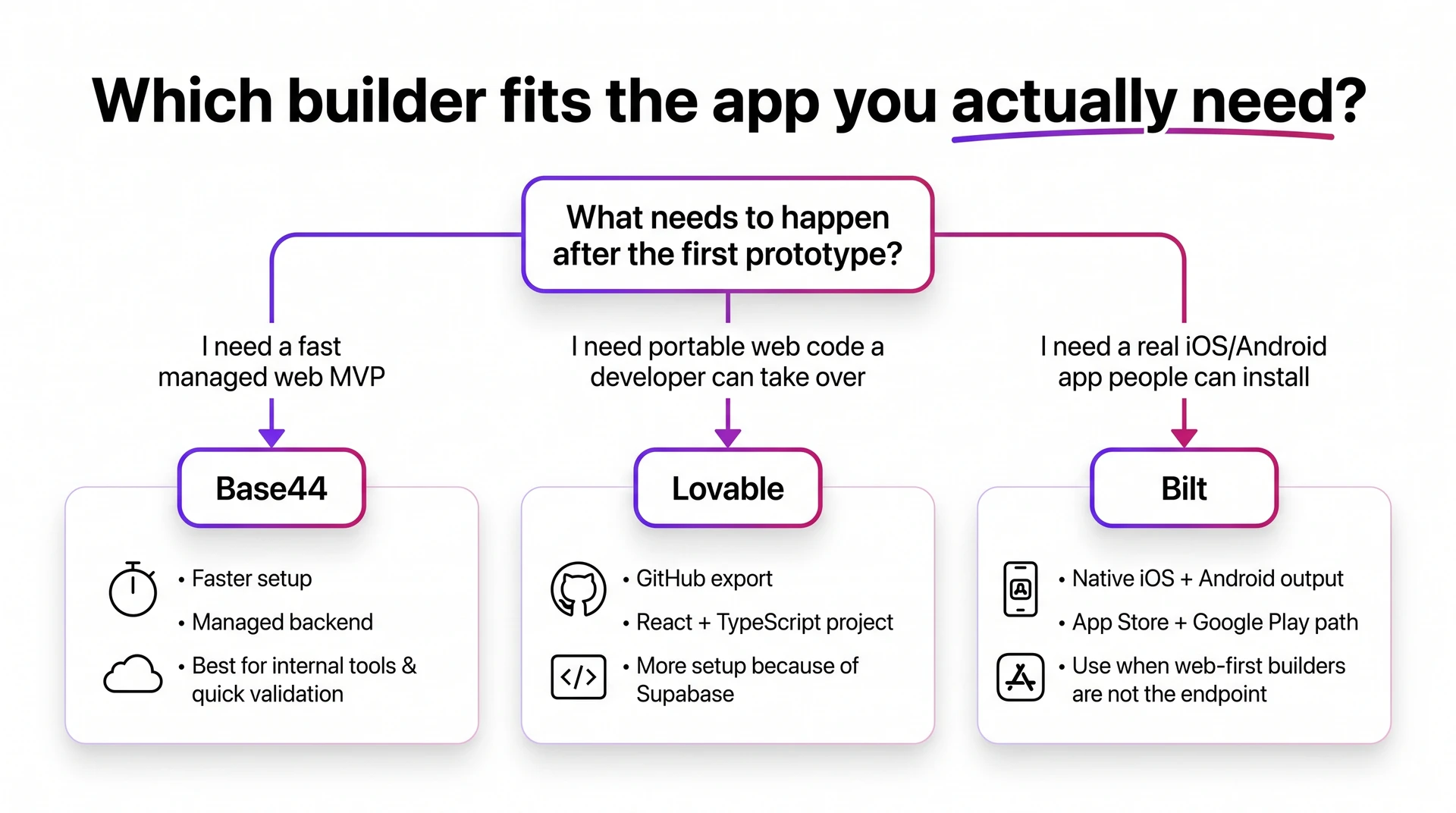
Which one fits your project?
Start with the app you need at handoff, not the demo you can make fastest.
Base44 is cleaner for a managed web prototype. Lovable makes more sense when someone may need to inspect, edit, and host the code later.
For native iOS or Android, treat both as prototype tools, because the finished app still needs a native build path.
Base44: the managed prototype lane
Base44 fits when your team wants a hosted web app and accepts that production will mostly live inside Base44.
- You need a working web app quickly. Base44 handles app structure, backend, auth, and hosting inside the platform.
- You are building an internal tool. CRM-style workflows, forms, dashboards, and simple process apps fit better than public software with complex scale needs.
- You are validating a concept. Base44 can test an idea, workflow, or data model before you spend developer time on a full build.
- You want fewer setup decisions. The managed environment keeps early configuration light, which helps non-technical teams move faster.
The boundary I would check before paying:
- The app can remain hosted and operated in Base44.
- Builder export gives developers app files and backend function files. It does not move the live app to new hosting for you.
- Prompting and integration actions can push a validation project into a paid tier sooner than expected.
- Native mobile output is outside the fit.
Lovable: the code handoff lane
Lovable fits when the web app has to become developer-maintained after the first version.
The relevant questions are less about speed and more about handoff:
- Code ownership: Exported project files give a developer something to open, review, and change in normal web development tools.
- Developer handoff: A contractor can continue from the generated project when the structure is clean enough to trust.
- UI control: Lovable gives more room to refine product screens before a user demo.
- SaaS MVPs: It makes more sense when custom flows, account logic, and product screens may keep evolving.
The catch is cleanup. Long prompt sessions can leave repeated files, unclear naming, and fragile flows that a developer has to untangle.
Lovable has a cleaner exit path, but I would still budget an engineering review before trusting customer data to the generated app.
A quick practical map
Use this map when the choice is less about features and more about the project you are trying to finish.
| Project priority | Base44 fit | Lovable fit |
|---|---|---|
| Fast first MVP | Managed setup | More UI control |
| Code ownership | Weak fit | Stronger export path |
| Non-technical setup | Fewer setup decisions | More configuration |
| Iteration budget | Watch credits | Watch message caps |
| Production handoff | Likely rebuild | Cleanup and refactor |
| Native mobile output | Not the endpoint | Not the endpoint |
When managed-web limits become the concern, a post-prototype Base44 alternatives list compares broader exit paths.
Teams that need App Store or Google Play distribution should validate the web prototype first, then move to a native-focused builder such as Bilt.
The lock-in question: what happens if your app succeeds?
Lock-in can cost time, customer data, and revenue when an app needs to move after users already rely on it.
Check the exit path before launch, especially if the app will hold customer records or paid workflows.
Check three pieces before you commit:
- Infrastructure control: Move hosting and deployment settings when needed.
- Code control: Give developers app files they can open, review, and change without starting from zero.
- Backend and data control: Change login rules, database behavior, and integrations without recreating the product blind.
With Base44
Base44 can export the complete codebase and backend functions. The lock-in risk shows up after export, when the live app has to run somewhere else.
For a non-technical founder, export means your developer receives the app files and backend function files.
A Base44 exit usually has five workstreams:
- Document the current screens, workflows, and data model.
- Export the codebase and backend functions from Base44.
- Set up hosting, environment variables, and database connections outside Base44.
- Reconnect login, file storage, and email sending.
- Retest user flows, permissions, and data writes before switching traffic.
The failure mode is half-migration. The app opens, but login rules, email sending, or data writes break under real users.
Base44 still makes sense for fast validation. I would get export tested before launch if the app will hold customer records or paid workflows.
With Lovable
Lovable’s export path is easier for a developer to understand because the project looks more like a standard web app.
For a founder, the practical difference is simple: a developer can open the project, see the screen files, and continue without rebuilding every workflow.
A Lovable handoff usually has cleanup work:
- Review screen files and navigation.
- Remove repeated or fragile code from prompt iterations.
- Audit login rules, permissions, and database rules.
- Move API keys and private settings into team-owned tools.
- Run tests before relying on production usage.
Long prompt sessions can leave duplicate code and dead screens. Confusing state logic still needs developer time before production.
My take: Lovable lowers migration risk more than Base44, but neither platform removes the need for a developer review before production.
What about building a real native app?
Base44 and Lovable make sense when you need a quick web app, landing-page prototype, or internal tool you can open in a browser.
The tradeoff shows up when the app needs to live on someone's iPhone or Android home screen. Web-first builders do not hand you a store-ready mobile release.
Where the store-ready gap shows up
The prototype can look finished in Base44 or Lovable, then fail the simple question buyers care about: can someone download it from the App Store or Google Play?
Lovable gives you more control over the web app than Base44. The store release step remains separate before people can install the app.
Closing that gap usually takes extra packaging work before Apple or Google can review the app. The work can also change how the app performs on a phone.
What a native mobile release actually needs
A native release needs more than responsive screens. The app has to pass the checks Apple and Google use before people can install it.
For a non-technical builder, the checklist is practical:
- Installable app files: the iOS and Android files Apple and Google can review.
- Code signing: proof that your Apple and Google accounts are allowed to release the app.
- Store assets and metadata: icons, screenshots, descriptions, privacy details, and category information.
- Submission workflows: the App Store Connect and Google Play Console steps for review, fixes, and release.
- Mobile app behavior: login, payments, file storage, notifications, and app data that keep working on phones.
- Real-device testing: checks on iPhones and Android phones, instead of only a browser preview.
A browser prototype can prove the idea, but friends and customers need a published app they can download from the App Store or Google Play.
Bilt lets you describe your idea and get a real native app for both iOS and Android, without hiring a developer for the first build.
Build and ship a real native app today with Bilt
Bring the screens and workflows your web prototype already proved. Bilt turns that product plan into a mobile build prepared for store publishing.
Describe an app and watch Bilt build a native app in live preview.
The goal has changed: you need an app people can install from the App Store or Google Play.
Bilt handles the app structure and backend. Publishing support covers the App Store and Google Play.
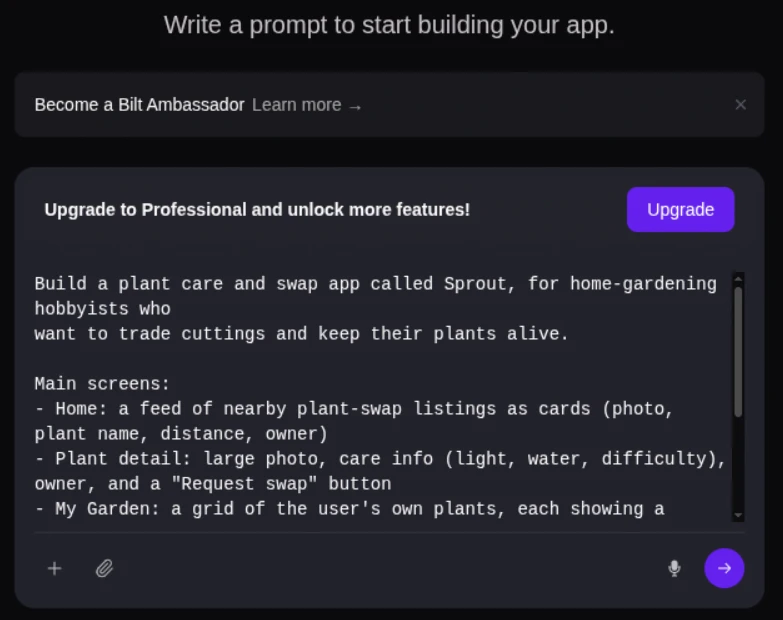
- Native output: Bilt generates React Native mobile app code, rather than browser apps wrapped for phones.
- Full app build: Bilt creates the screens and behind-the-scenes pieces for login, data, files, and user accounts.
- Publishing support: Bilt handles native builds and code signing, uploads iOS builds to App Store Connect, and can send Android builds to Google Play’s internal testing track.
The prototype already did its job. Now build the version people can keep on their phones.
Start with Bilt if you want a native app people can download and keep using, with Bilt handling the native builds, signing, and store uploads.
Start building free at Bilt.
Free to start. No credit card.
Do Base44 or Lovable offer free plans?
Yes. Base44 and Lovable both have free plans, but the limits show up quickly once you start iterating.
The $0 label matters less than the usage rules:
| Plan detail | Base44 free tier | Lovable free tier |
|---|---|---|
| Monthly cost | $0 | $0 |
| Daily message or credit limit | 5 messages per day | 5 messages per day |
| Monthly cap | 25 messages per month | Up to 30 build credits per month |
| Bug-fix attempts | Not specified | “Try to fix” costs 0 credits |
| Advanced integrations | Requires paid plan | Requires paid plan |
| Collaboration features | Requires paid plan | Requires paid plan |
My take: Base44’s free tier is the cleaner sanity check for a non-technical founder. Lovable’s free tier is better for seeing how fast iteration consumes credits.
Which is better for beginners?
For beginners, Base44 is easier because backend setup stays inside a managed workflow.
Lovable asks more from you earlier:
- Supabase setup
- Schema choices
- API keys
- Developer handoff decisions
That complexity is worth it when code ownership matters. For teams, the harder question is who needs access and control.
Which platform works better for teams?
Lovable fits larger teams better when governance and handoff matter. Base44 fits smaller teams that want one managed workflow with fewer infrastructure decisions.
I would make the call this way:
- Lovable: Better when governance is a requirement, especially SSO/SAML or audit logs.
- Base44: Better when the team wants a managed backend and app workflow automation without owning external infrastructure.
Costs get messy when usage and seats both grow. Before comparing plan names, map who builds and who needs admin control.
Bolt appears below as a speed benchmark for browser-based web prototypes, rather than a third ownership model.
How does Bolt fit in compared to these two?
Bolt belongs here as context only: a fast browser-based AI builder for web app prototypes. A full three-way shortlist needs fresh Bolt research.
Use Bolt as a speed benchmark for quick MVPs or hackathon-style prototypes. For product planning, Base44 versus Lovable tells you more about ownership and operating model.