Base44 is a capable prototyping tool, but most builders hit the same wall: they get a convincing demo, then realize the mobile layer, backend control, and App Store path are still ahead of them.
This guide covers 10 alternatives across native mobile, web SaaS, no-code visual builders, and research-first platforms. If your goal is to ship a native iOS or Android app, Bilt is the top pick.
TL;DR: quick comparison
The best Base44 alternatives in 2026 are Bilt for native iOS and Android apps, Lovable and Replit for full-stack web apps, and Adalo or FlutterFlow for visual no-code builds.
- Best for native mobile apps: Bilt, Rork, or Blink. All three generate React Native code for iOS and Android. Note: App Store and Google Play publishing on Blink requires the Max plan ($200+/month); Starter and Pro plans cover app generation and code export.
- Best for web SaaS or internal tools: Lovable or Replit. Both support full-stack backends with Supabase or PostgreSQL and GitHub export.
- Best for visual no-code with zero coding: Adalo or FlutterFlow. Both offer drag-and-drop canvases and automated app store publishing without writing a line of code.
- Best for market research plus app building: Rocket. It's the only tool here that integrates competitor analysis and idea validation before generating an app.
Why look for a Base44 alternative?
Base44 is a fast prototyping tool, not a production platform. It generates web-view wrappers, not true native iOS or Android binaries, so any mobile presence means a PWA running inside a browser shell rather than a real App Store app.
The Builder plan, listed at $40/month with annual billing, is required for code export and GitHub integration (Base44 pricing page).
The export still is not portable. Database calls, authentication, and data handling remain tied to Base44's proprietary backend, so a true iOS or Android app requires replacing that backend layer.
Base44 lists two lower-priced tiers (Base44 pricing page):
- Free: 25 monthly message credits and 100 integration credits
- Starter: $16/month
| Pain point | Specific evidence |
|---|---|
| Credit burn | Users report exhausting monthly credits on bug-fix loops before shipping features. |
| Code lock-in | Database, auth, and backend are tied to Base44's proprietary stack. Exporting requires the Builder plan at $40/month billed annually. |
| Trust & stability | 2.2/5 on Trustpilot from 505 reviews, with recurring complaints about credit overages. |
| Wix acquisition | The June 2025 acquisition raises questions about pricing independence and platform direction. |
If any of those limitations apply, the next question is figuring out which category of alternative fits what you are building.
How we evaluated these tools
To rank these alternatives, the same three test apps went into each platform: a habit tracker, a booking app, and a client portal.
Each build was scored on four criteria:
- Native binary output
- App Store submission path
- Backend depth
- Credit predictability
What kind of app builder do you actually need?
The single biggest variable is output type: native mobile app or web app. Everything downstream flows from that one decision.
Native mobile app vs. web app
Native mobile builders like Rork, Vibecode, FlutterFlow, Adalo, Blink, and RapidNative produce iOS/Android binaries submitted to the App Store and Google Play. Web builders like Lovable, Bolt.new, and Replit produce browser-accessible apps with no store presence.
Some tools in this list label themselves mobile but deliver web-wrapped PWAs. Replit and Vibecode both support React Native but neither is optimized for native App Store publishing.
If your app needs push notifications, GPS, camera access, or App Store distribution, you need a true native builder. Blink, Vibecode, and RapidNative use Expo for managed App Store deployment, which handles much of the signing and submission complexity.
MVP prototype vs. production-ready app
Rork and Vibecode are built for MVPs and prototypes. Both hit walls when apps grow in backend complexity or sustained traffic.
FlutterFlow, Adalo, and Blink are rated adequate to strong for production use. Adalo has case studies showing 1M+ monthly active users, though user reports note performance degradation above 5,000 users.
Auth, payments, backend logic, and edge cases are where AI-generated code tends to break down. Factor in how far you need to go before picking a tool.
Code ownership and exit
Adalo has no code export. Apps built on Adalo stay in the Adalo ecosystem, so switching platforms means starting over.
Lovable (GitHub sync), Blink (full React Native source), RapidNative (NativeWind/TS/Expo Router), FlutterFlow (Flutter code), and Rocket (GitHub download) all export clean, standard code. If you plan to hand the project to a dev team or self-host later, prioritize tools that export React Native, Flutter, or Next.js rather than proprietary formats.
Backend complexity: database, auth, and integrations
Rork is limited to simple or local storage for prototypes. It has no explicit database, Supabase, or Stripe support on its primary feature pages.
FlutterFlow, Adalo, Lovable, Replit, and Blink all treat backend as a core strength. They include built-in databases (Postgres, Firebase, or Supabase), auth, REST APIs, and third-party integrations like Stripe and Zapier. If your app requires user accounts, subscription billing, or external service connections, eliminate any builder rated weak on backend before evaluating anything else.
Flat-rate vs. credit-based pricing
Rork, Vibecode, Lovable, Replit, Blink, and RapidNative all charge per prompt or per AI action. Heavy iteration sessions can exhaust credits faster than expected.
Adalo uses flat monthly pricing with no usage metering: Starter at $36/month, Professional at $52, Team at $160.
Credit-based pricing suits builders who plan carefully and work in focused sessions. Flat-rate suits teams who experiment frequently or cannot predict prompt volume.
| I need... | Best tools |
|---|---|
| True iOS/Android App Store app | Bilt, Rork, FlutterFlow, Adalo, Blink (Max), RapidNative |
| Web app or internal tool | Lovable, Replit |
| Visual drag-and-drop builder | Adalo, FlutterFlow |
| No credits / flat pricing | Adalo, FlutterFlow |
| Full code ownership | Bilt, Blink, Lovable, FlutterFlow, Rocket, Vibecode |
| Market research + app building | Rocket |
The 10 best Base44 alternatives
-
Bilt - AI chat builder for production-ready native iOS and Android apps with automated App Store deployment
-
Rork - natural language to native mobile apps with Apple-first AR and game support via Rork Max
-
Vibecode - prompt-based React Native builder using Claude for mobile and web apps with credit rollover
-
FlutterFlow - visual low-code Flutter builder with Figma imports and true cross-platform native output
-
Adalo - no-code visual builder with AI prototype generation and automated App Store publishing
-
Lovable - AI full-stack web app builder with Supabase backend, GitHub export, and one-click hosting
-
Replit - Agent 4 platform for conversational full-stack development across mobile and web in one repo
-
Rocket - vibe solutioning platform combining market research, competitor analysis, and Flutter app generation
-
Blink - YC-backed React Native builder with SQL database, code export, and one-click store publishing
-
RapidNative - multi-input React Native builder accepting text, images, sketches, and PRDs with real-time collaboration
Seven of the 10 tools here use credit-based pricing. Rocket's higher tiers cost $250 to $350 per month, while Rork's listed plans extend to $1,800 per month.
FlutterFlow and Adalo use flat monthly subscriptions instead of charging per generation. FlutterFlow still caps monthly AI requests by plan, while Adalo does not meter Ada-assisted iterations by action.
| Tool | Primary output | Publishing path |
|---|---|---|
| Bilt | Native iOS and Android with React Native | Guided App Store and Google Play publishing |
| Rork | Native iOS with React Native and Expo | iOS and TestFlight from the platform; Google Play requires manual export |
| Vibecode | React Native and Expo for iOS and Android | Real mobile output, with a less guided store-publishing workflow |
| FlutterFlow | Native iOS, Android, web, and desktop with Flutter | App Store and Google Play deployment tools |
| Adalo | Native iOS and Android, plus web | Automated App Store and Google Play publishing |
| Lovable | Web apps | No native app-store output |
| Replit | Web apps, with React Native support through Expo | Mobile publishing requires more technical setup |
| Rocket | Native mobile apps with Flutter | External store-submission steps |
| Blink | React Native mobile apps, plus web | Max plan required for App Store and Google Play publishing |
| RapidNative | Native iOS and Android with React Native and Expo | Designed for prototype, export, and developer handoff |
Bilt is the one purpose-built for native iOS and Android only. It is not a web app builder. Founders who need a web-first or full-stack web product should look at Lovable or Replit instead.
1. Bilt
Bilt is an AI mobile app builder for creating and publishing real native apps on iOS and Android. Describe your idea in plain English, and Bilt builds the app, lets you refine it through conversation, and handles the app-store steps that usually slow non-technical builders down.
No code needed. No developer handoff just to get started. You can start free, preview the app on your phone, and move toward publishing without learning App Store setup.
Best for
Non-technical founders, vibecoders, and web app owners who want a real mobile app on both iOS and Android.
The build process is simple:
- Tell Bilt what your app should do: screens, features, users, and the basic flow.
- Bilt builds a working React Native app you can preview on your phone.
- When you're ready, Bilt handles code signing, App Store submission, and Google Play upload.
Where it beats Base44
Real native apps for iOS and Android
Base44 stops at web-wrapped mobile output. Bilt builds a real React Native app that works on both iOS and Android.
App-store setup handled for you
Bilt handles code signing, provisioning profiles, store compliance, App Store submission, and Google Play upload.
Help from real engineers
Bilt engineers fix bugs directly in projects and respond live on Discord, with most issues resolved within the hour, so you are not stuck waiting in a slow ticket queue.
In a simple habit-tracker test, one prompt produced a working React Native preview ready for phone testing in under 10 minutes.
The bigger difference shows up when the app gets past the first demo. Bilt uses its own mobile-focused agent, offers in-browser native Simulator streaming, and supports paywall testing with RevenueCat and Apple Review instead of leaving those steps to the builder.
Bilt is not for every project. Skip it if you are:
- Building a web dashboard or internal tool
- Trying to keep one shared web and mobile codebase
- Looking for a drag-and-drop visual canvas
Pricing
Bilt starts free with 3M tokens, enough for about 12-30 prompts to explore your idea and build the first version.
Paid plans unlock the pieces you need to publish and earn from a real app: production builds, App Store submission, Google Play upload, and priority support.
- Professional ($25/month): 10M tokens, about 40-100 prompts
- Professional Plus ($50/month): 20M tokens, about 80-200 prompts
Enterprise pricing is available for larger teams. Annual billing saves 2 months on paid plans.
Apple charges $99/year for a Developer Account to publish on the App Store. That fee goes to Apple, not Bilt.
Start building free. Describe your app idea and get a real native iOS and Android app moving today.
Builders who switch from web-first tools often say some version of, "It got me a demo, but not something I could actually ship." Bilt is for turning that early idea into a scalable mobile app business, not another web prototype.
2. Rork
Rork focuses on one lane: Apple. It turns natural language prompts into native iOS apps, with Rork Max unlocking ARKit, SceneKit, and Vision Pro targets that no other tool in this list touches.
Best for
Rork is best for non-technical entrepreneurs and vibecoders building Apple-centric prototypes, games, or MVPs who need fast device testing and straightforward App Store deployment.
Rork Max targets advanced Apple-ecosystem apps that go well beyond a standard prototype. Supported targets include:
- Apple Watch, Apple TV, and Vision Pro
- AR and 3D games at 60fps via ARKit and SceneKit
- On-device AI, Siri integration, and HealthKit
Rork also includes a UGC Marketing Academy with TikTok viral distribution strategies for app creators who want help growing after launch.
Where it beats Base44
Base44 has no Apple Watch, Vision Pro, or ARKit support. Rork Max covers all three natively.
Rork handles iOS App Store and TestFlight publishing from the chat interface. Google Play publishing currently requires a manual export via GitHub and EAS — Rork's docs list this as coming soon.
Rork Max goes further with ARKit and SceneKit-based apps, including 60fps 3D games and Vision Pro experiences. No other tool in this list lists ARKit, SceneKit, or Vision Pro support.
When we tested a simple AR product-viewer app prompt, Rork Max returned a SceneKit-powered preview in about 12 minutes. The preview worked on device, but adding a database layer still required a developer handoff.
Compared with Bilt, the missing pieces are native Simulator preview in the browser and hands-on engineering support during the mobile build.
Pricing
Rork uses a monthly credit model with plans from free to $1,800/month. Credits reset monthly and burn at roughly 9-10% per prompt.
| Plan | Price/mo | Credits/mo | Notes |
|---|---|---|---|
| Free | $0 | 35 total (5/day) | Limited daily usage |
| Junior | $25 | 100 | Entry paid tier |
| Middle | $50 | 250 | Mid-range usage |
| Senior | $100 | 500 | Higher volume |
| Scale 10K | $1,800 | 10,000 | High-volume teams |
Pro tip: Rork credits burn at roughly 9-10% per prompt. On the $25/month Junior plan, that is about 10 iterations before you hit the ceiling. Plan your build sessions in advance, or upgrade to the $50 Middle plan if you expect more than one focused work session per week.
Key tradeoff
Build a slick Apple-native UI in Rork and it shines. Add a SQL database or Stripe integration and it falls apart.
Users report failures with custom logic and heavy backend requirements. Reviews describe Rork output as "tutorial-level apps" that crash under production load, with no explicit Supabase or Stripe support.
3. Vibecode
Some Base44 builders land on Vibecode once they hit the mobile wall. It uses Claude to generate React Native apps with built-in databases, auth, and app store submission, shipping to real phones where Base44 stops at prototypes.
Best for
Solopreneurs, indie hackers, and vibecoders building mobile or web app prototypes without managing backend setup.
Vibecode handles fitness trackers, simple mobile tools, and lightweight web apps. Users who want code access can export the source and open it in Cursor or another editor.
Where it beats Base44
The credit rollover alone separates Vibecode from Base44. Unused credits carry forward; on Base44 they expire.
Vibecode generates true React Native/Expo code for both iOS and Android. Base44 packages mobile apps as IPA/AAB web-view wrappers, while Vibecode outputs real React Native code for better device performance.
Bilt's hands-on edge is the full mobile lifecycle around the generated app: sharing builds, collecting user analytics and feedback, and getting support when native details get messy.
Pricing
Vibecode uses a $1-per-credit model with rollover credits. Plus is $20/month for 20 credits, Pro is $50/month for 55 credits, and Max is $200/month for 220 credits.
Key tradeoff
A common pattern is a clean prototype in the first 4-6 weeks. By month 2, added screens and edge cases can produce conflicting logic.
Vibecode's React Native and Expo output is a real cross-platform mobile app, not a web wrapper. The tradeoff is workflow depth: FlutterFlow offers more visual control, Adalo simplifies no-code publishing, and Bilt adds guided publishing plus mobile lifecycle support.
4. FlutterFlow
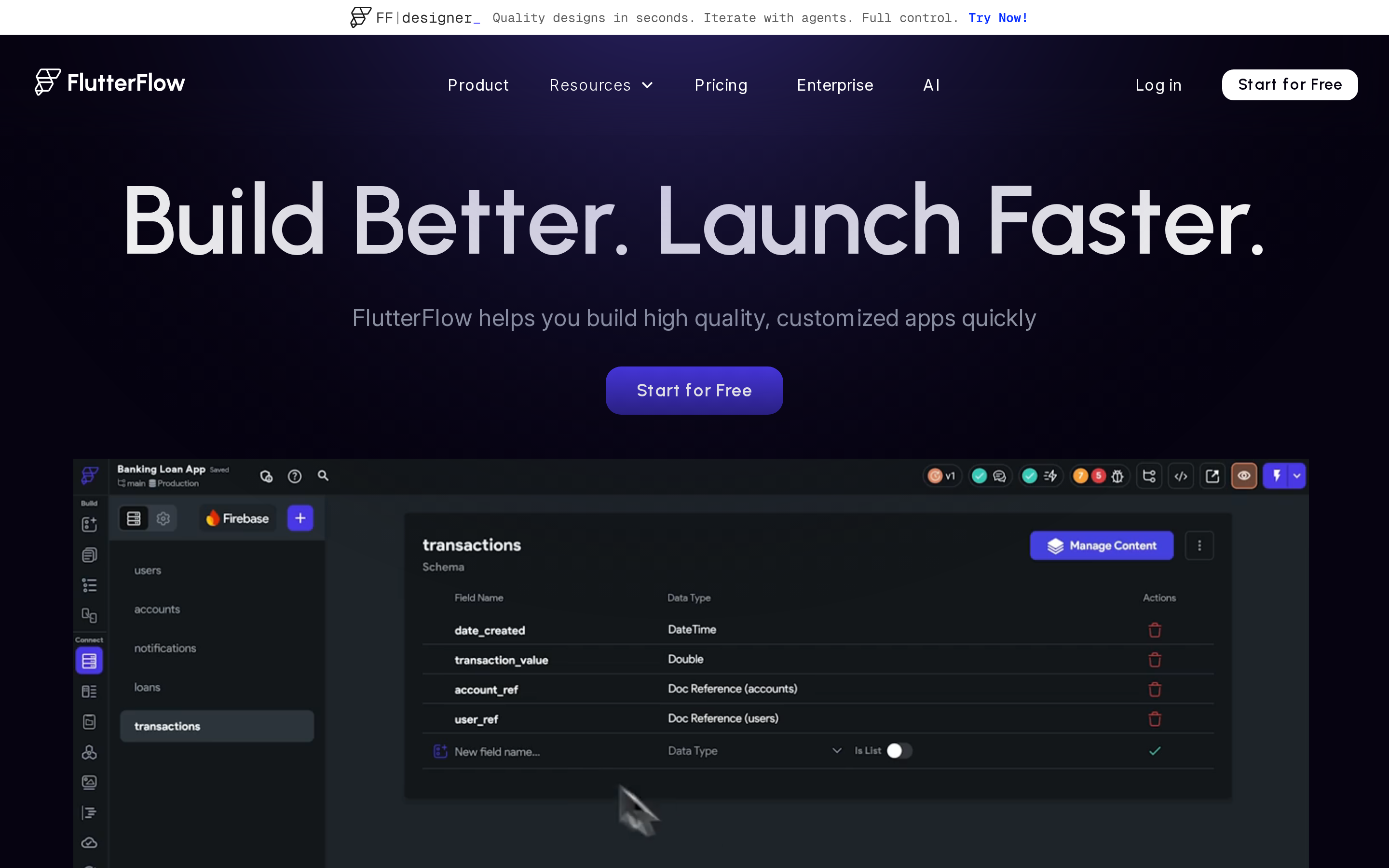
FlutterFlow builds native iOS, Android, and web apps on a visual low-code canvas using Flutter, with drag-and-drop design and AI-assisted UI generation.
Best for
- Design-led teams: Figma import means no rebuild from scratch.
- Multi-platform builders: one codebase, four targets — iOS, Android, web, desktop.
- Code-ownership required: full Flutter export, no lock-in.
FlutterFlow is also a strong fit for small teams that want visual iteration speed without giving up the ability to hand off clean code.
Where it beats Base44
Designers can import Figma files directly. Base44 has no design handoff path.
A Figma-to-working-app test with a 5-screen design file took under 20 minutes to import and generate a deployable build.
FlutterFlow's drag-and-drop canvas includes 200+ widgets alongside AI prompts, letting you visually iterate on layouts instead of regenerating from a chat window. Figma-to-component import lets design teams hand off pixel-perfect mockups directly into a live app.
Compared with Bilt, FlutterFlow gives more visual control, while Bilt covers more of the mobile lifecycle around the app: app sharing, user analytics, feedback, and support after the first build.
- Code export: clean Flutter code that opens in VS Code or Android Studio, with full ownership and no vendor lock-in
- Cross-platform reach: a single codebase targets iOS, Android, web, and desktop
- Native deployment: one-click App Store and Google Play submission with push notifications and haptics built in
Pricing
FlutterFlow has a free tier. Paid plans start at $39/month on monthly billing ($29.25/month billed annually). AI request limits are 50/month on Basic, 200/month on Growth, and 500/month on Business.
Entry-level alternatives like Blink ($25/mo Starter) and RapidNative ($20/mo) cost less upfront, but their credit-based models escalate quickly with heavy iteration. Annual billing on FlutterFlow saves roughly 25% across all paid tiers.
| Plan | Price (monthly) | Price (annual) | AI Requests/mo |
|---|---|---|---|
| Free | $0 | $0 | 5 (lifetime cap) |
| Basic | $39/mo | $29.25/mo | 50/mo |
| Growth | $70/mo | $56/mo | 200/mo |
| Business | $70/user/mo | $56/user/mo | 500/mo |
Key tradeoff
Expect a learning curve. The visual canvas offers detailed control, but DreamFlow is still in beta. If you want a different workflow, compare these FlutterFlow alternatives.
Based on user reviews on G2 and Reddit, FlutterFlow's AI generation is generally rated below pure chat tools like Rork, Blink, and Lovable for first-pass code quality. Users who want to skip the visual canvas entirely don't have a stable shortcut while DreamFlow remains in beta.
FlutterFlow's Trustpilot score is 2.5, versus a G2 score of 4.5. Users report support response times of 3-7 days and consistent pricing complaints.
5. Adalo
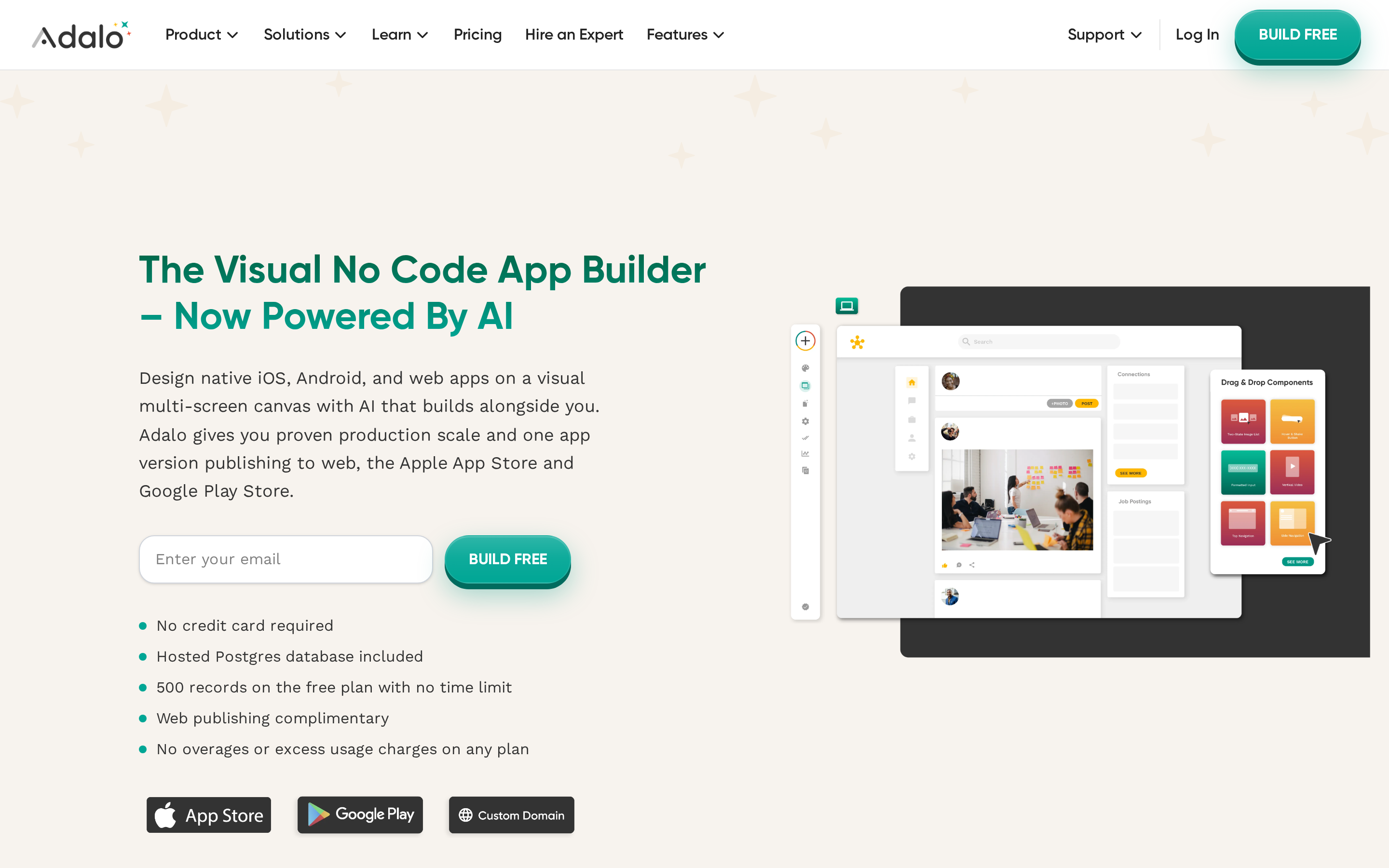
Adalo's no-code visual builder uses Ada to turn natural language prompts into native iOS and Android apps, plus web apps with a built-in Postgres database.
Best for
Adalo is best for non-technical founders building database-driven apps like marketplaces or booking systems that need visual multi-screen design and native app store publishing.
HomeQuest, a property-search app built entirely in Adalo by a non-technical founder, reached $200k ARR within 3 weeks of launch. The founder described the screens, wired up listings data in Adalo's visual editor, and published to the App Store that same week.
Adalo 3.0 scales to 1M+ monthly active users and 20 million daily requests, based on published case studies.
Adalo's built-in Postgres database supports unlimited records on paid plans, making it a good fit for apps with relational data like user profiles, listings, and bookings. The AI assistant Ada generates screens, database schema, logic, and auth from a single prompt in roughly 2 minutes.
Where it beats Base44
Base44 charges per AI action. Adalo charges a flat monthly fee regardless of how much you iterate.
Adalo generates true native IPA (iOS) and AAB (Android) binaries with automated App Store and Google Play submissions. Built-in features include geolocation, push notifications, and Stripe payments.
Bilt goes further on lifecycle support after the build, including app sharing, user analytics, feedback, and help with the native app-store path.
The editor works like PowerPoint: you place screens spatially, connect them visually, and refine with point-and-edit Magic Add or text prompts.
Adalo includes built-in Postgres with unlimited records on paid plans, plus Zapier (5,000+ zaps), Airtable, Google Sheets, Xano, REST, and Make integrations. Higher plans add RBAC and SSO for enterprise-grade access control.
When we tested a booking app prompt with user profiles and appointment scheduling, Ada returned a working multi-screen prototype in roughly 3 minutes. The prototype used Adalo's built-in Postgres database from the start.
Pricing
Adalo uses flat monthly pricing with no usage credits: Free (no publishing), Starter $36/mo, Professional $52/mo, and Team $160/mo, with 20% annual discount.
Most tools in this article charge per AI action: Rork ($25-$1,800/mo), Blink ($25-$200+/mo), RapidNative ($20-$49/mo), and Lovable (~$25-$50/mo) all use credit-based billing. Adalo's flat model includes Ada-assisted iterations at no extra cost per action, so there's no credit-burn risk when you're iterating heavily.
| Plan | Price (monthly) | Apps included | Key limit |
|---|---|---|---|
| Free | $0 | 1 (no publish) | Cannot publish to App Store/Google Play |
| Starter | $36/mo | 1 app | Basic features, no SSO/RBAC |
| Professional | $52/mo | 2 apps | Full features, no team management |
| Team | $160/mo | 5 apps | Multi-editor, RBAC/SSO |
| Extra app add-on | +$25/app | Per app | Add beyond plan limit |
| Extra editor add-on | +$15/editor | Per seat | Add collaborators |
Key tradeoff
Everything you build in Adalo stays in Adalo. If code ownership matters, compare Adalo alternatives that support code export.
- No code export on any plan — all logic, data, and screens stay inside Adalo
- Blink and RapidNative export full React Native source; FlutterFlow exports Flutter to VS Code or Android Studio
Performance degrades above roughly 5,000 concurrent users, despite the 1M+ MAU headline. That stat measures total user base, not simultaneous load. Adalo's Trustpilot score is 3.3, with recurring complaints about bugs and slowdowns at higher loads.
6. Lovable
Lovable generates editable React code with Supabase as the backend. Projects sync to GitHub and deploy with one-click hosting.
It is best suited to web apps, not native mobile apps.
Best for
Lovable is the go-to for solo founders who want a working web app fast, without wiring up a backend from scratch. Its library of 20+ example apps (AI CRMs, landing pages, internal tools) gives non-technical builders a running start.
A solo founder building a client-facing booking portal with a Supabase backend, for instance, can go from blank canvas to a deployed URL in an afternoon.
Where it beats Base44
Base44 locks you into a proprietary database with no export path. Lovable gives you GitHub sync, a portable Supabase backend, and full code export at any time.
Every Lovable project syncs directly to a GitHub repository, giving full version control and an exit path with a complete, standard codebase. Any developer can open and modify the exported React code without platform-specific knowledge.
The Supabase backend includes PostgreSQL, auth, real-time subscriptions, and file storage out of the box. Integrations extend to Jira, Notion, Linear, n8n, and CRMs, with SOC2, SSO, and RBAC available on higher plans.
When we tested a client-facing booking portal prompt with Supabase auth and Stripe payments, Lovable returned a deployed URL in under 30 minutes. The full React codebase synced to GitHub automatically.
For a fuller side-by-side on export, backend setup, and pricing, see the Base44 vs Lovable breakdown.
Pricing
Lovable uses a credit-based model: Free (limited), Pro around $25/month for 100-150 credits, Business/Teams around $50/month, and Enterprise on custom pricing.
Credits run out faster than the pricing page suggests. User reviews in 2026 describe opaque billing and credits consumed by bug-fix loops rather than productive builds.
| Plan | Price | Credits/Month | Notes |
|---|---|---|---|
| Free | $0 | Limited (5/day) | Basic access, credits expire |
| Pro | ~$25/mo | 100-150 | Student discount at $12.50/mo |
| Business/Teams | ~$50/mo | Varies | Team workspaces, collaboration |
| Enterprise | Custom | Custom | SOC2, SSO, RBAC included |
Key tradeoff
Lovable handles sophisticated UI and basic backend logic well, but complex business rules, intricate data relationships, and heavy external integrations push it past its limits.
Watch out for credits disappearing on bug-fix loops. Users consistently report spending 20-30% of their monthly credits on AI re-attempts rather than new features.
Lovable stops at the browser. If your idea needs to live in someone's pocket, on the App Store and on real phones, Bilt is the path from idea to published native app with native components, simulator preview, and engineering support.
7. Replit
What started as a cloud IDE, Replit has grown into an AI app builder that runs entirely in the browser. Describe what you want, the agent builds it, and there's no local setup required.
Best for
Replit is best for full-stack web apps and automation agents. It technically supports React Native via Expo, but production-ready mobile specifics like native device APIs, App Store compliance, code signing, push notifications, payments, auth, and scalable backend logic make dedicated mobile builders a safer fit.
Replit Agent 4 uses parallel multi-agents and task sequencing for autonomous iteration. Web dashboards, data visualizations, games, and automation agents all live in the same cloud environment.
Dev-comfortable users get significantly more out of it than pure no-coders. Replit generates exportable TypeScript code, which makes developer handoff straightforward.
Where it beats Base44
Base44 is web-only. Replit covers web, native mobile, games, and automation, and all of it lives in one repo.
When we tested a web dashboard prompt, Replit Agent 4 built a functional TypeScript app with a PostgreSQL backend in about 15 minutes. A poorly worded follow-up prompt then triggered a credit-draining agent loop that required manual intervention.
Replit Agent 4 builds, tests, and fixes apps autonomously using task sequencing and parallel multi-agents, with an Infinite Canvas for visual orchestration.
The built-in stack covers:
- Database: Lakebase/PostgreSQL
- Auth, storage, APIs, payments, and SMS — all shared across mobile and web
- Community: 40M+ creators (per Replit's about page)
Pricing
Replit uses a credit-based model. Core is $25/month ($20/month billed annually) with $25 in monthly credits. Pro is $100/month ($95/month billed annually) with $100 in monthly credits.
Credits burn quickly on iterative or poorly structured prompts. Flat-rate tools like Adalo ($36-160/month, unlimited AI) offer more predictable costs for builders who iterate frequently.
| Plan | Price (monthly) | Price (annual) | Credits included |
|---|---|---|---|
| Core | $25/mo | $20/mo | $25 in monthly credits |
| Pro | $100/mo | $95/mo | $100 in monthly credits |
Key tradeoff
Agent loops are the main frustration. Complex or poorly phrased prompts cause credit drain and stuck states. Minor phrasing changes can produce completely different results, which amplifies on large or complex projects.
For pure no-code mobile building, Adalo or FlutterFlow are more reliable. Replit suits dev-comfortable builders who want conversational full-stack control and can tolerate the occasional agent loop, while Bilt is built for the full mobile lifecycle with owned React Native code and less mobile lock-in.
Replit gives developer-comfortable builders broad full-stack control, but mobile publishing takes more setup than a dedicated mobile workflow. See our Base44 and Replit comparison for a hands-on look at both tools.
8. Rocket
Rocket calls itself a "vibe solutioning" platform. In practice, it combines pre-build market research, Flutter-based native app generation, and post-build competitor monitoring in one workflow.
Best for
Rocket is best for solo founders and product teams who want market research, competitor intelligence, and native app generation in a single platform.
Rocket's workflow runs market research and competitor analysis before generating the app, so founders validate ideas without switching tools. Over 25k+ templates cover a wide range of app categories, reducing ideation time for teams without a design background.
Rocket holds SOC2 and ISO certifications and supports SSO and RBAC, making it one of the few AI builders here with enterprise-grade security built alongside app generation.
Where it beats Base44
- Solve mode researches first. Rocket runs market research and competitor analysis before app generation starts.
- The build uses that context automatically. Rocket passes the research into the app generation prompt, so the output reflects the market work already done.
- Monitoring continues after launch. Rocket keeps tracking competitor activity post-launch, so teams do not need a separate tool for ongoing market watching.
Pricing
Rocket uses a credit-based model:
- Free: 20 one-time credits
- Build: $25/month for 100 monthly credits
- Solve+Build: $250/month for 1,000 monthly credits
- Solve+Build+Intelligence: $350/month for 1,500 monthly credits
- Enterprise: Custom pricing
That puts Rocket at the same entry price as Rork and Blink ($25/month), and above RapidNative at $20/month.
The bigger cost question is credit visibility. Users still report that Rocket does not make action-level credit usage clear before a run starts.
Key tradeoff
Rocket's main tradeoff is premium pricing, unclear action-level credit use, and generated backends that can become difficult to scale. Builders facing those limits can compare Rocket alternatives for more predictable pricing or backend control.
Reddit users report AI-generated backends become messy and unscalable for complex apps, placing Rocket best for viral MVPs.
FlutterFlow (Firebase/Supabase auto-setup) or Adalo (1M+ MAU documented) are stronger when backend architecture matters.
For budget-conscious builders, Blink ($25/month) or RapidNative ($20/month) offer similar native mobile output at lower cost.
9. Blink
Backed by YC, Blink generates React Native mobile apps, web apps, and SaaS products from natural language chat, complete with SQL databases and one-click store publishing.
Best for
Blink is best for vibecoders and developers building cross-platform MVPs with backend needs who want code ownership, fast iteration, and direct app store publishing.
Blink covers React Native mobile apps, web apps, and SaaS templates from a single chat interface, supporting cross-platform MVPs without separate toolchains. 50+ premium templates including VibeShop cover common SaaS and consumer app patterns, reducing time-to-MVP for non-developers.
Blink exports 100% of source code (React Native) with no lock-in, making it a good fit for builders who plan to hand code to developers or continue in their own environment. Unlike Adalo, which keeps apps locked in its ecosystem with no code export, Blink gives full source access on all paid plans.
Where it beats Base44
Blink publishes directly to TestFlight in one click. App Store and Google Play publishing require the Max plan or above, with RevenueCat for in-app purchases, push notifications, and haptics included.
The backend includes a SQL database with visual editor and migrations, authentication (Google, Apple, email), edge functions, and Stripe webhooks out of the box. Blink integrates natively with Firebase, Supabase, and RevenueCat, covering the most common stacks for consumer and SaaS mobile apps.
Blink's AI agents self-correct bugs during generation and pull from 200+ AI models, reducing the stuck loops that are a common complaint with tools like Replit Agent.
Compared with Bilt, Blink still leaves more of the native preview and engineering-support experience outside the browser-based build flow.
Pricing
Blink uses credit-based pricing. Free includes 5 daily refresh credits, capped at 30 per month, while paid plans start at $25/month and add 5 daily refresh credits without a monthly cap.
Blink's entry plan now matches Rork at $25/100 credits, so it no longer undercuts Rork on entry pricing or credits per dollar. Higher tiers start at $50/month for 200 credits and $200/month for 800-50,000 credits, which makes Blink a fit for builders who need more monthly volume.
| Plan | Price/mo | Credits/mo | App Store publishing |
|---|---|---|---|
| Free | $0 | 5/day (30/month cap) | No |
| Starter | $25/mo | 100 plan credits + 5/day | TestFlight only |
| Pro | $50/mo | 200 plan credits + 5/day | TestFlight only |
| Max | $200+/mo | 800–50,000 plan credits + 5/day | App Store + Google Play |
Key tradeoff
Blink works best for simple to mid-complexity MVPs. Free tier credits are capped at 30/month, scalability for high-traffic apps remains unproven, and output quality varies with prompt quality.
Blink's free plan uses a daily credit limit, which suits light prototyping more than sustained MVP work. If that ceiling feels restrictive, compare Blink alternatives with different pricing and publishing tradeoffs.
10. RapidNative
RapidNative converts text, images, sketches, and PRDs into production-ready React Native/Expo apps with full-stack backend support.
Best for
Founders, PMs, designers, and agencies validating mobile app ideas quickly with prototypes, team collaboration, and clean code export.
Teams starting from a PRD or design sketch get the most out of it. RapidNative accepts images, screenshots, and structured requirement documents, not just chat prompts.
Where it beats Base44
The platform accepts text prompts, images, wireframe sketches, screenshots, and full PRD documents as starting inputs. Base44 can generate app-store-ready files, but those builds still wrap the web app in a lightweight native web view.
Code export includes modular React Native with NativeWind, TypeScript, and Expo Router. Teams can collaborate in real time, fork projects, and hand the code to developers when the prototype is ready.
Compared with Bilt, RapidNative is closer to a prototyping and handoff tool. Bilt adds more lifecycle support around sharing the app, collecting analytics and feedback, and moving toward store release.
Pricing
RapidNative uses credit-based pricing: Free includes 20 credits with no export, Starter is $20/month for 50 credits, Pro is $49/month or $199/year, and Enterprise is custom.
Key tradeoff
RapidNative is strongest as a prototyping and handoff tool, not a final environment for complex production apps. For heavier production needs, FlutterFlow or Adalo are better next steps.
Base44 alternatives compared: features, pricing, and fit
The table below covers all 10 alternatives across mobile focus, AI interaction, backend depth, pricing model, and code ownership.
If you're narrowing specifically for non-technical native tools, our no-code mobile app builder roundup is the better category view.
Six of the ten tools here generate true native iOS/Android binaries for App Store and Google Play submission: Bilt, Rork, FlutterFlow, Adalo, Blink, and RapidNative.
Lovable is web-first only. Replit and Vibecode support React Native but with documented limitations that keep them in the "adequate" tier. Rocket is fully native but uses Flutter/Dart rather than React Native, which matters if you plan to hand the code off to a developer.
Adalo is the only tool in this list with flat monthly pricing: no credits, no metering, no surprises regardless of how much you iterate. Credit-based tools vary widely. Rork burns roughly 9-10% per prompt (100 credits at $25/mo lasts about 10-11 prompts), while Blink's Starter plan at $25/mo gives 100 monthly credits plus 5 daily credits, with full code export included.
| Tool | Primary output | Build style | Backend | Pricing | Code ownership |
|---|---|---|---|---|---|
| Bilt ✨ | Native iOS and Android with React Native | Chat | Full stack with guided store submission | Free; paid plans from $25/month | Full React Native export to GitHub |
| Rork | Native iOS with React Native and Expo | Chat | Limited; no documented Supabase or Stripe support | Credits; $25 to $1,800/month | Export limitations apply |
| Vibecode | React Native and Expo for iOS and Android | Chat | Built-in database and authentication | Credits; $20 to $200/month with rollover | Source export by SSH or download |
| FlutterFlow | Native iOS, Android, web, and desktop with Flutter | Visual canvas and AI prompts | Firebase, Supabase, REST, and Zapier | Flat plans; $0 to $70+ per user/month | Full Flutter export and GitHub sync |
| Adalo | Native iOS and Android, plus web | Visual canvas and Ada AI | Postgres, Zapier, Xano, Airtable, and REST | Flat plans; $0 to $160/month | No code export |
| Lovable | Web apps | Chat | Supabase, Postgres, REST, and GitHub sync | Credits; about $0 to $50+/month | Full React export and GitHub sync |
| Replit | Web apps, with React Native support through Expo | Agent 4 chat | PostgreSQL, authentication, payments, and SMS | Credits; $25 to $100/month | TypeScript export |
| Rocket | Native mobile apps with Flutter | Chat and research workflow | Generated backend; tradeoffs for complex apps | Credits; $0 to $350/month | GitHub download |
| Blink | React Native mobile apps, plus web | Chat | SQL database, authentication, Stripe, Firebase, and Supabase | Credits; $0 to $200+/month | Full source export on all plans |
| RapidNative | Native iOS and Android with React Native and Expo | Chat, image, sketch, and PRD input | Full stack with real-time collaboration | Credits; $0 to $49+/month | React Native and NativeWind export |
For non-technical founders who want a published native iOS/Android app, Bilt covers the full path from prompt to App Store submission.
Builders who want a web-first tool with clean code export should start with Lovable or FlutterFlow.
How to choose the right Base44 alternative
Start with output type. The native vs. web decision affects everything else.
App Store or Google Play? Use Bilt, Rork, FlutterFlow, Adalo, Blink (Max plan), or RapidNative. Skip Lovable (web only). Treat Replit and Vibecode as adequate at best for sustained mobile.
Builder style:
- Chat-first: Rork, Blink, Vibecode, Lovable, Replit
- Visual canvas: FlutterFlow for full control, Adalo for simpler point-and-click
Pricing and budget:
- Unpredictable iteration? Adalo's flat $36–$160/month means no credit watching.
- Tight budget, moderate prompting? Blink starts at $25/month (100 credits), RapidNative at $20/month (50 credits).
- Avoid Rork for heavy iteration on a budget. At 9–10% burn per prompt, $25/month lasts about 10 prompts.
Scale and production:
- Treat Rork, Vibecode, and Lovable as MVP tools. All three have documented issues with complex logic and tech debt.
- Adalo has 1M+ MAU case studies, though performance walls appear above 5,000 concurrent users.
- FlutterFlow, Replit, Blink, and RapidNative are all rated adequate for production.
Code ownership:
- Avoid Adalo if exiting to another environment matters. There is no code export.
- Everything else here exports clean code: Flutter (FlutterFlow), React Native (Blink, RapidNative, Vibecode), TypeScript (Replit), or Flutter/Next.js (Rocket).
Most common mistake
The most common mistake is picking the tool that makes the best first impression in a demo, not the one that still works three months in when your app needs a database and real users.
Production readiness signals
Check these before committing to any tool:
- Native binary output and who owns the store submission process
- Code and data portability if you switch tools later
- Backend migration requirements once you outgrow the built-in database
- Security certifications and enterprise access controls, like SSO or SCIM, if your team needs them
- Usage-based billing exposure, since credit systems can spike during heavy iteration
- Testing workflows that catch bugs before submission, not after a rejection
- Support responsibilities: who answers when a build breaks
Build and ship a native app today, without the Base44 ceiling
Most tools in this list will get you to a working prototype. Fewer will get you to a published app, and that gap is where most builders get stuck.
Describe the idea in plain English, and Bilt turns it into a real native app for iOS and Android. The first build targets about 2 minutes, and you can keep iterating by conversation while owning the exported React Native source code.
Bilt users have published apps to the iOS and Android app stores, avoided the cost of a traditional $30k-$100k+ mobile build, and turned web-app starts into native apps without rebuilding from scratch.
Murat built the web app with Lovable, then converted it to a native iOS and Android app in one click using Bilt's Web to App feature. Henrik used Bilt to build a fully custom investment portfolio app, with the features he needed and none of the bloat he didn't.
You've compared enough tools. If you're ready to ship a native app, start building free.
Want a second opinion on your idea first? Book a call with the team.
FAQ
Is Base44 free?
Base44's Free tier includes 25 monthly message credits and 100 integration credits, enough for light testing but not for steady building.
Paid plans start with Starter at $16/month billed annually. Builder runs $40/month billed annually and adds GitHub sync plus code export.
Pricing changes over time, so check Base44's official pricing page before you commit to a plan.
Can I export my Base44 app?
No, Base44 code export requires the Builder plan ($40/month billed annually) or higher. On Builder and above, you can download a ZIP or sync to GitHub.
The exported code does not include the full backend infrastructure. Database calls, authentication, and data handling all remain tied to Base44's proprietary backend.
Bilt covers several of these directly. It gives you exported, owned React Native source code, native mobile output instead of a web wrapper, and automated App Store Connect submission.
Bilt's iOS simulator also lets you test paywalls and purchase flows before Apple's review.
If you need a native iOS or Android binary to submit to the App Store, you will need to rebuild the mobile layer in a different tool. The code export on Builder plan is useful for web deployments, but it is not a full handoff — the backend infrastructure does not travel with it.
Is Base44 secure enough for business use?
Base44 is secure enough for standard business use with SOC 2 Type II, ISO 27001, SSO, and RBAC but not for high-sensitivity regulated data due to 2025 critical vulnerabilities.
If your app will handle sensitive customer data, healthcare records, or financial information, those 2025 vulnerabilities are a meaningful risk to weigh before committing. SOC 2 Type II certification covers process compliance, not immunity from application-layer exploits.
Which alternatives have the best built-in AI?
Bilt, Rork, Vibecode, Replit, and RapidNative all offer prompt-based AI, but they target different outcomes.
Bilt covers native iOS and Android through publishing. Rork and Vibecode focus on mobile generation with backend or publishing tradeoffs, Replit favors dev-comfortable full-stack work, and RapidNative suits prototyping and handoff.
If your goal is a published native app rather than a web prototype, Bilt is the purpose-built option in that group. It handles the full lifecycle from initial prompt through App Store submission, rather than stopping at code generation.
Is Base44 better than Replit?
Base44 usually fits non-technical builders who want a managed web app stack, with database, authentication, storage, analytics, and payments handled in one place.
Replit usually fits builders who want more control over the codebase, deployment, and integrations, and who don't mind usage-based billing.
Base44 allows GitHub export on the Builder plan and up, but its managed backend doesn't migrate as a turnkey service. For a store-ready native app, a dedicated mobile tool is the better fit.
Is there anything better than Base44?
Yes, several tools outperform Base44 depending on what you're building.
- Bilt is better for true native iOS and Android apps.
- Lovable and Bolt.new are better for full-stack web apps with code ownership.
- Adalo is better for visual, drag-and-drop building without code.