Rocket.new is one of the fastest ways to turn a plain-English idea into a testable native app for an early demo or investor pitch.
But a lot of builders hit a wall. Credits run out faster than expected, unused ones expire monthly, and when it's time to actually ship to the App Store, Rocket.new hands you an Xcode workflow you didn't sign up for.
These 10 alternatives cover the full range: AI-native builders that rival Rocket.new's generation speed, visual low-code tools with more control, and a dedicated website-to-app converter for teams that already have a web product. The AI-native group (Bilt, Rork, Vibecode) all build on React Native and Expo, so apps compile to real iOS and Android binaries rather than web wrappers.
TL;DR — best Rocket.new alternatives in 2026
- Bilt.me (full disclosure: this is our product) — best for native iOS and Android app creation via natural language with managed App Store deployment
- Rork - best for lightning-fast AI-generated mobile prototypes and one-click App Store publishing
- Vibecode - best for full-stack native and web MVPs using Claude AI agents with prompt-based generation
- FlutterFlow - best for visual low-code building with full Flutter/Dart code export and no vendor lock-in
- Adalo - best for non-technical founders building directory, marketplace, or booking apps with templates
- Thunkable - best for entrepreneurs needing AI chat-to-native-app generation across iOS, Android, and web
- Draftbit - best for teams transitioning from prototype to production with full React Native code access
- GoodBarber - best for content, eCommerce, or booking apps with high-design templates and managed submissions
- Andromo - best for content creators building simple monetized apps like news, audio, or eBook apps
- AppMySite - best for converting existing WordPress, WooCommerce, or Shopify sites into hybrid mobile apps with push notifications and store presence
What to look for in a Rocket.new alternative
Deployment automation. Does the tool handle code signing and App Store deployment, or does it hand you a ZIP?
Production readiness. Look beyond the first demo. The app should have working navigation, backend logic, and data flows, plus a clear way to test everything before launch.
Predictable usage limits. Check how the tool charges for prompts, fixes, and retries. Look for clear monthly limits, whether unused credits expire, and a realistic estimate of how far each plan will take you.
Code ownership. Can you export the full source code and continue building elsewhere? React Native and Flutter exports give you that option, while proprietary formats keep your app tied to the platform.
Device preview. Use browser simulators and QR code testing to catch bugs on real devices before submitting your app to the stores.
What Rocket.new is best at
Rocket.new builds full native iOS and Android apps from conversational prompts: UI, navigation, logic, and API connections, no coding required.
Browser-based simulators and QR code testing let you preview builds instantly. Code signing and asset generation are part of the build process.
Rocket.new is best for early-stage MVPs, investor demos, and simple consumer apps where speed matters more than code ownership. If you need a working prototype for a pitch next week, it delivers.
Why teams look for Rocket.new alternatives
- Credits run dry mid-build, and every failed prompt counts against your balance
- No code export or GitHub sync for projects that need to scale beyond the platform
- A last 5% problem where AI-generated apps stall before they're production-ready
- App Store deployment is manual from the start, with no managed submission pipeline
The Build plan runs $25/month for 100 credits. Solve + Build costs $250/month for 1,000 credits. Unused credits expire at month end.
On complex or iterative projects, that credit budget disappears quickly:
- Trustpilot reviewers (3.8/5 from 82 reviews) flag "tokens running out quickly" as a recurring complaint
- One user reported 1M tokens consumed trying to fix a single bug, with the AI looping on the same error
- Credits deplete on every prompt, including failed attempts. Debugging eats the same budget as building
Code export is limited. Rocket.new generates Flutter code, but access depends on your plan:
| Feature | Free Plan | Paid Plans |
|---|---|---|
| Code export | Not available | ZIP download |
| GitHub sync | Not available | One-way push to repo |
| Code format | — | Flutter (mobile + web) |
| Deployment pipeline | Manual | Manual |
Rocket.new handles standard screens and CRUD flows well. The work gets harder when your app needs:
- Custom authentication flows
- Third-party API integrations
- Offline support
- Complex state management
Users must download the source code and handle every deployment step independently.
Publishing to either store requires an active Apple Developer account ($99/year) or Google Play developer account ($25 one-time).
For iOS specifically:
- IPA downloads are available for device testing on web, but App Store submission still requires Xcode on a Mac
- TestFlight is not supported, so beta distribution requires the full App Store Connect workflow
- Deployment involves multiple manual steps: code signing, asset preparation, and store submission
Trustpilot reviewers without programming backgrounds consistently cite this handoff from AI generation to live deployment as a hurdle they could not clear on their own.
1. Bilt.me: best for native iOS and Android app creation
Bilt is an AI mobile app builder for people who do not code. Describe your app idea in plain English, and Bilt builds a real native app for iOS and Android.
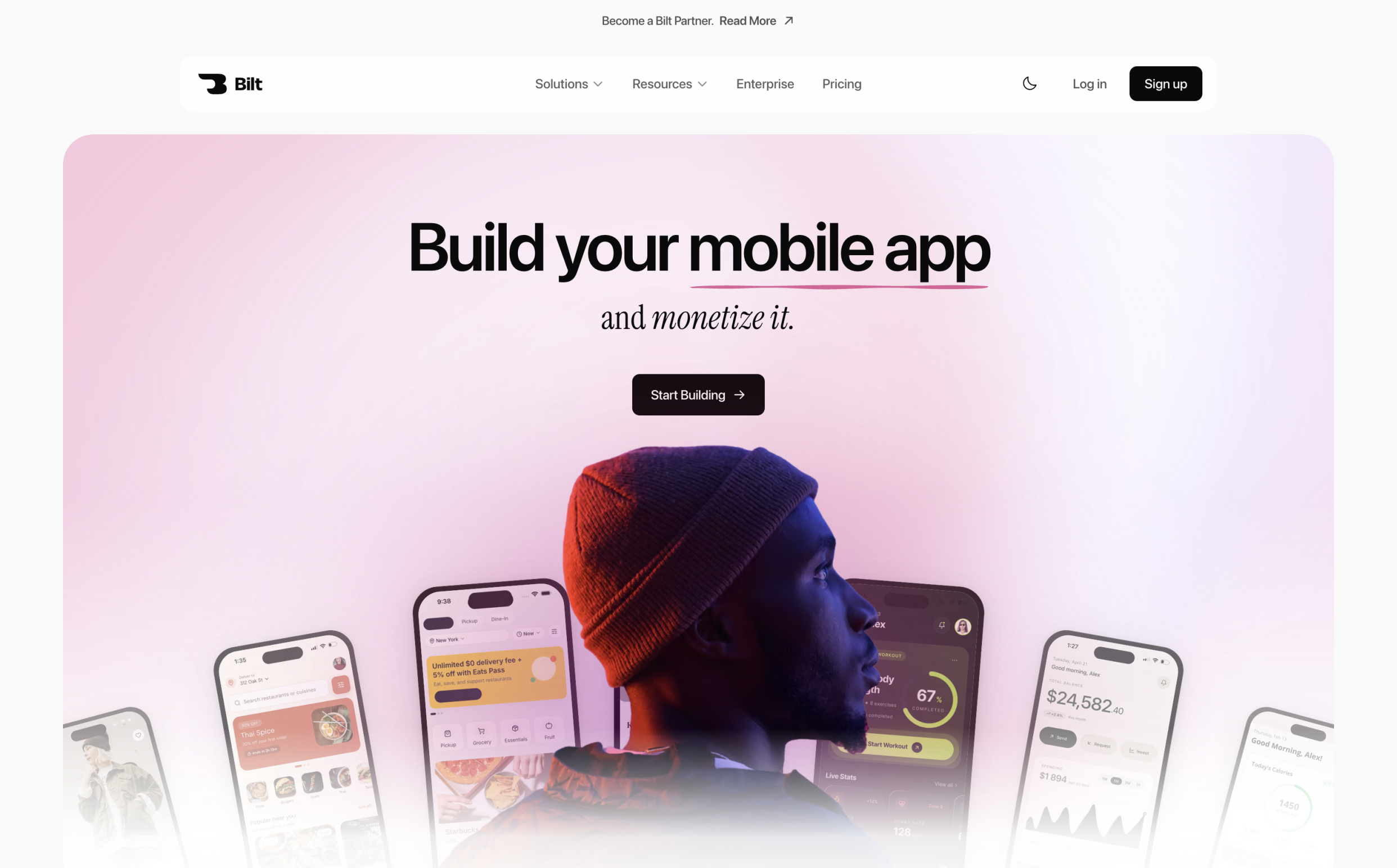
Keep refining it through chat, test it on your phone, and prepare it for the App Store and Google Play without opening Xcode.
No code needed. No Xcode. No handoff to a developer just to get through the store steps.
Bilt serves non-technical founders and vibecoders who want native apps without learning Swift or Kotlin.
It also supports web builders moving from Lovable, v0, or Next.js to a real app on people's phones.
What Bilt handles for you:
- App creation from a conversation: describe the screens, features, and flow you want, then keep refining through chat
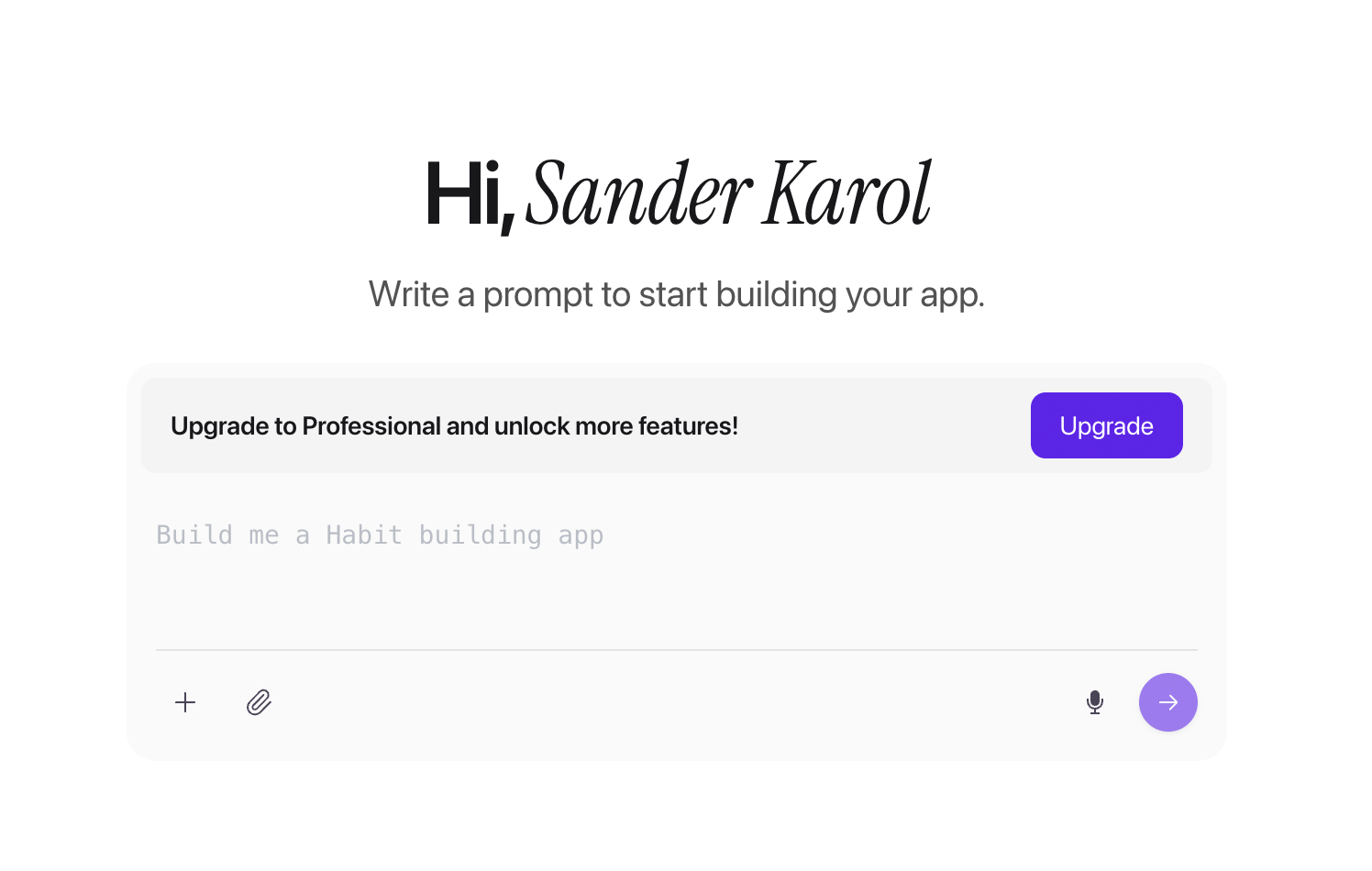
Bilt.me prompt screen with a text field for describing an app idea - Real native output: your app runs on both iOS and Android instead of feeling like a website wrapped in an app shell
- Live iPhone preview: test your app in the browser before you install anything
- QR code phone testing: scan a code and try the app on your own device
- Backend setup: add accounts, data, and app logic without wiring everything together yourself
- Store-ready builds: Bilt handles the code signing and build steps that usually send non-technical builders into Xcode
- App Store and Google Play help: get your app submitted to both stores so you can publish, share, and earn from the app when your business model supports it
Pricing
Bilt starts free. Paid plans use fixed monthly tiers with clear token counts and prompt estimates, so you always know what a prompt costs, unlike credit systems that spike as you iterate.
- Free: $0, 3M tokens/mo, about 12-30 prompts
- Professional: $25/mo, 10M tokens/mo, about 40-100 prompts
- Professional Plus: $50/mo, 20M tokens/mo, about 80-200 prompts
- Enterprise: custom token limits, hands-on help, and setup support for larger teams
Annual billing saves 2 months on all paid plans. See all plans for full pricing details.
Before you publish:
You still need an Apple Developer account ($99/year) and a Google Play account ($25 one-time). Every app store requires those accounts, but Bilt handles the hard parts after that.
Best first step: start with one core screen. Once that screen works, add the next feature through conversation.
Less suited for: teams that need full local code control, or enterprise apps with custom backend rules that need a traditional engineering team.
Ready to build a native app? Start building free or book a free 15-minute call.
2. Rork
Rork is an AI app builder that turns natural-language prompts into native iOS and Android apps, with one-click App Store publishing. Rork says users built 1.6 million apps in its first year.
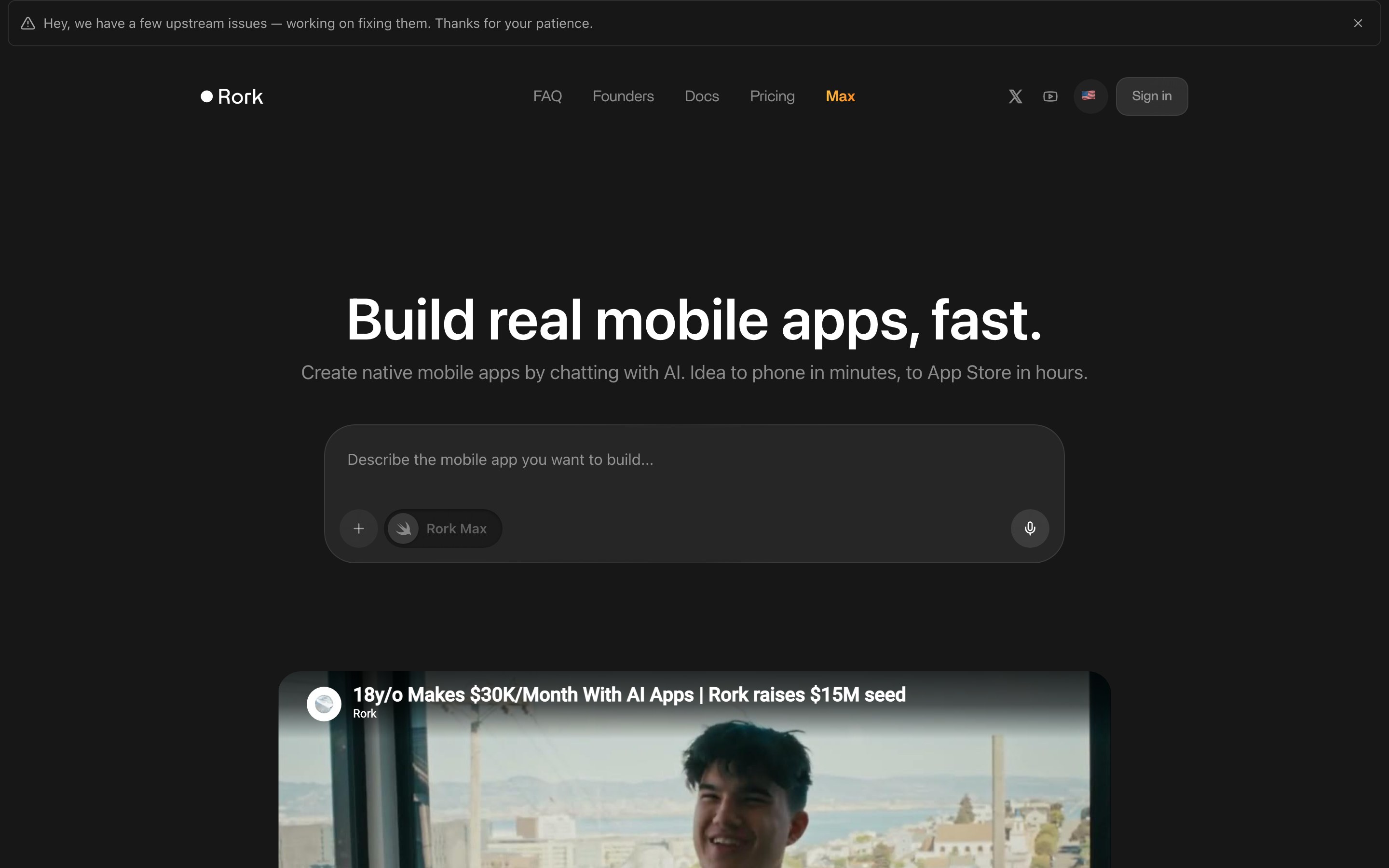
Rork gets you far, but App Store submission is still on you — Bilt handles that automatically. Rork also adds a SwiftUI tier (Rork Max) for deeper Apple-platform access.
Rork's AI builds UI, navigation, state management, and API integrations from a single prompt or uploaded file. In Rork Max mode, the agent iterates autonomously without requiring re-prompting.
Users report building a full app UI in roughly 45 minutes. Rork's Trustpilot rating sits at approximately 2.9/5, with recurring complaints about friction in the final stage before submission.
Rork does offer an in-app code editor and GitHub sync for developer handoff, but complex state management and custom auth flows still require human intervention. Teams needing full code ownership are better served by FlutterFlow (#4), which exports clean Flutter/Dart code with no vendor lock-in.
Rork uses a credit-based model where credits represent AI compute consumed during generation and iteration.
Unlike fixed monthly tools like Adalo, Rork's costs rise with iteration. The more you prompt and revise, the more credits you burn.
| Plan | Monthly Price | Credits/Month | Best For |
|---|---|---|---|
| Free | $0 | 35 credits | Testing and light prototyping |
| Junior | $25 | 100 credits | Solo builders, simple apps |
| Middle | $50 | 250 credits | Indie hackers with regular iteration |
| Senior | $100 | 500 credits | Frequent builders, MVP launches |
| Scale 10K | $1,800 | 10,000 credits | High-volume teams and agencies |
If Rork's credit model feels too unpredictable, Vibecode takes a similar AI-native approach but bundles a full-stack backend and rolls credits over month to month.
Credit costs aside, Rork stays the fastest path to a SwiftUI prototype, and Rork Max adds autonomous iteration for deeper Apple-platform builds. Complex apps that need long-term code ownership still point toward Bilt or FlutterFlow.
3. Vibecode
Vibecode is an AI-native builder for creating full-stack React Native and Expo apps from plain-English prompts. Its key difference is Vibecode Cloud, which gives generated apps a built-in backend without requiring a separate setup.
Three Vibecode features stand out:
- Pinch to Build: pinch any element in the live device preview to request an edit without returning to the prompt window
- Model flexibility: switch between Claude Code, GPT-5, and Grok 4. Vibecode lets you choose among three models instead of locking every project to one.
- Built-in backend: Vibecode Cloud and more than 20 native integrations work without API keys, while prompts can add hardware features such as haptics, camera access, and push notifications
Over 5,000 apps have shipped on the platform since launch, according to Vibecode's own usage figures.
Where Vibecode falls short
The Android gap is hard to ignore. Vibecode scores 2.0/5 on Google Play versus 4.7/5 on the App Store, a meaningful divide for any Android-first project.
Trustpilot sits at 3.1/5, with user complaints about billing and broken deploys.
Deployment is partially manual:
- iOS publishing requires the Expo wizard, which takes roughly 20 minutes, plus an Apple Developer account ($99/year)
- Android includes code generation but no managed Google Play submission
- Complex apps can accumulate tech debt, and the platform recommends programming knowledge for maintenance
Vibecode pricing
Vibecode runs on a credit system where $1 equals 1 credit of AI usage.
- Plus: $20/month, 20 credits
- Pro: $50/month, 55 credits
- Max: $200/month, 220 credits
Credits roll over month to month, and annual billing unlocks a discount on all plans.
Vibecode fits iOS-first founders who want a full-stack MVP without stitching together a backend.
Pinch-to-build editing and switching between Claude Code, GPT-5, and Grok 4 come built in.
Android support is the tradeoff covered above. If a visual canvas you control directly matters more, FlutterFlow is the next stop.
4. FlutterFlow
FlutterFlow is a visual low-code alternative to Rocket.new for builders who want more control and exportable code.
It builds iOS, Android, web, and desktop apps in Flutter. Paid plans include full Dart code export and GitHub sync, so teams can keep building outside the platform.
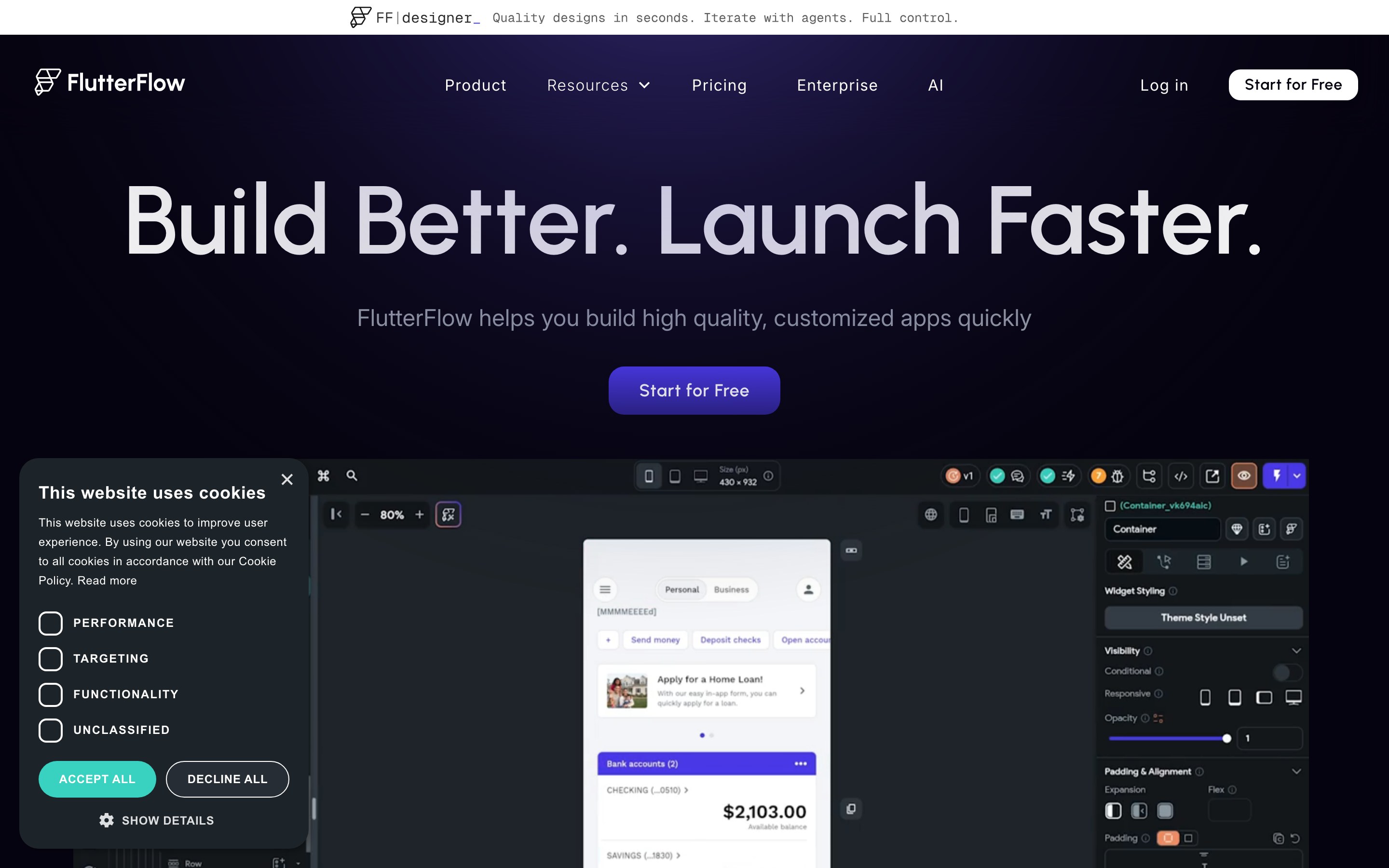
Unlike Rork and Vibecode's fully conversational model, FlutterFlow uses a hybrid approach: a drag-and-drop visual canvas plus assistive AI (Prompt to Component, Image to Component). You trade some automation for more direct visual control.
Draftbit is FlutterFlow's closest comparison because both provide code export and GitHub integration.
FlutterFlow supports desktop output and has a 4.5/5 G2 rating. Draftbit holds 4.3/5 on Capterra.
The code escape hatch
FlutterFlow outputs native iOS, Android, web, and desktop apps from a single Flutter project. Flutter compiles to native ARM code rather than using a JavaScript bridge, which shows up in animation-heavy or CPU-intensive apps.
On paid plans, the full build-to-ship pipeline is included:
- One-click App Store and Google Play deployment
- Custom domain web hosting
- GitHub push for version control and team collaboration
Where FlutterFlow falls short
Trustpilot scores 2.7/5, with recurring complaints about slow support and platform bugs. G2 reviews skew more positive, but that audience is largely developers comfortable working around rough edges.
The AI is assistive, not conversational, and AI requests are capped at 50 to 500 per month depending on your plan. That's a hard ceiling compared to Rork's credit-based iteration model.
FlutterFlow plans and pricing
Four fixed tiers, with annual billing saving roughly 25%:
- Free — $0, limited builds
- Basic — $39/mo, 50 AI requests/mo
- Growth — $80/mo per seat, 200 AI requests/mo
- Business — $150/mo per seat, 500 AI requests/mo
FlutterFlow sits at the premium end of this list, though it's more affordable than Draftbit for teams that need full code export.
Code ownership is what sets FlutterFlow apart. Its AI works component-level, Prompt to Component and Image to Component, rather than generating a full app from one description.
Skip the canvas entirely and just describe your app instead, and Bilt or Rork will get you there faster.
5. Adalo
Adalo is a no-code builder with a drag-and-drop canvas, 50+ templates, and assistive Ada AI for building native iOS, Android, and web apps without writing code.
FlutterFlow is the closest comparison to Adalo because both use visual drag-and-drop editors. FlutterFlow exports Flutter and Dart code, while Adalo does not.
Adalo's Starter plan costs $36 per month, slightly below FlutterFlow's $39 Basic tier.
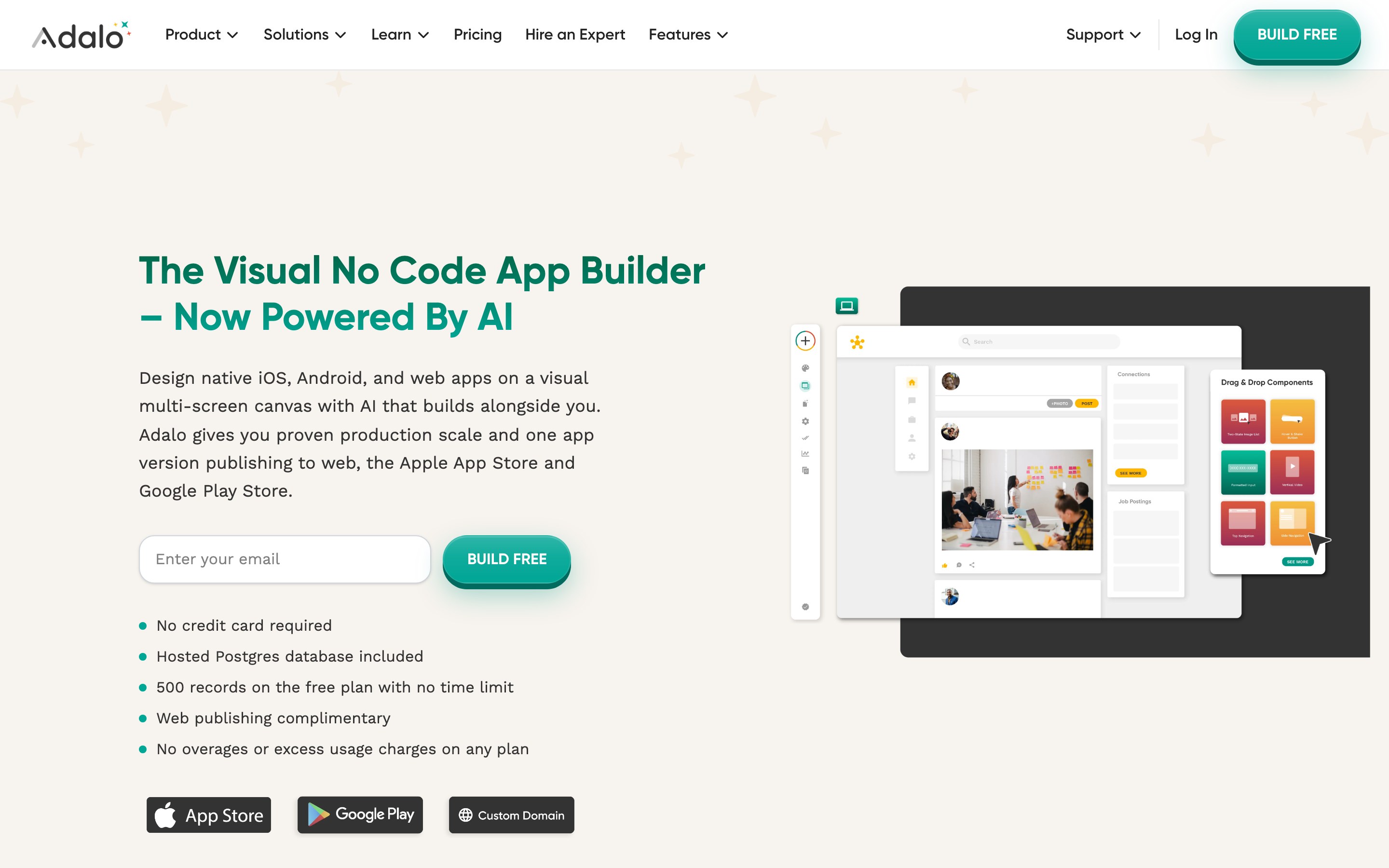
Ada AI, included on all paid plans, generates databases, screens, and edits from prompts — blending assistive AI with the visual canvas rather than replacing it.
Three more reasons non-technical builders rate Adalo highly in review roundups:
- Native Postgres hosting — no third-party database to wire up
- One-click store submissions — publishes to iOS, Android, and web from a single project
- Fixed monthly pricing — no AI credit consumption regardless of how many iterations you run
Lower tiers enforce record limits on the native Postgres database, and data-heavy apps hit performance walls quickly. Adalo also lacks browser-based device previews for real-time testing, unlike Bilt's in-browser simulators.
Plan breakdown:
- Free — $0, testing only
- Starter — $36/mo
- Professional — $52/mo
- Team — $160/mo
- Enterprise — custom pricing
Annual billing saves 20% across all paid tiers. Higher plans remove the record and action limits that cause performance issues on lower tiers.
Adalo is the strongest fit for non-technical solopreneurs and SMBs building directory, marketplace, or booking apps who prefer templates and visual iteration over conversational prompts.
| Adalo | FlutterFlow | |
|---|---|---|
| Code export | No | Yes — Flutter/Dart |
| AI type | Assistive (Ada AI) | Assistive |
| Entry price | $36/mo | $39/mo |
6. Thunkable
Thunkable is a hybrid no-code platform: Thunkable AI (launched March 2026) handles chat-to-native-app generation, while a visual canvas lets users refine screens post-generation. Rork and Vibecode are pure prompt-to-code with no visual editor; FlutterFlow is primarily drag-and-drop with AI added on. Thunkable makes conversational generation the primary entry point, backed by a proven publishing pipeline across 12M+ apps.
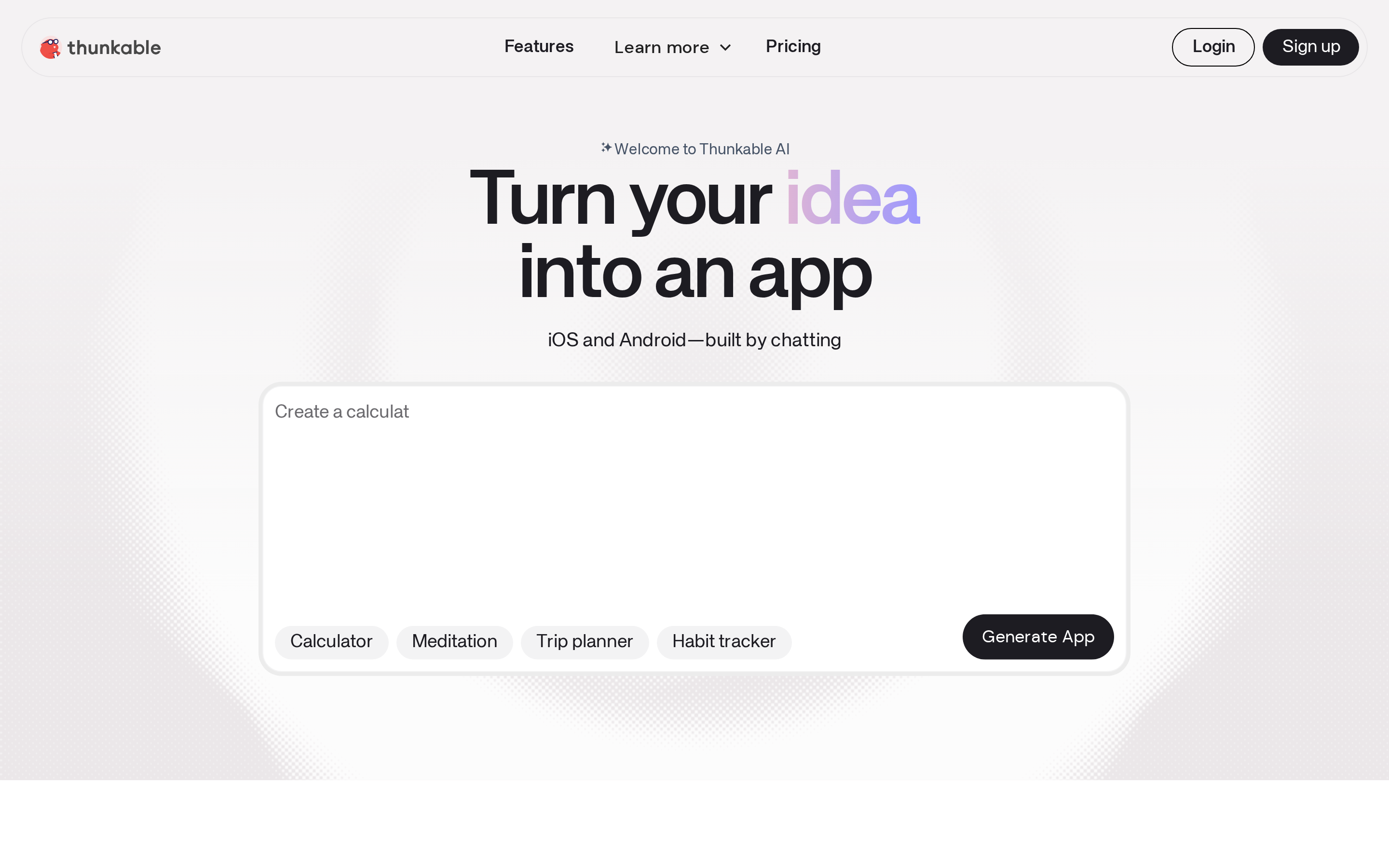
What Thunkable brings to the table:
Chat-to-app generation with scale proof: Thunkable AI builds complete native apps from prompts. The platform has shipped 12M+ apps across 185 countries, with 29 Fortune 100 companies in its user base. Discuss Mode lets users clarify requirements before generation begins, cutting revision loops.
Automated publishing: Code signing, store submissions, and app updates to the App Store, Google Play, and web are all handled by the platform directly.
Post-build AI fixes: Users can fix logic errors through prompts instead of manually debugging visual components.
Where Thunkable hits limits:
Token limits are Thunkable's version of the last-5% problem. The Free plan's 2,000 tokens deplete fast on iterative builds.
The Accelerator's 20,000 tokens run out quickly too. Users have flagged recent pricing hikes on review sites.
Thunkable pricing:
- Free — 2,000 tokens
- Accelerator — $19/mo, 20,000 tokens
- Builder — $59/mo, 50,000 tokens
- Advanced — $189/mo, 100,000 tokens
- Enterprise — custom pricing
Only the Advanced plan ($189/mo) unlocks unlimited live published apps.
Lower tiers cap the number of active published apps, which matters for agencies or builders managing multiple projects.
The $19/mo Accelerator plan is the lowest-cost entry to automated App Store publishing in this list.
Thunkable hits the sweet spot between AI generation and visual control, especially if you want a proven publishing pipeline behind your app.
Thunkable fits these situations:
- You want predictable token costs instead of Rork's credit-based usage
- You want a visual canvas for refining the app after generation
- You need a simple MVP and the $19 per month Accelerator plan fits your budget
7. Draftbit
Draftbit is a low-code React Native builder with an infinite-canvas visual editor, AI agents, full TypeScript code access, and optional expert development services.
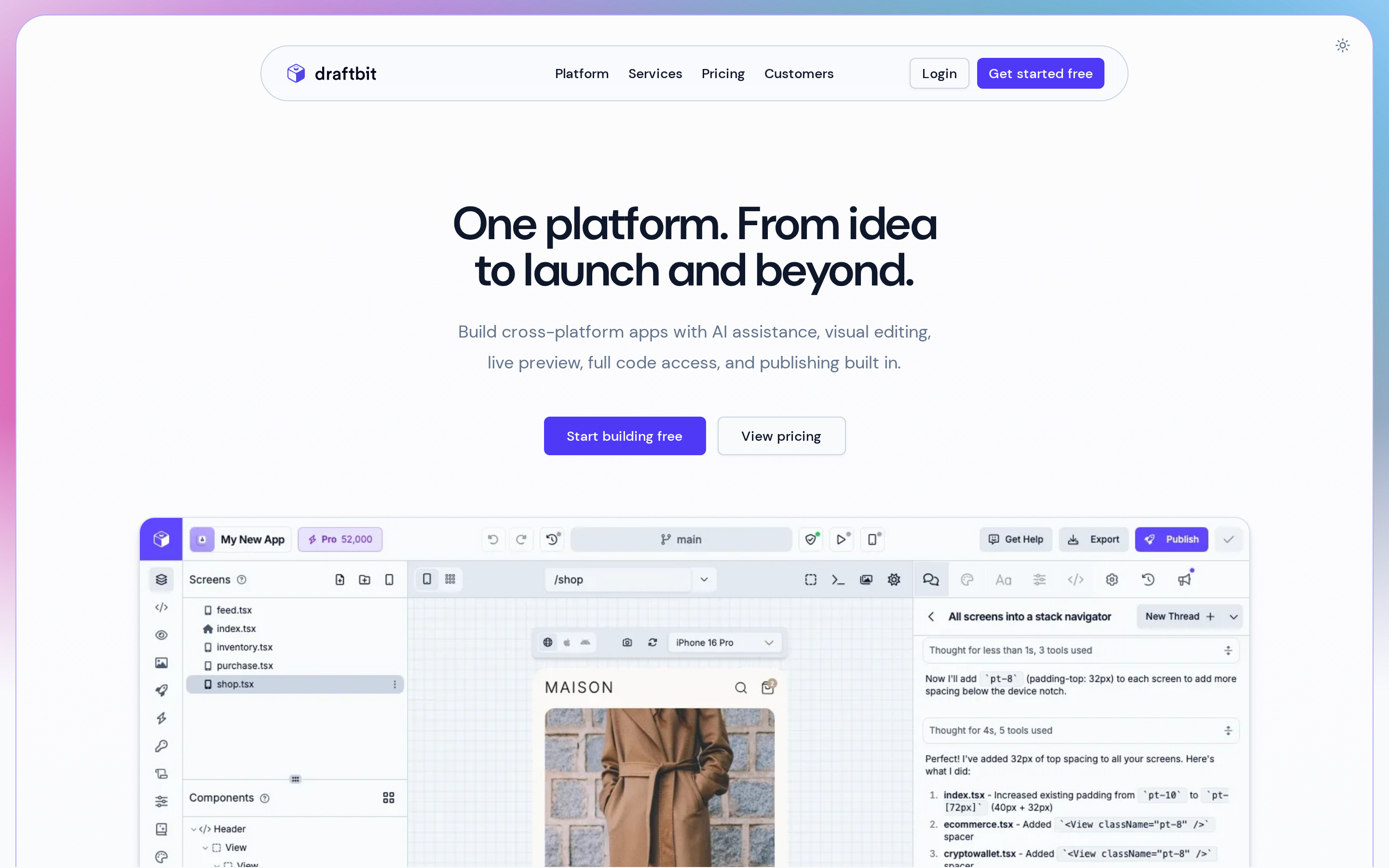
Draftbit sits between pure AI builders like Rork and Vibecode and simpler no-code tools like Adalo and GoodBarber. It's the strongest option for code ownership in this list, with full React Native/TypeScript access and GitHub export.
What Draftbit does differently:
- Full code access — The entire React Native/TypeScript codebase is exposed in an inline editor, with GitHub export and rollbacks.
Over 50,000 apps have been built on the platform.
- Portable output — The generated code is clean React Native, not a proprietary format. Teams can hand off to external developers at any point without migration or rewriting.
- Multi-model AI agents — Draftbit runs AI agents powered by Claude, GPT, and Gemini to generate screens, logic, and bug fixes from prompts.
Standard plans include 1 parallel agent. Higher tiers unlock 10 or more running simultaneously.
Draftbit's inline code editor is specifically built for the last 5%: when AI generation stops and a human needs to finish the logic.
Where it falls short:
Draftbit's AI assists within an existing canvas rather than generating a full app from a single prompt. That's the key difference from Rork and Vibecode.
Draftbit holds a 4.3/5 on Capterra. Here's how it stacks up against FlutterFlow on stability and code ownership:
| Draftbit | FlutterFlow | |
|---|---|---|
| Code output | React Native, TypeScript | Flutter, Dart |
| Stability | Reddit users report slowness and bugs | Rated more stable by teams who switched |
| Version control | GitHub export, rollbacks | GitHub branching |
| Community | Smaller | Stronger developer community |
Teams that hit stability issues on Draftbit often move to FlutterFlow, trading React Native for Flutter in exchange for steadier performance.
Draftbit pricing:
- Free — 10,000 credits/month
- Standard — $20/mo, 25,000 credits/month
- Pro — $40/mo, 50,000 credits/month
- Team — $200/mo, 250,000 credits/month
- Enterprise — custom
Mobile publishing and code export are locked behind paid plans.
Compared to Adalo ($36/month) and GoodBarber ($30/month), Draftbit's Standard plan at $20/mo is the most affordable entry point among code-export tools in this list.
Draftbit keeps you inside a visual canvas that still needs manual polishing after the AI stops. GoodBarber skips the canvas entirely, offering ready-made templates for teams that want a polished content app without touching code.
8. GoodBarber
GoodBarber is the safest budget pick for content and eCommerce apps in this list. Its 4.6/5 on Trustpilot is the highest reliability score among budget-tier tools here.
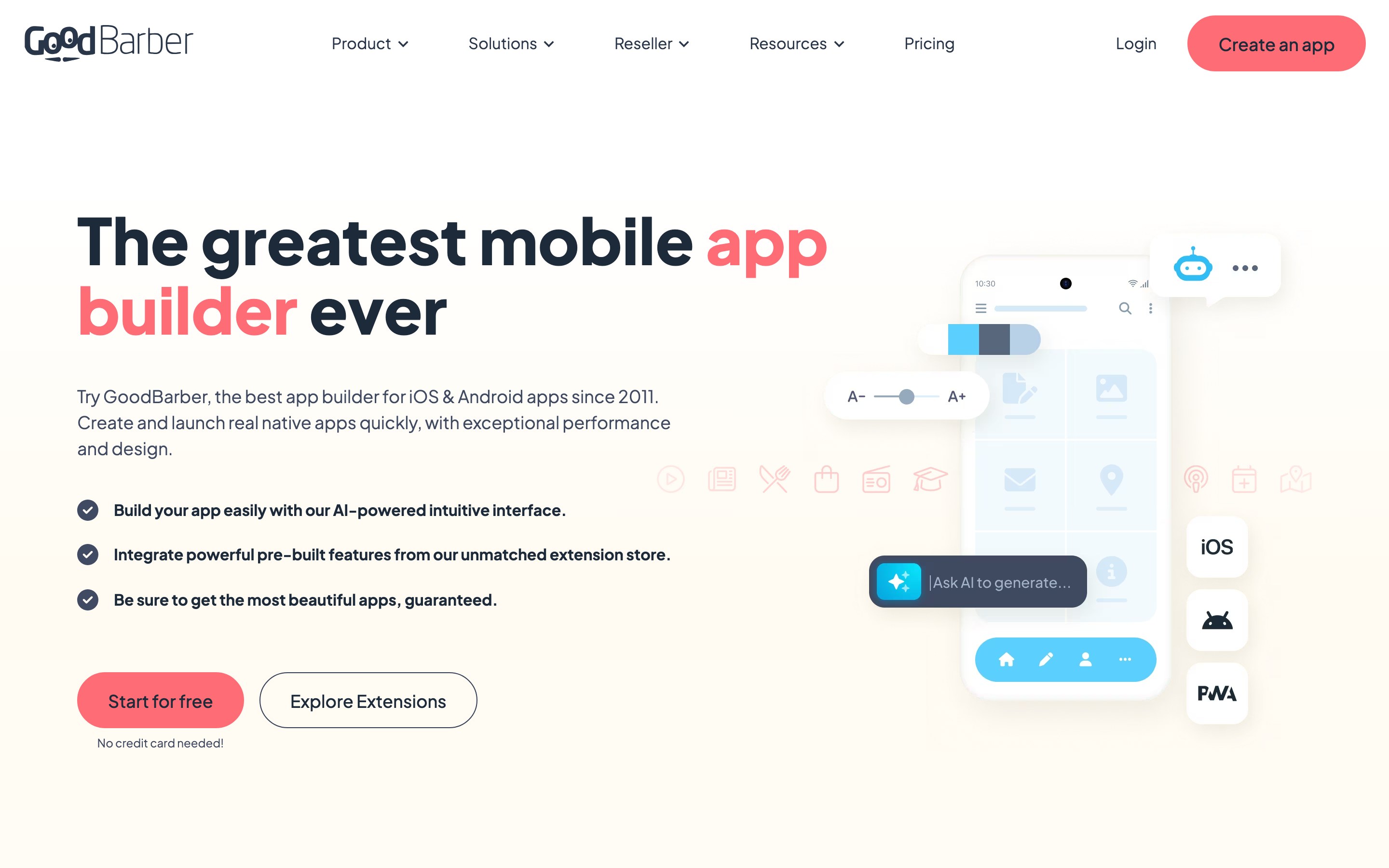
GoodBarber is a mature no-code drag-and-drop builder for native iOS (Swift), Android (Kotlin), and PWA apps. It comes with 190+ extensions, high-design templates, and assistive AI, with output quality comparable to FlutterFlow and Thunkable at a lower entry price. It does not offer conversational app generation like Rork or Vibecode.
How GoodBarber compares to similar no-code tools:
| Feature | GoodBarber | Adalo | Andromo |
|---|---|---|---|
| Extensions / modules | 190+ | ~50 marketplace components | 30+ pre-built features |
| Revenue commission | None | None | None |
| Trustpilot score | 4.6/5 | Not rated | 2/5 |
| Code export | No | No | No |
GoodBarber has no code export, which means vendor lock-in the moment you outgrow its widget-and-extension model. Complex logic, custom workflows, or a developer handoff are off the table.
AI capabilities top out at text generation, translations, and palette suggestions. For conversational app generation, Rork or Vibecode are better fits.
Billing complaints appear in user reviews, including reports of unauthorized charges. This pattern shows up with Andromo and AppMySite as well.
GoodBarber starts at $30/month for Content apps on annual billing, and $40/month for eCommerce apps.
A 30-day free trial is available. Reseller and Agency plans start at $215/month, with extensions and push notifications charged separately. That puts it above Andromo's $24/month Hobbyist tier but well under FlutterFlow at $39/month.
GoodBarber works best for solopreneurs and small businesses who want polished design templates and managed store submissions without code access. For AI generation or complex logic, Rork or FlutterFlow are the right call.
GoodBarber covers design-first apps with broad use cases. Andromo narrows the focus: it's built almost entirely for content monetization.
9. Andromo
Andromo claims 70 million monthly active users and holds a 2/5 on Trustpilot. That gap between reach and user satisfaction says something about who actually uses it and what they expect.
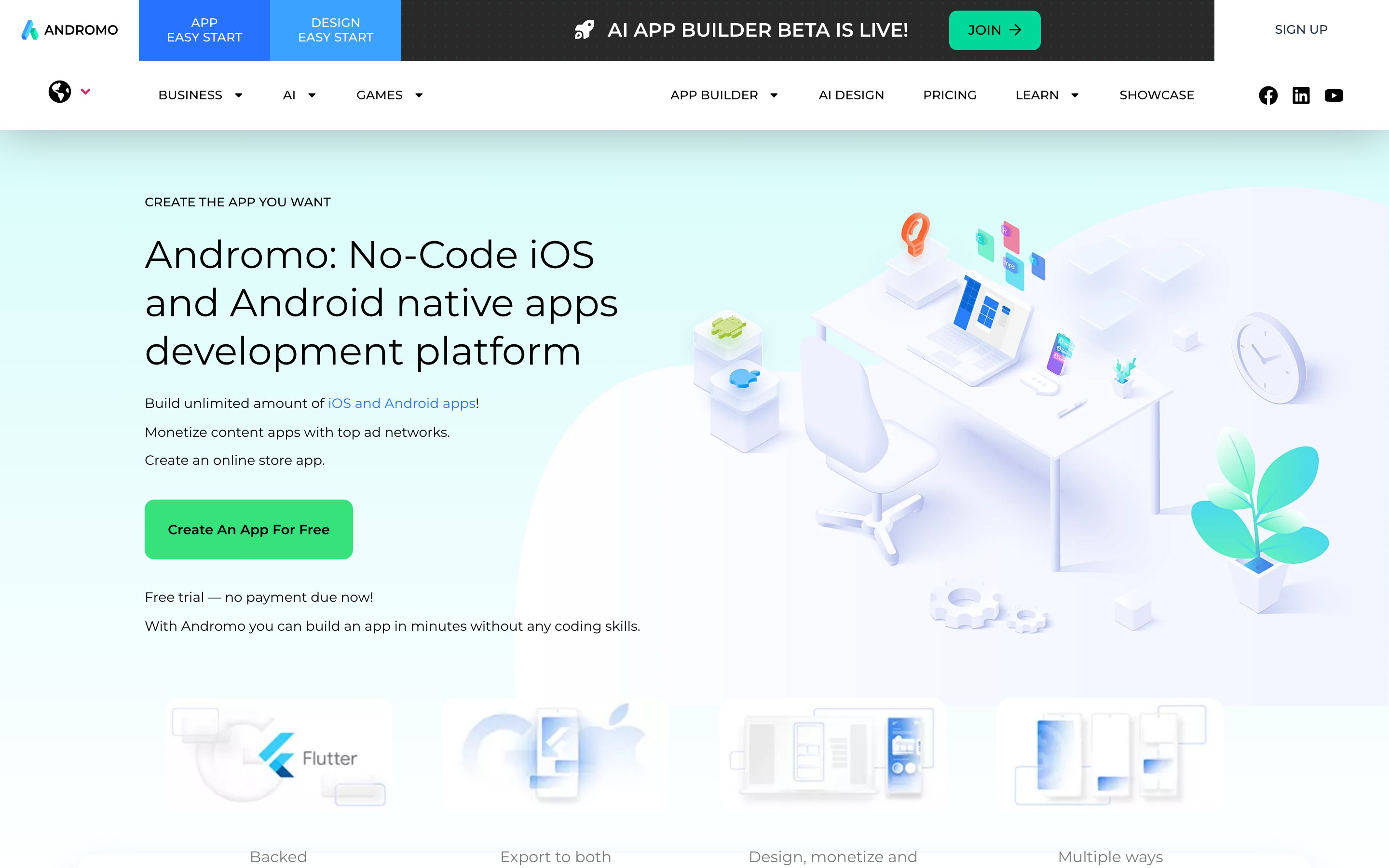
Andromo is a no-code Flutter-based drag-and-drop builder for native Android and iOS apps, focused on content, audio, and eCommerce monetization. Its AI App Builder is in closed beta and covers web apps only.
That leaves current mobile builders working through the standard drag-and-drop editor, since the AI tool isn't available for iOS or Android apps yet.
Andromo's own marketing materials claim earnings of up to $10,000/day from ads and in-app purchases, with AdMob and IAP monetization built in.
- News and media apps
- Audio and podcast apps
- eBook readers
- Simple eCommerce storefronts
Anything outside these formats hits Andromo's template ceiling fast: the built-in content modules won't stretch to cover it.
Trust signals are mixed. The 2/5 Trustpilot score comes with recurring complaints about deceptive billing and difficult cancellation. Capterra rates it 4.2/5 for ease of use, though reviewers flag limited functionality beyond simple content app types.
FlutterFlow (Dart/Flutter export) and Draftbit (React Native/TypeScript export) are the right alternatives to Andromo for teams that need to scale or hand code off to developers.
Andromo pricing starts at $24/month (Hobbyist, annual billing). Monetization features require the Ultra plan at $56/month. eCommerce and small business tiers run $76-$130/month.
- Andromo Hobbyist: $24/mo
- GoodBarber Content: $30/mo
- Adalo Starter: $36/mo
- Thunkable Accelerator: $19/mo (cheapest paid tier in this list)
Note: The 14-day trial does not allow app store publishing or monetization testing.
Andromo is a fast lane for content monetization. News apps, podcast players, and eBook readers fit the template well. Anything beyond that needs a different tool: AI generation, custom logic, or code you own means Rork or FlutterFlow.
10. AppMySite
AppMySite is a no-code web-to-app converter that transforms existing WordPress, WooCommerce, Shopify, or custom websites into hybrid iOS, Android, and PWA apps.
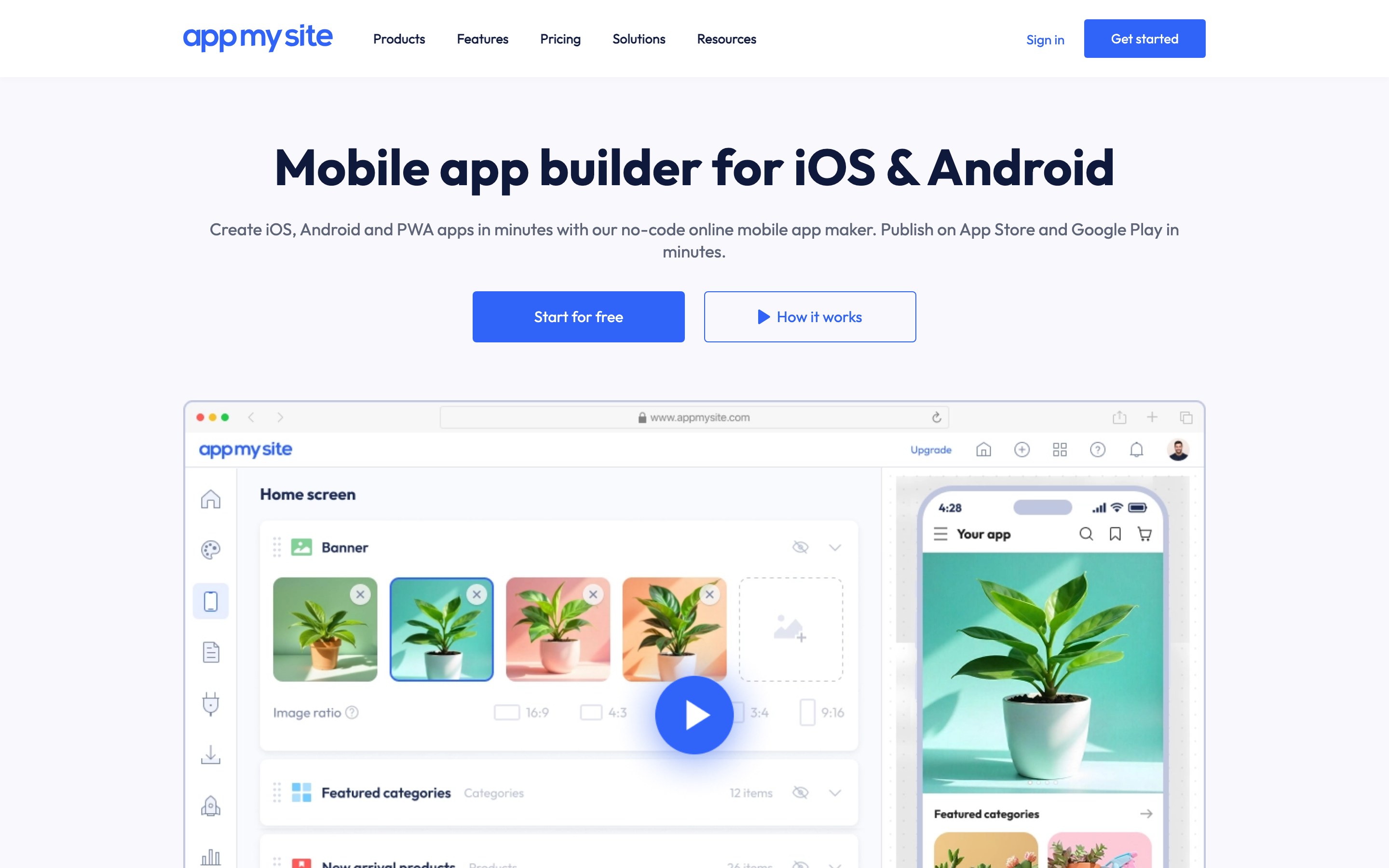
AppMySite's strongest feature is its CMS sync. WordPress, WooCommerce, and Shopify content, including products, posts, and categories, pulls into the app automatically without manual data entry.
- Push notifications and in-app ads from a drag-and-drop editor
- Multi-store publishing to iOS, Android, and PWA in one workspace
- Agency and white-label tools for resellers managing multiple client sites
The basic workflow looks like this:
- Connect your WordPress, WooCommerce, or Shopify site via plugin or API key.
- Customize the app shell, colors, icons, and navigation tabs in the drag-and-drop editor.
- Preview in a browser simulator.
- Submit to the App Store and Google Play through AppMySite's managed pipeline.
No rebuilding. No re-entering product data.
AppMySite's ceiling is the source website. The converted app wraps the site in a mobile shell, so deep native features like complex animations and offline logic are not supported, and anything the website can't do, the app can't either.
Only the Custom App tier compiles to genuine native code. The standard converter stays hybrid, wrapping the site instead of building native binaries.
There is no code generation or export, and the app's functionality stays tied to the source site.
AI tools on the platform are supplementary utilities:
- Text-to-image and image upscaling
- Content writing assistance
- ML-powered translations
Check the AppMySite pricing page for current rates, as pricing changes frequently. Tiers include Free, Starter, Pro, and Premium, with pay-per-app and unlimited workspace options. Agency white-label pricing is also available.
Premium unlocks unlimited apps, in-app purchases, priority support, and white-label (no AppMySite branding). Annual billing discounts are available.
Store developer accounts are not bundled in any plan: Google Play costs ~$25 one-time and Apple Developer Program costs $99/year. Users on Reddit also report billing increases of up to 8x after the first year (reported in Reddit's r/nocode community).
AppMySite fits bloggers, e-commerce store owners, and agencies that already have a live WordPress, WooCommerce, or Shopify site and want a fast app presence with push notifications, without rebuilding anything from scratch.
Teams that need a truly native app, AI-assisted generation, or code ownership should look at Rork, FlutterFlow, or Bilt.me. AppMySite cannot produce native functionality beyond what the source website already supports.
Rocket.new alternatives compared: features, pricing, and use case
| Tool | AI Generation | Code Export | App Store Submission | Backend Included | Native Performance | Starting Price |
|---|---|---|---|---|---|---|
| Bilt.me | Conversational — React Native | Yes | Fully automated | Yes (built-in) | True native (React Native) | Free tier |
| Rork | Conversational — RN + SwiftUI | GitHub sync | One-click | No (BYO backend) | True native (RN + SwiftUI) | Free (35 credits/mo) |
| Vibecode | Conversational — RN/Expo | Limited | Partial (Expo wizard) | Yes (built-in) | True native (Expo/RN) | Free |
| FlutterFlow | Assistive + visual canvas | Yes — Flutter/Dart | One-click (paid plans) | Firebase/Supabase integration | True native (Flutter/Dart) | Free / $39/mo |
| Adalo | Assistive (Ada AI) + visual canvas | No | One-click | Yes (built-in database) | Web-wrapper | Free / $36/mo |
| Thunkable | Conversational (Thunkable AI) | No | Automated | Limited integrations | Partial native | Free / $19/mo |
| Draftbit | Assistive AI + visual canvas | Yes — RN/TypeScript | Manual | No (BYO backend) | True native (React Native) | Free / $20/mo |
| GoodBarber | Assistive only | No | Managed | Managed CMS backend | Native (Swift/Kotlin) | $30/mo |
| Andromo | Template-based, no AI | No | Manual | No | Web-wrapper/hybrid | $24/mo |
| AppMySite | None — website converter | No | Managed pipeline | No | Web-wrapper | Free tier |
Which Rocket.new alternative should you choose?
Choose based on the part of the workflow you want handled:
- Native build plus managed submission: Bilt
- Visual editing with exportable code: FlutterFlow or Draftbit
- Prompt-led generation: Rork or Vibecode
- Prompting plus a visual canvas: Thunkable
- Website-to-app conversion: AppMySite
- Template-led content or eCommerce apps: GoodBarber or Andromo
Bilt fits the specific gap Rocket.new leaves at launch. It handles React Native generation, backend setup, code signing, and App Store submission in one workflow.
If another priority matters more, use the subsections below to compare code ownership, budget, and built-in monetization.
Owning exportable mobile code with no vendor lock-in
FlutterFlow and Draftbit are the two strongest options. Both give you real code you can take elsewhere.
- FlutterFlow exports clean Flutter/Dart with GitHub branching, no vendor lock-in, and deploys to iOS, Android, web, and desktop. AB.Money used it to scale to 4,000+ users.
- Draftbit provides full React Native/TypeScript code access, an in-browser editor, and GitHub export with rollbacks. Over 50,000 apps built on the platform.
Note: Adalo, GoodBarber, Andromo, and AppMySite do not offer code export. Choose these if staying on-platform works for you; choose FlutterFlow or Draftbit if portability matters.
Building on a tight budget with predictable pricing
Fixed-tier platforms are the safest choice for budget control. Credit-based AI tools can escalate fast during iterative builds.
- Adalo: Starter at $36/mo, Professional at $52/mo, Team at $160/mo. No usage fees or per-credit charges.
- GoodBarber: Starts at $30/mo (annual). No revenue commissions.
- Andromo: Hobbyist tier at $24/mo with a 14-day full trial.
Credit-based tools to watch:
- Rork: Scales from free (35 credits/mo) to $1,800/mo at 10,000 credits. See the Rork section above for the full pricing breakdown.
- Vibecode: Free tier includes $20 worth of credits. Iteration-heavy builds burn through them quickly.
Publishing content or eCommerce apps with built-in monetization
Andromo and GoodBarber are the specialists here, built for content-first apps rather than custom-logic products.
- Andromo is built for news, audio, and eBook apps. The platform reports 20M downloads and 70M monthly active users across apps built on it.
- GoodBarber includes 190+ extensions for content, eCommerce, and booking apps with offline caching. It holds a 4.6/5 score on Trustpilot.
- Neither platform offers code export or AI-driven full-stack generation, so they are not suited for complex or custom-logic apps.
For managed App Store submission and predictable usage costs, Bilt is built for that. Token-based pricing stays steady instead of spiking with every refinement loop.
Rocket.new vs the alternatives: which should you choose?
Best for AI-first, prompt-to-app native generation
Bilt and Rork both support prompt-to-app native generation, but their publishing workflows differ.
Bilt generates React Native code and manages store submission. Rork generates React Native or SwiftUI apps, while final App Store submission remains with the builder.
Vibecode and Thunkable AI are close alternatives. Vibecode uses Claude Code agents for full-stack generation. Thunkable AI launched in March 2026 and builds production-ready native apps from chat prompts.
Best for code ownership and no vendor lock-in
FlutterFlow exports clean Flutter/Dart code, supports GitHub branching, and deploys to iOS, Android, web, and desktop from a single project. No lock-in, no strings.
Draftbit gives full React Native/TypeScript code access with an in-app editor and GitHub export with rollbacks. It suits teams moving from prototype to production who want a code escape hatch.
Most budget-friendly with predictable pricing
Adalo ($36/mo), GoodBarber ($30/mo annual), and Andromo ($24/mo) all use fixed seat-based tiers with no usage fees or per-AI-interaction charges.
Credit-based tools scale with iteration. Rork and Vibecode both use credit models, so check their sections above for full pricing breakdowns.
Best for proven scale and enterprise use
Thunkable is the most proven platform by scale: automated code signing, unlimited live apps on the Advanced plan, and 29 Fortune 100 companies using it. FlutterFlow suits engineering teams who want seat-based collaboration (up to $150/mo on Business) and proven case studies like AB.Money scaling to 4,000+ users.
Build and ship native apps with AI, without getting stuck before launch
Rocket.new's token limits don't just slow iteration. They stop your build mid-conversation and send you back to the start.
The last mile of mobile work, code signing, backend wiring, and App Store submission, still falls on you when the tokens run out.
Bilt takes you from a plain-English idea to a real React Native app, then handles backend setup, code signing, and submission to both app stores. You can keep refining without paying for every prompt or opening Xcode.
Ready to go from idea to published app? Start building free or see all plans.
FAQ
What's better than Rocket.new?
Bilt is the strongest pick for end-to-end native generation and managed deployment. See the full breakdown in the Bilt.me section above.
FlutterFlow is the better choice if full code ownership matters more than a managed pipeline. For purely conversational AI generation with no visual editor, Thunkable and Rork fit best.
What is a good replacement for Rocket.new?
If you're stuck at the deployment stage specifically, Bilt is the clearest replacement.
Rocket.new stops short of managed iOS submission: you get a Flutter codebase, but you're on your own for Xcode signing and App Store Connect. Bilt automates that entire pipeline. It generates production React Native code, handles code signing, and submits to both the App Store and Google Play without you opening Xcode once.
Is Rocket.new the same as B2B Rocket?
Rocket.new and B2B Rocket are entirely different products from separate companies.
Rocket.new is an AI app builder that generates web and mobile apps from natural-language prompts. B2B Rocket is a sales automation and lead generation tool, and the companies are unrelated.
Are Rocket.new alternatives reliable? What do users say?
Reliability varies by platform and by the complexity of your app. Rork and Vibecode earn praise for fast prototyping, but reviews include complaints about stability and deployment.
More established visual builders such as GoodBarber and FlutterFlow have mature publishing workflows, but they still have limits around support, code ownership, or complex logic.
Test authentication, payments, data flows, and store builds before committing to any platform.